
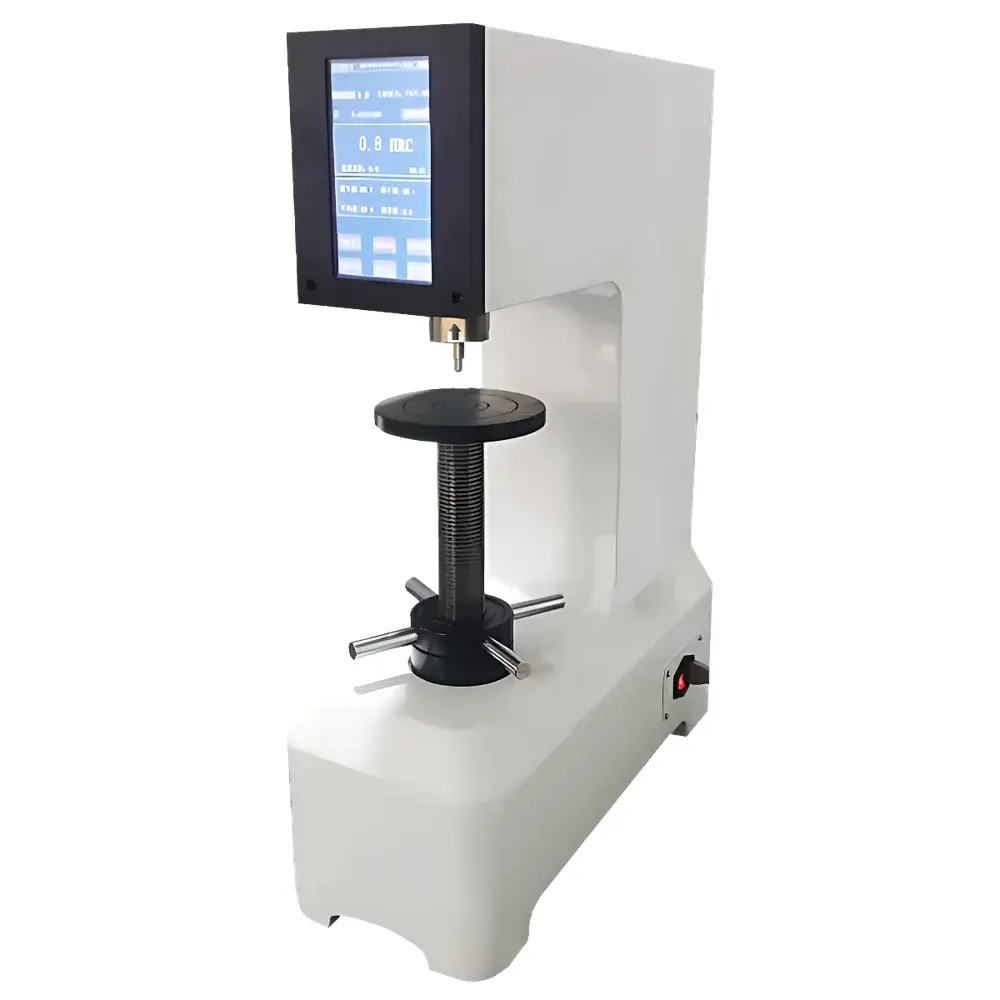
YANRUN YHRI-150M Automatic Sensor-Loaded Rockwell Hardness Tester
| Brand | YANRUN |
|---|---|
| Origin | Shanghai, China |
| Manufacturer Type | Manufacturer |
| Model | YHRI-150M |
| Hardness Scales | HRA, HRBW, HRC, HRD, HREW, HRFW, HRGW, HRHW, HRKW, HRLW, HRMW, HRPW, HRRW, HRSW, HRVW |
| Measurement Range | HRA: 20–95 |
| HRBW | 10–100 |
| HRC | 20–70 |
| Preliminary Test Force | 98.07 N (10 kgf) |
| Total Test Forces | 588 N (60 kgf), 980 N (100 kgf), 1471 N (150 kgf) |
| Hardness Resolution | 0.1 HR |
| Max Specimen Height | 180 mm |
| Indenter Center-to-Column Distance | 160 mm |
| Test Force Dwell Time | 0–99 s (adjustable in 1 s increments for preliminary, main, and return phases) |
| Compliance | GB/T 230.2, JJG 112 |
| Dimensions (W×D×H) | 530 × 210 × 780 mm |
| Weight | ~90 kg |
Overview
The YANRUN YHRI-150M is an automatic, sensor-loaded Rockwell hardness tester engineered for precision, repeatability, and compliance in industrial quality control and metrology laboratories. It operates on the fundamental Rockwell principle—measuring permanent depth deformation under controlled sequential loading: a preliminary force establishes baseline contact, followed by application of a major load; the difference in indentation depth before and after major load removal determines the hardness value. Unlike traditional dead-weight systems, the YHRI-150M employs a closed-loop electronic force control system with high-stability load sensors, ensuring consistent force delivery across all Rockwell scales—including HRA, HRC, HRBW, and 12 additional standard and superficial scales. Its rigid cast-iron frame minimizes mechanical drift and vibration sensitivity, while the integrated color touchscreen interface enables intuitive navigation without external PCs. Designed for routine testing of ferrous and non-ferrous metals—including hardened steels, aluminum alloys, brass, and case-hardened components—the instrument meets the mechanical and procedural requirements of GB/T 230.2 (equivalent to ISO 6508-2) and is verified per JJG 112 national verification regulation.
Key Features
- Full-color capacitive touchscreen interface with menu-driven operation—no keyboard or mouse required; supports multilingual UI configuration (English, Chinese, Spanish).
- Closed-loop sensor-based force application ensures ±0.5% accuracy across all total test forces (588 N, 980 N, 1471 N) and preliminary force (98.07 N), eliminating mechanical hysteresis and gravitational dependency.
- High-rigidity cast-iron body with vibration-damped base and optimized column geometry—designed for long-term dimensional stability under repeated 150 kgf loading cycles.
- Digital hardness readout with 0.1 HR resolution and real-time statistical calculation (mean, SD, max/min) for up to 99 measurements per batch.
- Onboard thermal-compensated load cell and temperature-stabilized electronics reduce drift during extended operation in ambient lab environments (10–35 °C).
- Configurable dwell times: independent adjustment (0–99 s, 1 s step) for preliminary force, total force, and post-unload stabilization—critical for viscoelastic or heat-treated materials.
- Integrated thermal printer with auto-print function for test reports including date/time stamp, operator ID, scale used, specimen ID, and raw depth values.
Sample Compatibility & Compliance
The YHRI-150M accommodates specimens up to 180 mm in height and 160 mm from column centerline, supporting flat, cylindrical, and irregular geometries via standard V-block, medium-flat, and large-flat anvils. It accepts both diamond cone (120° apex angle, 0.2 mm tip radius) and tungsten carbide ball indenters (1.5875 mm diameter), enabling full Rockwell scale coverage per ASTM E18 and ISO 6508-1. All hardness conversions—including HR to HV, HBW, HK, HRN, and HRT—are calculated using NIST-traceable polynomial algorithms aligned with ASTM E140. The system satisfies metrological traceability requirements for GLP and ISO/IEC 17025-accredited labs when operated within calibrated environmental conditions (±1 °C/h stability, <70% RH). Routine verification uses certified reference blocks traceable to NIM (National Institute of Metrology, China) or equivalent NMIs.
Software & Data Management
While standalone operation is fully functional via touchscreen, optional USB-host connectivity allows export of CSV-formatted test logs (including depth values, timestamps, and user annotations) to external storage. Firmware supports audit trail logging for critical parameters (force calibration history, dwell time changes, scale selection), compliant with basic FDA 21 CFR Part 11 principles for non-networked instruments. Data fields are immutable post-test; manual editing requires supervisor-level password authentication. Calibration certificates, verification records, and maintenance logs can be archived locally on internal flash memory (≥10,000 test records retained).
Applications
- Quality assurance of heat-treated automotive components (crankshafts, gears, valve seats)
- In-process verification of surface-hardened tooling steels and bearing rings
- Incoming inspection of aluminum extrusions and copper alloy forgings
- Research-grade hardness profiling across case depth gradients (with optional motorized Z-stage upgrade)
- Calibration laboratory verification of secondary hardness reference blocks
- Education and vocational training in metallurgy and materials science programs
FAQ
Does the YHRI-150M support ASTM E18 or ISO 6508-1 compliance?
Yes—the instrument’s force control architecture, indenter geometry tolerances, and test sequence logic conform to the essential requirements of both standards.
Can I perform hardness conversions to Vickers or Brinell scales directly on the device?
Yes—built-in conversion tables follow ASTM E140 Annex A1 and ISO 18265, covering all common metallic materials with material-specific coefficients.
Is external PC software required for data export or calibration?
No—CSV export is supported via USB flash drive; calibration is performed using onboard procedures with certified reference blocks.
What maintenance intervals are recommended for long-term accuracy?
Annual verification against certified reference blocks is advised; load cell recalibration is recommended every 24 months or after 10,000 test cycles.
Is the printer compatible with standard thermal paper rolls?
Yes—it accepts 57 mm wide, 30 mm core thermal paper rolls with auto-cutter functionality enabled.



