
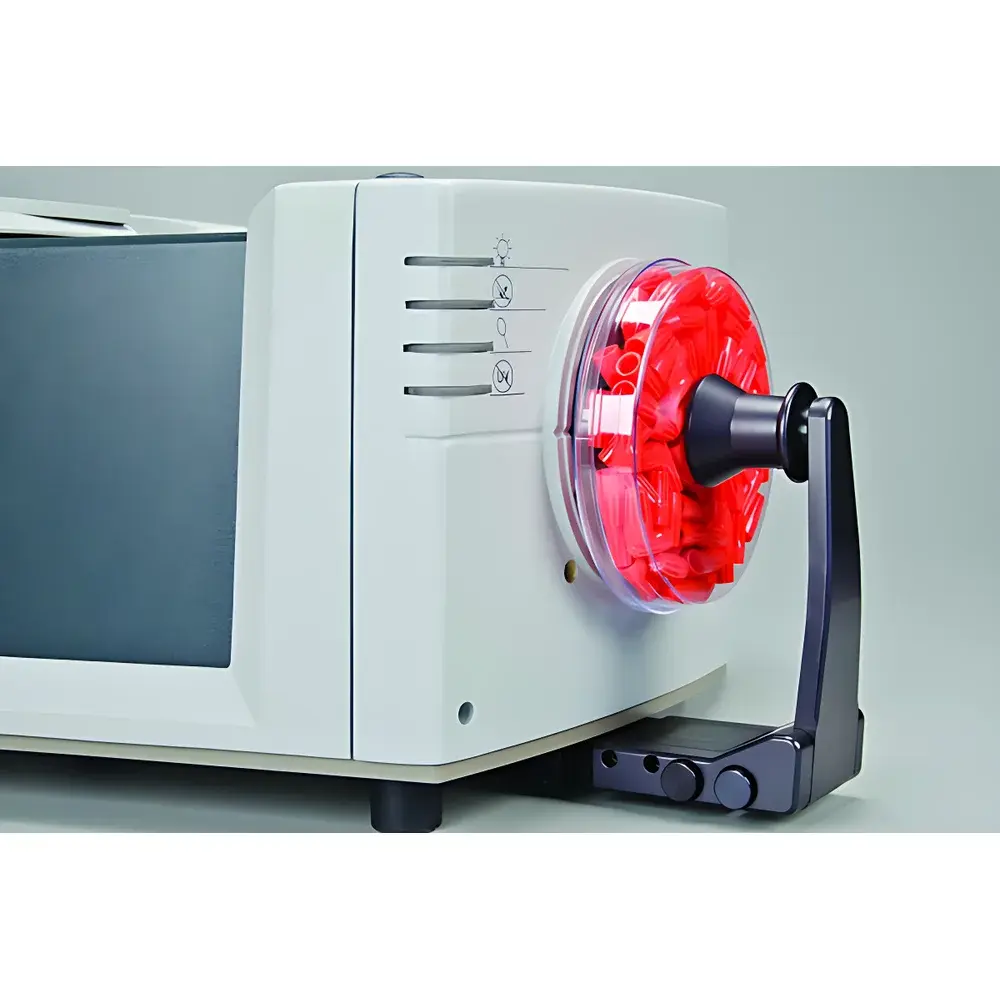
HunterLab UltraScan VIS Benchtop Color Spectrophotometer
| Brand | HunterLab |
|---|---|
| Origin | USA |
| Model | UltraScan VIS |
| Instrument Type | Benchtop |
| Optical Geometry | d/8° integrating sphere |
| Light Source | Pulsed xenon lamp |
| Spectral Range | 360–780 nm |
| Repeatability | ΔE*ab ≤ 0.03 |
| Aperture Sizes | 25 mm and 9.5 mm |
| Measurement Modes | Specular Component Included (SCI) and Specular Component Excluded (SCE) |
| Compliance | CIE No. 15:2004, ISO 7724-1, ASTM E308, USP <1061>, FDA 21 CFR Part 11 ready (via EasyMatch QC software) |
Overview
The HunterLab UltraScan VIS is a high-precision benchtop spectrophotometer engineered for absolute color measurement accuracy across solid, liquid, and translucent materials. Operating on the CIE-recommended spectral range of 360–780 nm, it employs a dual-beam silicon photodiode array detector and pulsed xenon illumination to deliver stable, drift-free spectral data acquisition. Its d/8° integrating sphere geometry conforms to ISO 7724-1 and ASTM E308 standards, enabling robust measurement of diffuse reflectance and transmittance—including samples exhibiting fluorescence under UV excitation (e.g., optical brighteners in textiles or detergents). The instrument’s optical architecture integrates a rigid stainless-steel mechanical platform, precision-machined baffles, and spectrally optimized internal coatings to minimize stray light and thermal drift—ensuring long-term photometric stability essential for GLP/GMP-compliant quality control laboratories.
Key Features
- Dual-beam diode array detection with real-time reference beam correction for enhanced photometric accuracy and signal-to-noise ratio
- Pulsed xenon lamp providing full-spectrum D65 simulation without warm-up time or intensity decay—rated for >2 million flashes
- Two interchangeable apertures (25 mm and 9.5 mm) supporting both large-area averaging and small-spot analysis of heterogeneous surfaces
- Simultaneous SCI and SCE measurement modes via motorized gloss trap, enabling precise distinction between surface appearance and inherent color
- Ergonomic sample compartment with three-sided open design and modular fixtures—accommodating bottles, films, powders, fibers, viscous liquids, and irregular solids
- Integrated status indicator LEDs for immediate visual confirmation of selected mode, aperture, and calibration state
- Robust industrial-grade enclosure with corrosion-resistant stainless-steel fasteners and vibration-damped optical baseplate
Sample Compatibility & Compliance
The UltraScan VIS is validated for routine measurement of diverse sample forms encountered in R&D and production environments: opaque solids (paint chips, ceramic tiles, plastic pellets), translucent media (milk, fruit juices, pharmaceutical suspensions), transparent containers (PET bottles, glass vials), and semi-crystalline substrates (fibers, spun yarns, nonwovens). Its large transmittance port accommodates oversized specimens up to 100 mm in height. All optical components—including the integrating sphere coating and calibration tiles—are traceable to NIST standards. The system supports ISO 17025-aligned calibration protocols and includes factory-certified calibration verification kits (white tile, green filter, UV fluorescence standard). Regulatory compliance extends to USP for pharmaceutical color testing and FDA 21 CFR Part 11 requirements when paired with audit-trail-enabled EasyMatch QC software.
Software & Data Management
EasyMatch QC software provides full instrument control, spectral data visualization, color space conversion (CIELAB, CMC, DIN99, Hunter L,a,b), and statistical process control (SPC) charting. It features multi-user role-based access, electronic signature support, and automated report generation compliant with ISO 9001 documentation workflows. Raw spectral data (.csv and .spc formats) are exportable for third-party analysis; all measurement events—including calibration logs, user actions, and parameter changes—are timestamped and archived with immutable audit trails. The software supports custom tolerance setting per product line, pass/fail flagging, and integration with enterprise MES/QMS platforms via OPC UA or RESTful API.
Applications
This spectrophotometer serves as a primary color metrology tool in industries requiring metrological traceability and inter-laboratory reproducibility. Typical use cases include: color release testing of automotive interior plastics against OEM specifications; batch-to-batch consistency evaluation of dyed textile fibers and carpet yarns; haze and yellowness index quantification in optical-grade polycarbonate lenses; fluorescence-corrected whiteness measurement of paper and detergent formulations; spectral transmission profiling of beverage solutions (e.g., orange juice clarity and browning index); and pigment dispersion uniformity assessment in architectural coatings. Its capability to resolve subtle metamerism—especially under varying illuminants (D65, A, F2)—makes it indispensable for formulation labs developing color-stable cosmetic emulsions (lipsticks, foundations) and food-grade packaging films.
FAQ
Does the UltraScan VIS support fluorescence compensation during measurement?
Yes—the instrument captures full spectral data from 360 nm, enabling detection and quantification of UV-excited fluorescence. When used with the optional UV-filtered calibration standard, it delivers fluorescence-corrected CIE tristimulus values per ISO 11664-7.
Can it measure small-diameter fibers or yarn bundles?
Yes—using the 9.5 mm aperture and fiber alignment fixture, users achieve repeatable measurements of single filaments or twisted yarns with minimal sampling variance.
Is the xenon lamp user-replaceable, and what is its service life?
The lamp is field-replaceable without optical realignment and is rated for ≥2 million flashes—equivalent to ~5 years of typical QC lab usage at 100 measurements/day.
How does the system ensure long-term measurement stability across temperature fluctuations?
Internal thermal sensors continuously monitor detector and sphere temperature; spectral data undergo real-time thermal correction using embedded polynomial coefficients derived from factory thermal mapping.
Does HunterLab provide IQ/OQ/PQ documentation packages for regulated industries?
Yes—validated installation qualification (IQ), operational qualification (OQ), and performance qualification (PQ) protocols are available upon request, aligned with ASTM E2500 and Annex 11 guidelines.




