
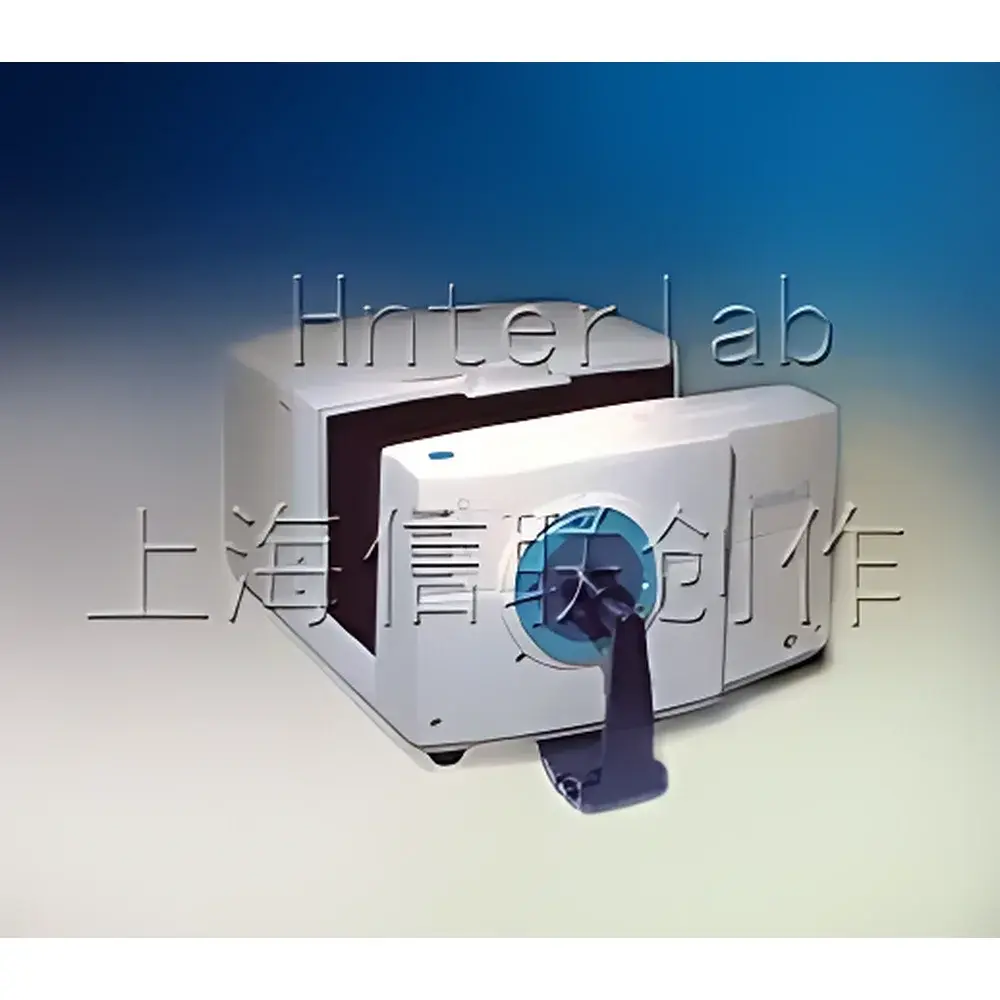
HunterLab ColorQuest XE Spectrophotometer
| Brand | HunterLab |
|---|---|
| Origin | USA |
| Model | ColorQuest XE |
| Product Type | Benchtop Spectrophotometer |
| Optical Geometry | d/8° Integrating Sphere |
| Light Source | Pulsed Xenon Lamp |
| Spectral Range | 400–700 nm |
| Repeatability | ΔE*ab ≤ 0.03 |
| Wavelength Resolution | < 3 nm |
| Wavelength Accuracy | ±0.1 nm |
| Photometric Range | 0–200% |
| Photometric Resolution | 0.003% (reported as 0.01%) |
| Measurement Time | < 1 s |
| Lamp Lifetime | > 1,000,000 flashes |
| Transmission Modes | Direct and Total |
| Integrating Sphere Diameter | 15.2 cm |
| Sphere Coating | Spectraflect® |
| Standard Aperture | 25.4 mm (illuminated) / 19.0 mm (measured) |
| Optional Apertures | 9.5 mm / 6.3 mm (SAV), 4 mm (X-SAV) |
| Mirror Finish Compensation | Automatic Inclusion/Exclusion |
| Spectral Bandwidth | 10 nm (isosceles triangle) |
Overview
The HunterLab ColorQuest XE is a benchtop spectrophotometer engineered for precision color measurement across diverse industrial and laboratory environments. Operating on the principle of double-beam spectral photometry, it employs a 256-element diode array detector coupled with a high-resolution concave holographic grating to deliver stable, high-fidelity spectral data from 400 nm to 700 nm. Its d/8° integrating sphere geometry—compliant with CIE, ASTM E308, ISO 7724, and USP —ensures consistent illumination and collection of diffuse reflectance and transmittance, accommodating both specular component included (SCI) and excluded (SCE) modes via automated optical switching. The instrument utilizes a pulsed xenon lamp filtered to closely approximate the CIE standard illuminant D65, eliminating thermal drift and enabling rapid, repeatable measurements without warm-up delay. With an integrating sphere diameter of 15.2 cm coated in Spectraflect®—a proprietary barium sulfate-based diffuse reflectance material—the system achieves >98% sphere efficiency and exceptional inter-instrument agreement.
Key Features
- Benchtop architecture optimized for production floor durability and laboratory-grade accuracy
- Automated aperture selection: standard LAV (25.4 mm × 19.0 mm), optional SAV (9.5 mm × 6.3 mm), and X-SAV (4 mm) for micro-area analysis
- Dynamic mirror finish compensation: real-time inclusion or exclusion of specular reflectance without mechanical recalibration
- High-speed acquisition: full spectral scan completed in under 1 second; minimum inter-measurement interval of 3 seconds
- Xenon flash lamp rated for >1,000,000 flashes; field-replaceable without calibration loss
- Robust optical path design with dual-beam referencing to minimize drift from ambient temperature or lamp aging
- Comprehensive spectral reporting at 10 nm intervals across the visible spectrum, with effective bandwidth of 10 nm (isosceles triangle)
Sample Compatibility & Compliance
The ColorQuest XE supports opaque, translucent, transparent, and liquid samples in both reflectance and transmission geometries. Its triple-open transmission chamber accommodates thick, irregular, or multi-layered specimens while enabling direct (collimated) and total (diffuse + collimated) transmittance evaluation—critical for applications such as APHA color, haze (ASTM D1003), yellowness index (ASTM E313), whiteness (CIE/ISO 11475), and opacity (TAPPI T425). All measurements conform to GLP/GMP documentation requirements when used with compliant software. Instrument performance is traceable to NIST standards, and validation protocols support FDA 21 CFR Part 11 compliance for electronic records and signatures.
Software & Data Management
The instrument operates natively with HunterLab’s EasyMatch QC software, providing configurable pass/fail tolerancing, statistical process control (SPC) charts, batch reporting, and audit-trail-enabled data logging. Raw spectral data (31-point or 10-nm interval) is exportable in CSV, XML, or ASTM E2849-compliant formats. Software modules support advanced color space conversions (CIELAB, CIELCH, CMC, DIN99, Hunter L,a,b), metamerism index calculation, and formulation prediction via integration with third-party dye-matching systems. All user actions—including method edits, tolerance changes, and result approvals—are timestamped and logged with operator ID for full regulatory traceability.
Applications
The ColorQuest XE serves as a primary color verification tool in quality control laboratories and manufacturing lines across chemical synthesis, polymer compounding, textile dyeing, architectural coatings, pharmaceutical excipient grading, food packaging film evaluation, and pulp & paper brightness testing. Its ability to quantify not only color difference (ΔE*ab, ΔE00) but also derived metrics—including haze, YI, WI, APHA, Gardner, Pt-Co, and opacity—makes it suitable for cross-functional use in R&D, incoming inspection, and release testing. In regulated environments, its stability and repeatability support IQ/OQ/PQ validation per ISO 17025 and ASTM D2244.
FAQ
What is the difference between SCI and SCE measurements?
SCI includes specular reflectance and is ideal for measuring intrinsic color of textured or matte surfaces; SCE excludes it and correlates more closely with visual appearance under typical viewing conditions.
Can the ColorQuest XE measure liquids in transmission mode?
Yes—it supports both direct (clear liquids) and total (turbid or colloidal liquids) transmission using standardized cell holders and pathlength options (10 mm, 20 mm, 50 mm).
Is the instrument compatible with existing HunterLab calibration standards?
Yes—certified ceramic tiles, liquid standards, and transmission reference materials from HunterLab’s current catalog are fully interchangeable with the ColorQuest XE.
Does the software support multi-user permissions and electronic signatures?
Yes—EasyMatch QC offers role-based access control, electronic signature capture, and full 21 CFR Part 11 audit trails when configured in validated mode.
How often does the instrument require recalibration?
Annual verification against traceable standards is recommended; routine daily verification using supplied calibration tiles satisfies most internal QA protocols.





