
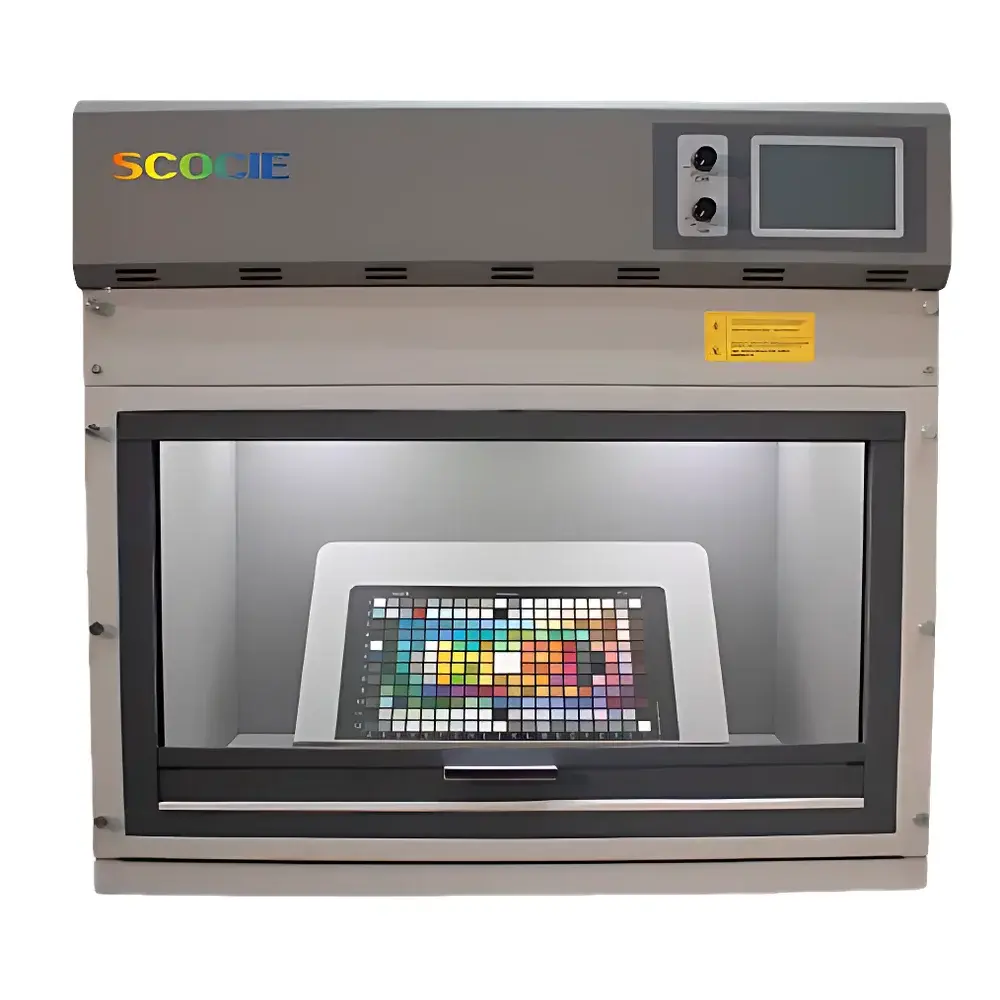
Shike FastnessGrade Desktop Spectrophotometric Colorfastness Analyzer
| Origin | Shanghai, China |
|---|---|
| Manufacturer Type | Authorized Distributor |
| Model | FastnessGrade |
| Product Category | Spectrophotometric Colorimeter |
| Instrument Type | Benchtop |
| Optical Geometry | 0/45° Integrating Sphere |
| Light Source | LED Array |
| Spectral Range | 350–700 nm |
| Repeatability | ΔE*ab ≤ 0.03 |
Overview
The Shike FastnessGrade Desktop Spectrophotometric Colorfastness Analyzer is an ISO-compliant, benchtop optical measurement instrument engineered for objective, repeatable assessment of textile colorfastness properties. Unlike conventional visual evaluation under standard illuminants, the FastnessGrade integrates high-fidelity RGB imaging with spectrophotometric measurement (350–700 nm) to quantify chromatic shifts across multiple standardized test protocols—including wash, rub, light, and perspiration fastness—per ASTM D2054, ISO 105-X12, ISO 105-B02, AATCC TM16, and GB/T 3920. Its 0/45° integrating sphere geometry ensures diffuse illumination and directional viewing, minimizing texture-induced metamerism and enabling robust quantification of both change-in-color (ΔE*ab, ΔL*, Δa*, Δb*) and staining transfer (stain index, grayscale correlation). The system operates on a dual-evaluation paradigm: spectral reflectance acquisition for absolute colorimetric traceability, and high-resolution image analysis for spatial pattern recognition—critical for grading pilling, abrasion marks, and localized dye migration.
Key Features
- Simultaneous spectral + spatial analysis: Captures full CIE XYZ tristimulus values and high-resolution RGB images in a single measurement cycle.
- Integrated standard illuminant simulation: Reproduces D65, A, F2, F7, and UV-enhanced spectra via calibrated LED array—compliant with CIE S 014-2/E:2020 for visual assessment consistency.
- Digital fastness grading engine: Automates classification per ISO 105-A02 grayscale and blue wool scale (ISO 105-B02), assigning numeric grades (1–5 for wash/rub; 1–8 for light fastness) with audit-trail metadata.
- Multi-sample throughput mode: Acquires up to 6 textile specimens in one frame—reducing operator intervention and supporting GLP-aligned batch documentation.
- Modular compliance architecture: Supports 21 CFR Part 11-compliant user access control, electronic signatures, and immutable data logging for regulated QC environments.
Sample Compatibility & Compliance
The FastnessGrade accommodates woven, knitted, nonwoven, and dyed fabric specimens up to 150 × 150 mm, including multi-fiber test cloths (MFT), crocking swatches, and pilling reference standards (ISO 12945-1). All optical calibrations are traceable to NIST SRM 2021 and verified against ISO 13655:2017 spectral reflectance standards. Instrument validation includes inter-laboratory reproducibility testing per ISO/IEC 17025 Annex B, demonstrating ≤0.03 ΔE*ab repeatability (n=20, 10mm aperture, D65/10°). Regulatory alignment extends to textile-specific frameworks: OEKO-TEX® Standard 100 colorfastness reporting templates, ZDHC MRSL v3.1 conformance checks, and EU REACH Annex XVII dye migration verification workflows.
Software & Data Management
FastnessGrade Control Suite v4.2 provides a validated, standalone Windows application with embedded calibration management, spectral library import (CIELAB, Munsell, RAL), and automated report generation (PDF/XLSX/PPTX). Raw spectral data (.spc), annotated images (.tiff), and grade logs (.csv) are stored in a relational SQLite database with SHA-256 hashing for integrity verification. Audit trail functionality records timestamped actions—including user ID, parameter changes, and grade overrides—with export capability for FDA 21 CFR Part 11 review. Cloud synchronization (optional) enables cross-site comparison of fastness results across global R&D labs while maintaining local data sovereignty per GDPR Article 44.
Applications
Beyond textile dyeing and finishing QC, the FastnessGrade supports cross-industry applications requiring chromatic stability assessment: pigment dispersion stability in coatings (ASTM D2244), batch-to-batch consistency in food-grade packaging films (ISO 11664-4), maturity grading of horticultural produce (CIE 15.2 chromaticity thresholds), and fluorescence quantification in security inks (UV365 excitation mode). In academic research, it facilitates accelerated aging studies correlating spectral drift (350–400 nm UV region) with photodegradation kinetics—enabling predictive modeling of service life for outdoor textiles.
FAQ
Does FastnessGrade comply with ISO 105 and AATCC test method requirements?
Yes—the instrument’s optical geometry, illuminant spectral power distribution, and software algorithms are validated against ISO 105-A02, ISO 105-B02, AATCC TM16-2021, and GB/T 3920, with full traceability documentation available upon request.
Can it replace manual gray scale evaluation entirely?
It provides objective, repeatable digital grading aligned to gray scale and blue wool references; however, final regulatory submission may require concurrent human review per ISO/IEC 17025 clause 7.8.2 for borderline cases.
Is UV calibration included in routine maintenance?
UV LED output is monitored daily via built-in photodiode feedback; full spectral recalibration using NIST-traceable standards is recommended every 12 months or after 10,000 measurements.
What sample preparation is required?
No special preparation—flat, tension-free specimens mounted on the standard sample holder suffice. For pilling assessment, pre-conditioned ISO 12945-1 test specimens are placed directly under the imaging module.
How is data integrity ensured during network transmission?
All exported reports include embedded digital signatures and cryptographic hashes; TLS 1.3 encryption is enforced for cloud-synced datasets.



