
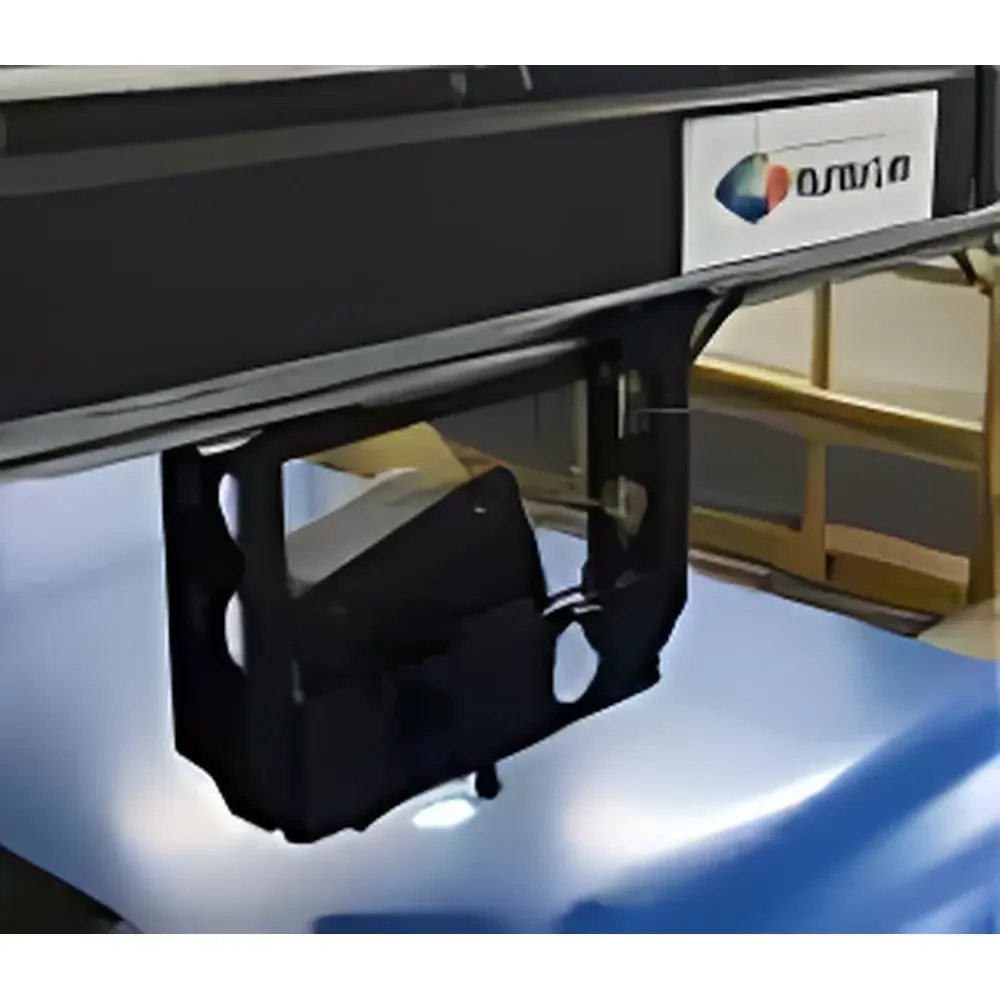
HunterLab STOL-M Series Online Color Measurement System
| Brand | HunterLab |
|---|---|
| Origin | USA |
| Manufacturer Type | Authorized Distributor |
| Product Category | Imported |
| Model | STOL-M Series |
| Product Type | Spectrophotometric Colorimeter |
| Instrument Type | In-Line |
| Optical Geometry | 0°/45° Integrating Sphere |
| Light Source | Full-Spectrum LED |
| Spectral Range | 400–700 nm |
| Repeatability | ΔE*ab ≤ 0.03 |
Overview
The HunterLab STOL-M Series Online Color Measurement System is an industrial-grade, in-line spectrophotometer engineered for continuous, non-contact color monitoring of coil-coated metal surfaces during high-speed production. Utilizing a fixed 0°/45° optical geometry with an integrating sphere and full-spectrum LED illumination, the system captures reflectance data across the visible spectrum (400–700 nm) with metrological traceability to NIST standards. Unlike laboratory-based instruments, the STOL-M is purpose-built for integration into continuous manufacturing lines—delivering real-time ΔE*ab, L*a*b*, and spectral reflectance data without interrupting line speed or requiring manual sampling. Its core function is to detect micro-variations in color consistency attributable to coating formulation drift, roller wear, oven temperature gradients, or pigment dispersion anomalies—enabling closed-loop process feedback and early deviation detection before material enters downstream inspection or packaging.
Key Features
- True in-line architecture with ruggedized IP65-rated housing, designed for ambient temperatures up to 50°C and vibration-prone coil coating environments.
- Full-width automated traverse mechanism enabling synchronized scanning across the entire strip width (customizable up to 1800 mm), eliminating blind zones and ensuring representative spatial averaging.
- Auto-probe retraction and acoustic-visual alarm system activated when strip edge proximity or mechanical obstruction is detected—ensuring personnel safety and sensor protection during threading or misalignment events.
- Self-calibrating optical path with programmable calibration interval scheduling (e.g., every 30 min, per shift, or on demand); eliminates dependency on operator intervention and mitigates human error or procedural inconsistency.
- High-stability full-spectrum LED source with <1% output drift over 10,000 hours, eliminating lamp replacement cycles and spectral aging effects common in xenon or tungsten-halogen systems.
- ΔE*ab repeatability of ≤0.03 under controlled conditions (per ASTM E308 and ISO 11664-4), verified using certified ceramic tile standards traceable to NIST SRM 2021.
Sample Compatibility & Compliance
The STOL-M is optimized for specular and diffuse reflectance measurement of flat, moving metallic substrates with organic coatings—including polyester, PVDF, and plastisol systems applied via roll coating. It accommodates surface roughness (Ra ≤ 1.6 µm), gloss levels from 10–90 GU (60°), and typical line speeds of 30–200 m/min. All measurements comply with CIE 15:2018 spectral computation methods and are reported in CIELAB (D65/10°) coordinates. The system meets electromagnetic compatibility requirements per EN 61326-1 and industrial safety standards IEC 61508 (SIL2 capable). Data integrity protocols support audit readiness for ISO 9001:2015 and IATF 16949 quality management systems.
Software & Data Management
The embedded Color iQ™ Control Software provides real-time dashboard visualization, statistical process control (SPC) charting (X̄-R, Cpk), and configurable alarm thresholds per color coordinate. Raw spectral data and metadata (timestamp, line speed, zone ID, calibration status) are exported in CSV or XML format via OPC UA or Modbus TCP for integration with MES/SCADA platforms (e.g., Siemens SIMATIC IT, Rockwell FactoryTalk). Audit trails record all user actions, calibration events, and parameter changes—supporting compliance with FDA 21 CFR Part 11 when deployed in regulated environments. Optional cloud synchronization enables remote diagnostics and historical trend analysis across multiple production sites.
Applications
- Real-time color deviation detection during coil coating of architectural panels, appliance skins, and automotive trim components.
- Correlation validation between in-line measurements and off-line lab spectrophotometers (e.g., HunterLab UltraScan VIS), ensuring inter-instrument agreement within ±0.15 ΔE*ab per ASTM D2244.
- Root-cause analysis of batch-to-batch color shifts by time-synchronized correlation with process parameters (e.g., mix tank pH, solid content, cure temperature).
- Automated pass/fail flagging at exit station to trigger automatic rejection or tagging of out-of-spec coils prior to slitting or packaging.
- Support for R&D process optimization through spectral fingerprinting of coating formulations under varying cure profiles.
FAQ
What is the minimum measurable strip width and maximum line speed supported?
The STOL-M supports strip widths from 600 mm to 1800 mm (custom-engineered) and line speeds up to 200 m/min with stable spectral acquisition and sub-pixel spatial registration.
Does the system require external reference standards for daily verification?
No—built-in ceramic reference tiles are automatically measured during scheduled calibrations; however, optional NIST-traceable verification standards can be used for quarterly performance qualification per ISO/IEC 17025.
Can the STOL-M interface with existing PLCs and MES systems?
Yes—native support for EtherNet/IP, Profinet, and OPC UA ensures seamless integration with major industrial automation platforms without middleware.
How is thermal drift compensated during extended operation?
Internal temperature sensors feed real-time correction coefficients to the spectral algorithm; optical path stability is maintained within ±0.005 nm/°C across the operating range.
Is software validation documentation available for regulated industries?
Yes—IQ/OQ documentation packages, including test scripts and traceability matrices, are provided for GMP/GLP environments upon request.





