
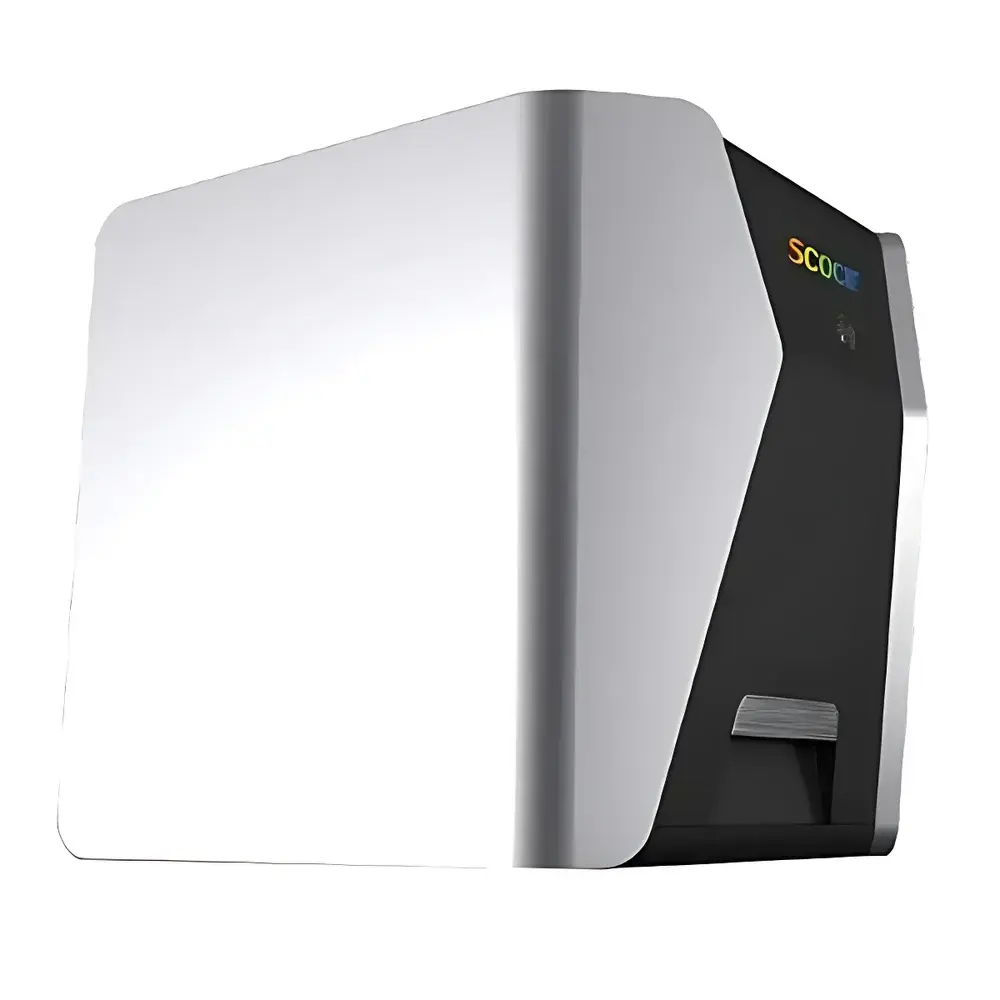
Digieye-Digicolor Spectrophotometric Color Imaging System
| Brand | SCOSIE |
|---|---|
| Origin | Shanghai, China |
| Model | Digieye-Digicolor |
| Type | Benchtop Spectrophotometric Color Measurement System |
| Optical Geometry | 0°/45° Integrating Sphere |
| Illuminant | Standard D65 (also supports A, F11, D50, F02, F07) |
| Spectral Range | 400–700 nm |
| Repeatability | ΔE*ab ≤ 0.03 |
| Color Spaces | CIELAB, CIELCH, CIELUV, Hunter Lab, Munsell |
| Observer Angles | 2° and 10° Standard Observer |
| Color Difference Formulas | CIE L*a*b*, CMC (l:c), CIE94, CIEDE2000 |
| Data Output Formats | CSV, QTX, TXT, DAT, Print |
| Compliance | ASTM E308, ISO/CIE 11664, ISO 12647, ISO 13655, USP <1061>, GLP/GMP-aligned audit trail capability |
Overview
The Digieye-Digicolor Spectrophotometric Color Imaging System is a benchtop, non-contact color measurement platform engineered for high-fidelity spectral imaging and quantitative color analysis across heterogeneous, textured, and geometrically complex surfaces. Unlike conventional tristimulus colorimeters or handheld spectrophotometers constrained by spot-size limitations and specular interference, the Digieye-Digicolor employs a calibrated 0°/45° integrating sphere optical architecture coupled with high-resolution digital imaging to capture spatially resolved spectral reflectance data across the visible spectrum (400–700 nm). Its measurement principle integrates multispectral image acquisition with full-spectrum photometric calibration—enabling pixel-level CIE-compliant colorimetric computation under standardized illuminants (D65, A, D50, F11, etc.) and observer functions (2° and 10°). This architecture ensures metrological traceability to CIE standards while preserving surface appearance attributes—including gloss, texture, metamerism, and spatial color variation—that are inherently lost in single-point measurements.
Key Features
- Benchtop 0°/45° integrating sphere design optimized for stable, vibration-insensitive operation in QC laboratories and production environments
- Non-contact, large-area imaging capability—measures irregular, curved, or fragile samples without physical contact or sample preparation
- Simultaneous acquisition of spectral reflectance curves and spatial color maps at pixel resolution, supporting both average-area and region-of-interest (ROI) analysis
- Comprehensive illuminant library compliant with ISO/CIE and industry-specific standards (e.g., D65 for daylight simulation, F11 for cool white fluorescent, A for incandescent)
- Integrated calibration validation via NIST-traceable ceramic tiles and built-in diagnostic routines for drift monitoring and instrument stability verification
- Support for multiple color difference metrics—including CIEDE2000 (ΔE₀₀), CMC (2:1), and CIE94—with configurable tolerance ellipsoids aligned to material-specific perceptual uniformity requirements
Sample Compatibility & Compliance
The Digieye-Digicolor accommodates diverse sample types including woven and knitted textiles, coated substrates, injection-molded plastics, printed packaging, cosmetic formulations, pharmaceutical tablets, ceramic glazes, and aged cultural heritage artifacts. Its non-contact geometry eliminates pressure-induced spectral shifts common in contact-based probes and avoids contamination risks in sterile or hygroscopic applications. The system conforms to ASTM E308 (computing tristimulus values from spectral data), ISO/CIE 11664 (colorimetry fundamentals), ISO 12647 (graphic technology process control), and ISO 13655 (spectral measurement of prints). For regulated industries, it supports 21 CFR Part 11–compliant user access control, electronic signatures, and immutable audit trails when deployed with validated software configurations—facilitating GLP and GMP compliance in pharmaceutical and medical device manufacturing.
Software & Data Management
The proprietary Digieye Control Suite provides a unified interface for instrument control, spectral acquisition, color space transformation, and statistical process monitoring. It enables real-time comparison against master standards, automatic Pass/Fail classification per user-defined tolerances (including multi-parameter pass criteria), and batch reporting with SPC charting (X̄-R, Cp/Cpk). All raw spectral data, metadata (illuminant, observer, geometry, calibration timestamp), and computed colorimetric values are stored in an indexed SQLite database with export support for CSV, QTX (QuarkXPress), TXT, and DAT formats. Data synchronization via secure HTTP(S) or OPC UA enables integration into MES, LIMS, and ERP systems—ensuring traceability from lab measurement to enterprise analytics.
Applications
The system serves as a primary color control tool across vertically integrated supply chains: textile mills use it to validate dye lot consistency and detect edge-to-edge variation in wide-format fabrics; paint and coating manufacturers deploy it for batch release testing of metallic and pearlescent finishes where goniochromism must be quantified; food packaging converters rely on its ability to assess print fidelity on flexible laminates under varying lighting conditions; and pharmaceutical QA labs apply it to verify tablet film-coating uniformity and detect subtle shade deviations indicative of excipient variability. In R&D contexts, its spectral imaging capability supports formulation optimization, metamerism analysis, and development of appearance-specification guidelines aligned with consumer perception studies.
FAQ
What distinguishes Digieye-Digicolor from conventional spectrophotometers?
It combines full-spectrum imaging with integrating sphere optics—capturing spatial color distribution and surface appearance attributes that single-spot devices cannot resolve.
Can it measure translucent or backlit materials?
Yes—the system supports configurable transmission mode with optional backlighting module for transmittance and haze analysis of films, lenses, and liquid samples.
Is spectral data export compatible with third-party color management software?
Raw reflectance spectra (31-point or 10-nm interval) are exportable in ASCII format, fully interoperable with Color iQC, BasICColor, and MATLAB-based spectral modeling workflows.
How is instrument calibration maintained over time?
Daily verification uses onboard reference tiles; annual recalibration is performed using NIST-traceable standards, with full calibration history logged in the audit trail.
Does the system support automated pass/fail decision logic for production line integration?
Yes—customizable rule engines allow Boolean logic across multiple color spaces, tolerances, and appearance parameters, with output signals via digital I/O or Modbus TCP for PLC interfacing.




