
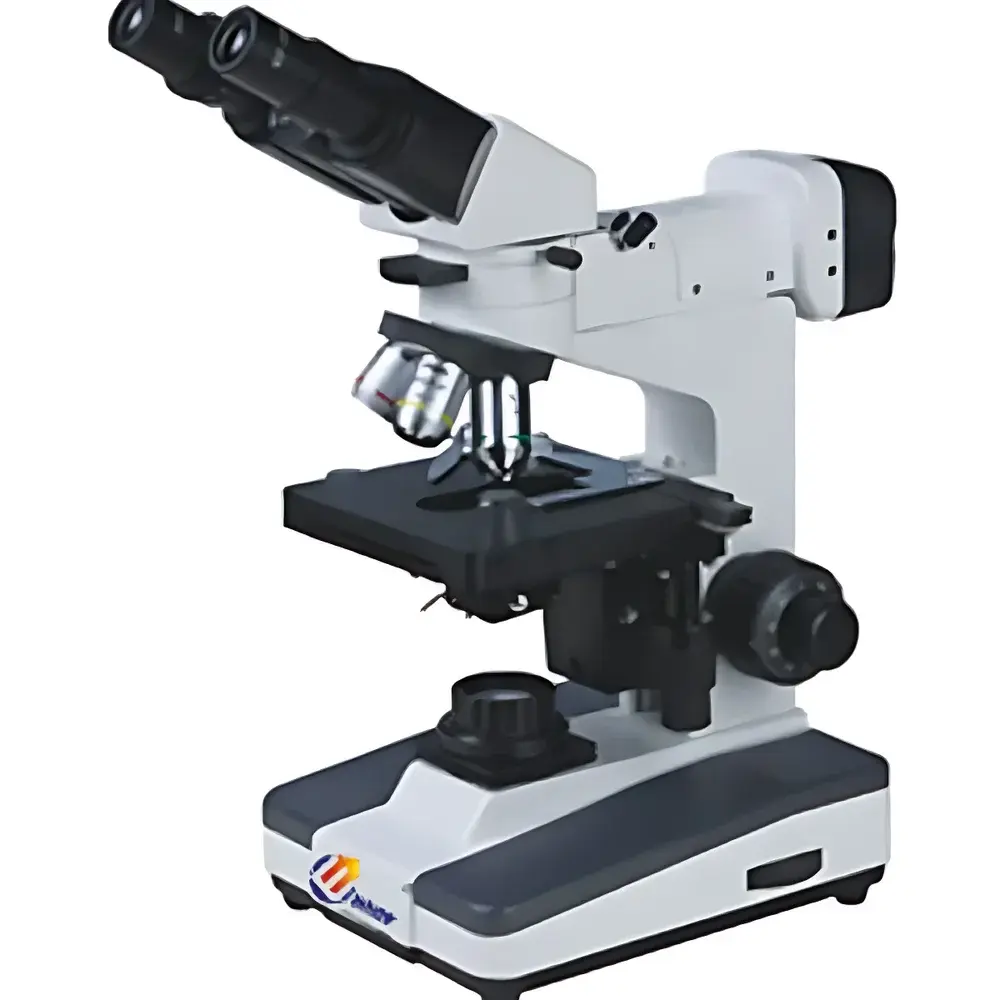
YANRUN 6XD Upright Polarizing Metallurgical Microscope
| Brand | YANRUN |
|---|---|
| Origin | Shanghai, China |
| Manufacturer Type | Direct Manufacturer |
| Product Type | Upright |
| Model | 6XD Upright Polarizing Metallurgical Microscope |
| Eyepieces | Widefield 10× (18 mm FOV), 10× reticle eyepiece with 0.1 mm graduated scale |
| Objectives | 4×/0.10 WD 25 mm, 10×/0.25 WD 11 mm, 20×/0.40 WD 9 mm, 40×/0.60 WD 3.8 mm |
| Binocular Head | 30° inclined hinge-type, interpupillary adjustment 50–75 mm |
| Nosepiece | Quadruple revolving nosepiece |
| Stage | 140 × 140 mm mechanical stage with 75 × 50 mm travel range |
| Focus Mechanism | Coaxial coarse/fine focusing |
| fine focus graduation | 2 µm per division |
| Illumination | Dual-path halogen lighting — transmitted (6 V/20 W, AC 85–230 V) and reflected (6 V/20 W, AC 85–230 V), both intensity-adjustable |
| Polarizing System | Rotatable analyzer (0–360°), removable polarizer and analyzer, stress-free optical path design |
| Condenser | N.A. 1.25 Abbe condenser with adjustable iris diaphragm and slide-in green/blue/yellow filters |
| Accessories Included | 0.01 mm stage micrometer, two 6 V/20 W halogen bulbs, full polarizing kit, filter set, CCD camera (1×), 0.5× C-mount adapter, documentation set |
Overview
The YANRUN 6XD Upright Polarizing Metallurgical Microscope is a precision-engineered optical instrument designed for quantitative microstructural analysis of opaque, polished metallic and ceramic specimens under both brightfield and polarized light conditions. Built on a rigid, vibration-damped upright platform, the system employs strain-free optical pathways and high-numerical-aperture achromatic objectives to ensure minimal birefringence artifacts—critical for reliable anisotropic phase identification in metallurgy, geology, and advanced materials research. Its dual-illumination architecture supports simultaneous transmitted-light observation (via Abbe condenser with N.A. 1.25) and incident-light epi-illumination, enabling comprehensive evaluation of grain morphology, inclusion distribution, phase boundaries, and crystallographic orientation in bulk alloys, heat-treated steels, cast irons, and sintered composites. The microscope conforms to fundamental ISO 10934-1 (microscopy — nomenclature and terminology) and ASTM E3-22 (standard guide for preparation of metallographic specimens), forming a foundational tool for laboratories operating under GLP-compliant or internal QA/QC protocols.
Key Features
- Rigid upright stand with coaxial coarse/fine focusing mechanism offering 2 µm fine-focus resolution and ergonomic parfocal alignment across all objectives.
- Quadruple revolving nosepiece accommodating four strain-free, infinity-corrected metallurgical objectives (4×, 10×, 20×, 40×) with specified working distances and numerical apertures optimized for high-contrast imaging of polished sections.
- 30° inclined binocular head with interpupillary adjustment (50–75 mm) and widefield 10× eyepieces (18 mm field number); includes one reticle eyepiece calibrated to 0.1 mm for rapid qualitative dimensional estimation.
- Dual independent halogen illumination systems—transmitted (6 V/20 W) and reflected (6 V/20 W)—each featuring continuous brightness control and integrated heat-absorbing filters to preserve specimen integrity during extended observation.
- Full polarizing suite: rotatable analyzer (0–360° vernier scale), push-in/pull-out polarizer and analyzer, and stress-optimized optical train ensuring accurate extinction angle measurement and interference color interpretation per Michel-Lévy charts.
- N.A. 1.25 Abbe condenser with centerable iris diaphragm and interchangeable green/blue/yellow filters for contrast enhancement and wavelength-specific observation (e.g., blue filter for improved resolution in high-magnification darkfield).
Sample Compatibility & Compliance
The 6XD accommodates standard 25 mm and 30 mm diameter metallographic specimens mounted in thermosetting resins or cold-mounting media. Its 75 × 50 mm mechanical stage travel enables systematic grid-based scanning of large-area mounts without repositioning. All optical components—including objectives, condenser, and polarizers—are manufactured to meet ISO 8578 (microscopes — mechanical tube length and parfocal distance) and DIN 58885 (requirements for polarizing microscopes). While the base configuration does not include image analysis software, its C-mount interface (0.5× adapter supplied) supports integration with third-party digital imaging platforms compliant with FDA 21 CFR Part 11 audit-trail requirements when paired with validated acquisition software. The instrument satisfies essential criteria for routine use in ISO/IEC 17025-accredited testing laboratories performing metallographic examination per ASTM E112 (grain size determination), ASTM E45 (inclusion rating), and ISO 643 (steel microstructure classification).
Software & Data Management
The YANRUN 6XD operates as a hardware platform compatible with industry-standard machine vision interfaces. The included 0.5× C-mount adapter ensures optimal sensor coverage for 1/2″ or 1/3″ format CCD cameras. Although no proprietary image analysis software is bundled, the system supports integration with validated third-party packages—including Olympus Stream, Leica Application Suite (LAS X), and open-source tools such as ImageJ/Fiji—enabling measurement traceability, annotation, report generation, and export of metadata-rich TIFF or DICOM-compatible files. For regulated environments, users may deploy software solutions with electronic signature capability, audit trail logging, and user-access-level controls to fulfill ALCOA+ (Attributable, Legible, Contemporaneous, Original, Accurate, Complete, Consistent, Enduring, Available) data integrity principles.
Applications
- Quantitative grain size analysis and phase fraction measurement in ferrous and non-ferrous alloys.
- Identification and characterization of anisotropic phases (e.g., graphite flakes in cast iron, TiAl intermetallics, quartz vs. feldspar in rock thin sections).
- Evaluation of heat treatment effects—including martensite lath width, carbide precipitation, and recrystallization behavior—under polarized contrast.
- Failure analysis of fracture surfaces, weld zones, and coating-substrate interfaces using differential interference contrast (DIC) enabled via optional Nomarski prisms.
- Teaching and training in materials science curricula where reproducible, hands-on polarization microscopy techniques are required.
FAQ
Does the 6XD support oil immersion objectives?
No—the standard objective set is dry-type only; however, optional 50×, 80×, and 100× objectives—including strain-free 100× oil immersion—are available as accessories.
Is the microscope compatible with digital camera systems from other manufacturers?
Yes—its standardized C-mount interface and 0.5× reduction lens enable seamless coupling with most industrial CCD/CMOS cameras meeting ANSI/ISO C-mount specifications.
Can the polarizing system be used for quantitative retardation measurements?
The 6XD provides angular calibration for extinction position but lacks built-in compensators (e.g., λ-plate or quartz wedge); quantitative birefringence analysis requires optional accessory modules.
What electrical safety certifications does the unit carry?
The instrument complies with IEC 61010-1 (safety requirements for electrical equipment for measurement, control, and laboratory use) and bears CE marking for operation within the European Economic Area.
Is service and technical support available outside China?
YANRUN maintains authorized distributor networks in Southeast Asia, the Middle East, and Latin America; firmware updates and optical alignment documentation are provided in English upon registration.






