
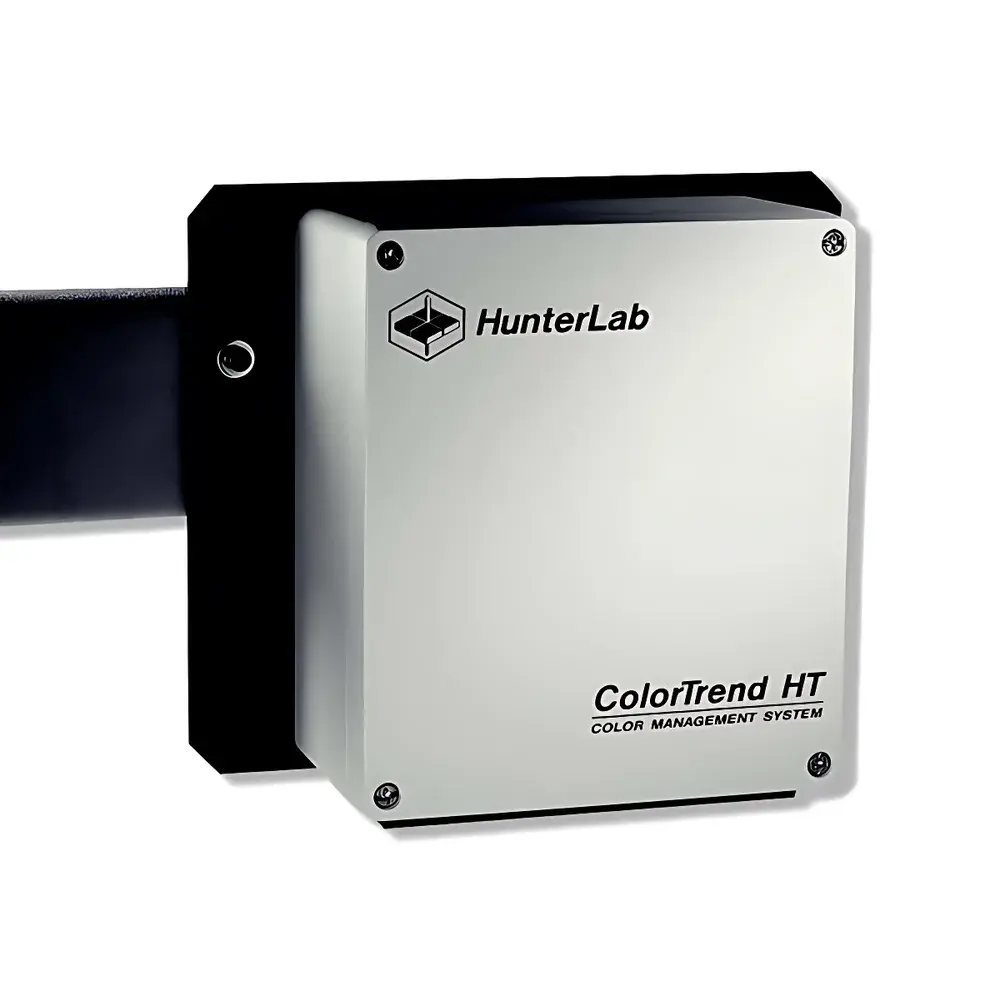
HunterLab ColorTrend HT (CTHT) Online Color Measurement System
| Brand | HunterLab |
|---|---|
| Origin | USA |
| Model | ColorTrend HT (CTHT) |
| Optical Geometry | 0°/45° dual-beam |
| Wavelength Range | 400–700 nm |
| Illuminant | C |
| Observer Angle | 2° |
| Measurement Spot Diameter | 20 mm |
| Measurement Distance | 50–150 mm |
| Illumination/Detection Area | 35 mm / 25 mm |
| Color Resolution | ±0.1 CIELab units |
| Height Resolution | ±0.1 mm |
| Repeatability (24 h, no recalibration) | < ±0.5 CIELab units |
| Output | Four user-configurable CIE tristimulus values + height via isolated 4–20 mA channels |
| Environmental Rating | NEMA 4 / IP65 |
| Operating Temperature | 10–50 °C |
| Power Supply | 90–250 VAC, 47–63 Hz |
| Communication | RS-232 or RS-485 |
| Compliance | Designed for GLP/GMP-aligned process monitoring environments |
Overview
The HunterLab ColorTrend HT (CTHT) Online Color Measurement System is an industrial-grade, non-contact, dual-beam spectrophotometric sensor engineered for continuous, real-time color and physical height monitoring of moving products on production lines. Based on the internationally recognized 0°/45° optical geometry—aligned with CIE standard illuminant C and a 2° standard observer—the CTHT delivers reflectance-based color measurements that correlate closely with human visual assessment and are fully compatible with laboratory-grade 0°/45° or 45°/0° instruments. Its dual-beam architecture actively compensates for ambient light fluctuations, lamp aging, and thermal drift, ensuring stable metrological performance in dynamic manufacturing settings. Unlike offline benchtop colorimeters, the CTHT integrates directly into process control infrastructure, enabling closed-loop feedback for color consistency management without interrupting throughput.
Key Features
- Dual-beam 0°/45° optical design with LED illumination (400–700 nm), eliminating measurement drift from environmental variability and source degradation.
- Simultaneous acquisition of CIELAB color coordinates (L*, a*, b*) and product height—height data validates measurement validity by confirming target presence and conveyor alignment, preventing erroneous readings from background surfaces such as belts or rollers.
- Integrated temperature-stabilized optical head ensures consistent spectral response across operating temperatures (10–50 °C); optional air-cooling and thermal shielding support deployment in high-temperature zones (e.g., extrusion, drying, or baking lines).
- Robust NEMA 4 / IP65-rated enclosure suitable for washdown, dust, and humidity exposure—certified for long-term operation in demanding industrial environments including food processing, paper mills, and nonwovens production.
- Standalone operation enabled by built-in display and keypad; remote handheld controller available for field adjustment without PC access.
- Four independently configurable CIE tristimulus outputs (e.g., L*, a*, b*, ΔE) plus height, delivered via isolated 4–20 mA analog channels for direct integration into DCS, PLC, or SCADA systems.
- Auto-calibration option with pneumatic lens cleaning ensures sustained accuracy during unattended operation.
Sample Compatibility & Compliance
The CTHT is validated for continuous measurement of opaque, semi-opaque, and textured surfaces—including pellets, sheets, webs, granules, and extruded profiles—across industries such as color concentrate manufacturing, recycled polymer processing, tissue and packaging paper, mineral pigments, and food-grade coatings. Its 20 mm measurement aperture and 50–150 mm working distance accommodate variable product geometries and line speeds. The system supports traceable calibration via HunterLab’s Hitching function, allowing field instruments to align numerically with master reference standards maintained in central QC labs—facilitating inter-site consistency and audit readiness. While not certified to ISO/IEC 17025 as a standalone calibration lab, the CTHT is designed to operate within GLP and GMP frameworks, supporting 21 CFR Part 11-compliant data integrity when paired with HunterLab’s validated online quality software suite.
Software & Data Management
The CTHT operates natively without external computing resources but interfaces seamlessly with HunterLab’s CTHT Online Quality Software via RS-232 or RS-485 serial protocols. This software provides real-time trending, statistical process control (SPC) charting (X-bar/R, Cp/Cpk), alarm thresholds, historical data logging with time-stamped metadata, and export to CSV or SQL databases. Audit trails record all parameter changes, calibration events, and operator actions—meeting documentation requirements for regulated environments. Data export formats comply with ASTM E308 and ISO 11664-4 for colorimetric reporting, and raw spectral data (if enabled via firmware upgrade) supports advanced multivariate analysis for root-cause investigation of color excursions.
Applications
The CTHT serves as a primary process analytical technology (PAT) tool in continuous manufacturing operations where color consistency directly impacts regulatory compliance, brand integrity, or functional performance. Typical use cases include: real-time color tracking of masterbatch blends prior to extrusion; endpoint detection in pigment dispersion processes; color uniformity verification of coated paper or nonwoven fabrics; batch-to-batch consistency monitoring in mineral filler production; and hue stability assessment of heat-sensitive food coatings during thermal processing. Its height-synchronized measurement logic makes it especially effective in applications involving variable-thickness substrates or intermittent product flow.
FAQ
Does the CTHT require daily recalibration?
No—its dual-beam architecture and internal thermal stabilization provide < ±0.5 CIELAB unit repeatability over 24 hours without recalibration. Scheduled verification against a ceramic tile standard is recommended per shift or per production lot.
Can the CTHT replace laboratory color measurement?
It is not intended as a replacement for ASTM D2244-compliant lab-grade instruments but serves as a statistically representative, high-frequency surrogate for in-process control—reducing reliance on destructive sampling and accelerating corrective action.
Is the 4–20 mA output intrinsically safe?
The standard output is non-intrinsically safe; however, signal isolation and barrier integration can be implemented at the control panel level to meet Class I, Div 2 requirements.
What maintenance does the optical head require?
With optional pneumatic lens cleaning, routine maintenance is limited to periodic inspection of the purge air filter and annual verification of height sensor zero offset using a certified gauge block.
Can multiple CTHT units share one software license?
Yes—HunterLab’s enterprise software supports concurrent monitoring and centralized configuration management for up to 32 networked CTHT sensors.



