
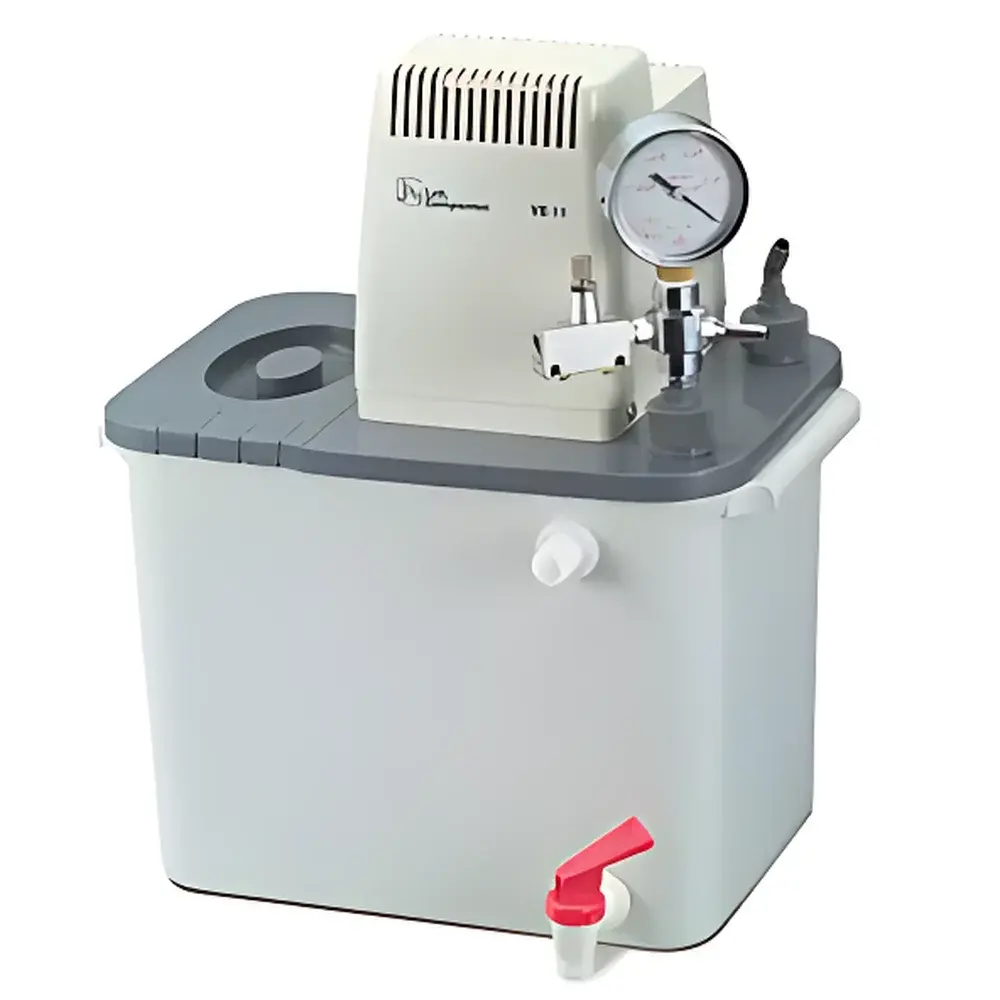
JEIO TECH WE11 Water Circulating Vacuum Pump
| Brand | JEIO TECH |
|---|---|
| Origin | South Korea |
| Model | WE11 |
| Pump Type | Oil-Free Water Circulating Vacuum Pump |
| Application | Rotary Evaporation, Vacuum Drying, Vacuum Filtration |
| Construction Material | Polypropylene (PP) Body, 304 Stainless Steel Inlet Fittings, Nickel-Plated Brass Components, Silicone Rubber Tubing |
| Inlet Tube Dimensions | Two × 6 mm ID × 20 cm PP-Reinforced Rubber Tubes |
| Operating Principle | Bernoulli’s Principle via Pressurized Water Flow |
Overview
The JEIO TECH WE11 Water Circulating Vacuum Pump is an oil-free, water-aspirated vacuum generation system engineered for reliable, low-maintenance operation in academic, pharmaceutical, and industrial laboratory environments. Unlike mechanical or diaphragm vacuum pumps, the WE11 leverages the Bernoulli principle—where accelerated water flow through a constricted venturi nozzle induces pressure differentials—to generate stable vacuum levels typically ranging from 10 to 30 Torr (13–40 mbar), sufficient for routine vacuum-assisted processes including rotary evaporation, vacuum filtration, and low-temperature solvent removal. Its fully oil-free architecture eliminates contamination risks associated with hydrocarbon vapors, making it especially suitable for applications involving volatile organic solvents where pump oil degradation or cross-contamination must be avoided. The unit operates without electrical vacuum components—only requiring connection to a standard tap water supply—and thus presents no risk of spark generation, enhancing safety in flammable solvent handling workflows.
Key Features
- Oil-free vacuum generation using pressurized tap water—no lubricants, no oil changes, no vapor emissions
- Dual independent suction nozzles (6 mm inner diameter) enable simultaneous operation of two vacuum-dependent instruments (e.g., one rotary evaporator + one filtration manifold)
- Integrated dual-stage anti-backflow protection: stainless steel ball check valve + molded silicone rubber flap valve prevents water or solvent back-siphoning during sudden pressure loss or power interruption
- Chemically resistant construction: polypropylene (PP) main body, 304 stainless steel inlet fittings, nickel-plated brass connectors, and silicone-reinforced rubber tubing ensure long-term compatibility with weak acids, bases, and common organic solvents
- Low water consumption design (typical flow rate: 0.8–1.2 L/min at 2–3 bar inlet pressure), minimizing operational cost and thermal load
- Ergonomic front-mounted drain valve enables rapid, tool-free water evacuation—critical for overnight shutdowns or seasonal storage
- Modular accessory set included: two 20 cm and one 100 cm length, 6 mm ID PP-coated silicone rubber tubes rated for continuous use up to 60 °C
Sample Compatibility & Compliance
The WE11 is compatible with standard laboratory glassware featuring 6 mm or 8 mm hose barbs (with appropriate adapters). Its non-reactive wetted path ensures safe use with aqueous solutions, ethanol, acetone, ethyl acetate, dichloromethane, and other low-boiling-point solvents commonly employed in extraction and concentration protocols. While not certified to ISO 8573 (compressed air purity) or FDA 21 CFR Part 11 (as it lacks digital control or data logging), the pump supports GLP-compliant workflows when integrated into validated vacuum systems—for example, as part of a USP compliant aseptic processing train where vacuum integrity is monitored externally. Its mechanical simplicity and absence of electronic controls render it inherently robust for ISO/IEC 17025-accredited testing laboratories requiring traceable, repeatable vacuum conditions without software dependencies.
Software & Data Management
The JEIO TECH WE11 is a purely mechanical, analog-operated device with no embedded electronics, firmware, or connectivity interfaces. It does not incorporate data logging, remote monitoring, or software-based parameter control. Vacuum level is regulated manually via upstream water pressure adjustment (using standard lab faucet valves or inline pressure regulators). This architecture eliminates cybersecurity vulnerabilities, firmware obsolescence, and calibration drift associated with digital sensors—making it ideal for environments prioritizing operational continuity, audit readiness, and minimal validation burden. Users record vacuum performance using external gauges (e.g., digital Pirani or capacitance manometers), and all operational parameters—including inlet pressure, flow rate, and duration—are documented manually per institutional SOPs.
Applications
- Rotary evaporation of heat-sensitive compounds under reduced pressure (e.g., natural product isolates, polymer precursors)
- Vacuum-assisted gravity filtration of crystalline precipitates or cell lysates
- Short-path distillation setups requiring moderate vacuum stability
- Desiccator evacuation for moisture-sensitive reagents or hygroscopic standards
- Support vacuum for Schlenk line manifolds during inert-atmosphere transfers
- Low-cost vacuum source for undergraduate teaching labs conducting basic physical chemistry experiments (e.g., vapor pressure determination, boiling point elevation studies)
FAQ
What vacuum level can the WE11 achieve under typical lab water pressure?
Under 2.5–3.0 bar municipal water pressure and ambient temperature (20–25 °C), the WE11 consistently delivers 15–25 Torr (20–33 mbar) at the outlet port—sufficient for most non-cryogenic vacuum applications.
Can the WE11 handle corrosive vapors such as HCl or HF?
No. While the polypropylene body resists many organics and dilute acids, concentrated mineral acids—especially hydrofluoric acid—will degrade PP and silicone components. Use only with non-oxidizing, low-concentration aqueous or organic streams.
Is tubing replacement required regularly?
Silicone-reinforced rubber tubing should be inspected quarterly for swelling, cracking, or loss of elasticity; typical service life is 6–12 months depending on solvent exposure frequency and temperature.
Does the pump require a dedicated water line?
It connects directly to standard laboratory faucet outlets via supplied quick-connect fittings—no permanent plumbing modification is needed.
How is maintenance performed?
Routine maintenance consists of monthly visual inspection of check valves, quarterly drain valve actuation to clear sediment, and annual replacement of inlet gaskets if water hardness exceeds 200 ppm.



