
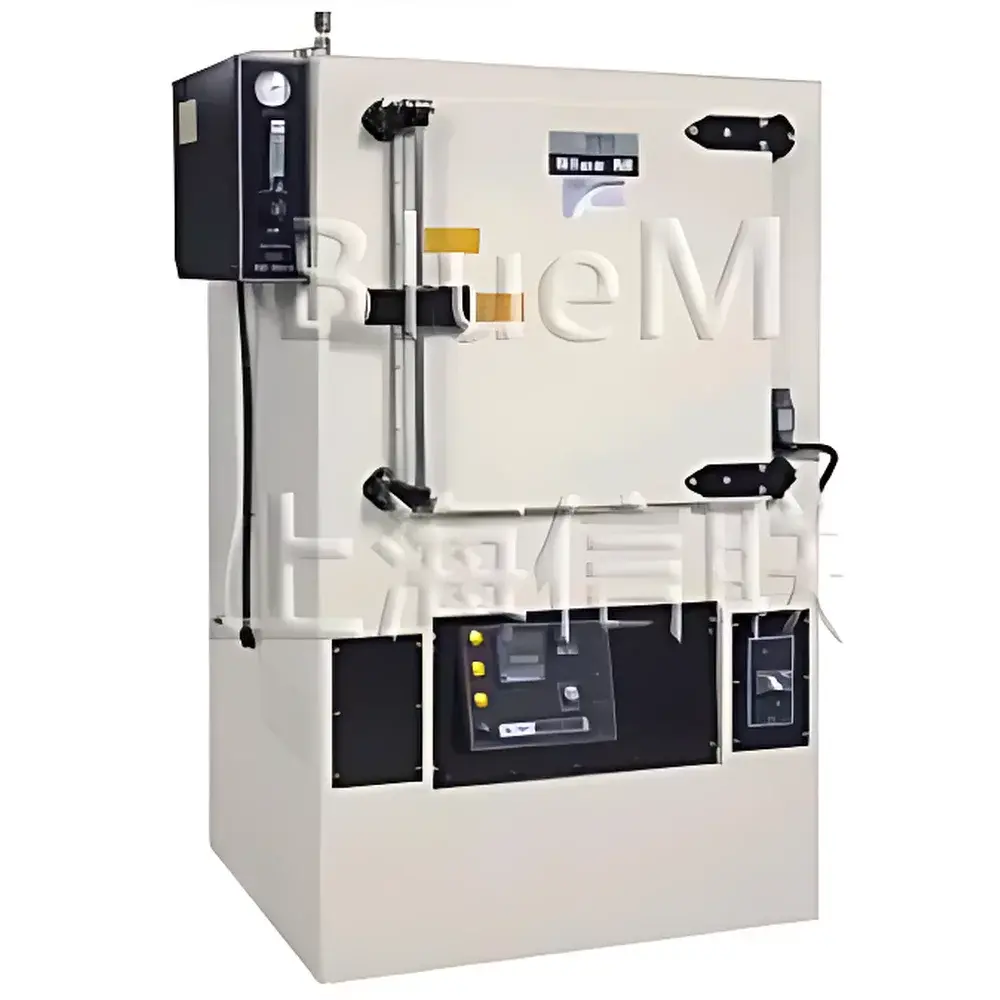
Blue M SPX Blue M 146 Inert Atmosphere Oven
| Brand | Blue M |
|---|---|
| Origin | USA |
| Model | SPX Blue M 146 |
| Temperature Range | Ambient +15°C to 350°C |
| Temperature Uniformity | ±1% |
| Control Accuracy | ±0.5°C |
| Resolution | ±0.1°C |
| Max Power | 7500 W |
| Heating Method | Forced Air Convection |
| Internal Dimensions | 20×18×20 in to 48×24×36 in (1.6–24 cu.ft) |
| Ramp Time to 300°C | ≤60 min |
| Insulation | 4-inch Mineral Wool |
| Chamber Construction | Full-Welded 304 Stainless Steel |
| Door Seal | Blue M Fiberglass Gasket |
| Safety | Interlocked Purge-Integrity Door Switch |
| Compliance | Designed for ASTM E145, ISO 17025, and GLP-compliant thermal processing environments |
Overview
The Blue M SPX Blue M 146 Inert Atmosphere Oven is an engineered solution for thermal processing under controlled, oxygen-reduced, or fully inert gas environments—commonly employed in materials science research, battery electrode drying, catalyst activation, semiconductor precursor annealing, and pharmaceutical stability testing. Unlike standard convection ovens, the SPX 146 integrates a hermetically sealed chamber architecture with integrated gas purge management, enabling precise maintenance of low-oxygen (<10 ppm O₂) or high-purity nitrogen/argon atmospheres during heating cycles. Its operation relies on forced-air convection with tangential blower placement and baffle-directed airflow to ensure uniform thermal distribution across the entire working volume—critical for reproducible moisture removal, solvent evaporation, or thermal aging without oxidation artifacts.
Key Features
- Full-welded 304 stainless steel chamber with zero penetrations into insulation layers—eliminates gas migration pathways and preserves atmosphere integrity.
- 4-inch thick mineral wool insulation (density ≥8 lb/ft³) minimizes thermal loss and supports stable temperature hold at maximum setpoint (350°C).
- Reinforced heavy-gauge steel outer casing (16-gauge minimum) provides structural rigidity and long-term dimensional stability under repeated thermal cycling.
- Blue M proprietary fiberglass door gasket system maintains >99.9% seal efficiency over 10,000+ open/close cycles; validated per ASTM F209 leak-rate specifications.
- Interlocked safety switch disables heating and purging when door is unlatched—ensuring continuous atmosphere containment during access.
- Dual-stage gas inlet manifold with optional mass flow controller integration supports programmable purge sequencing (e.g., initial evacuation → inert fill → pressure stabilization → thermal ramp).
- Front-panel digital controller with real-time graphing, alarm logging, and configurable ramp-soak profiles—supports up to 16 segments per program.
Sample Compatibility & Compliance
The SPX Blue M 146 accommodates diverse sample formats including petri dishes, crucibles, electrode-coated foils, ceramic substrates, and polymer films—compatible with both static and dynamic gas-flow configurations. Its construction meets requirements for ISO 17025-accredited laboratories performing thermal validation per ICH Q1A(R2) and USP . The sealed chamber design complies with ASTM E145 Class II (gravity/convection) classification and supports qualification protocols aligned with FDA 21 CFR Part 11 for electronic record integrity when paired with optional data-logging software. Optional HEPA-filtered exhaust bypass enables operation in ISO Class 5–7 cleanroom environments.
Software & Data Management
Equipped with Blue M’s SPX Series Controller firmware (v4.2+), the oven supports RS-485 Modbus RTU communication for integration into centralized lab automation systems (e.g., LabVantage, Thermo Fisher SampleManager). Optional Ethernet module enables secure HTTPS-based remote monitoring and audit-trail generation—including user ID, timestamp, parameter changes, and alarm events—with retention configurable up to 12 months. All temperature logs are stored in CSV format with millisecond-resolution timestamps and include calibration offset metadata for traceability. Software packages comply with ALCOA+ principles (Attributable, Legible, Contemporaneous, Original, Accurate, Complete, Consistent, Enduring, Available) for GxP-regulated workflows.
Applications
- Drying of lithium-ion battery cathode/anode slurries under N₂ to prevent transition-metal oxidation.
- Thermal curing of epoxy composites requiring oxygen-free crosslinking to avoid surface blush or void formation.
- Pre-treatment of metal-organic frameworks (MOFs) prior to gas adsorption analysis—preserving pore structure integrity.
- Stabilization of hygroscopic reference standards (e.g., potassium hydrogen phthalate) under argon for gravimetric calibration.
- Controlled pyrolysis of carbon precursors where residual oxygen content directly impacts graphitization yield.
- Accelerated aging studies of encapsulants and conformal coatings per IPC-9701 and JEDEC JESD22-A108.
FAQ
What inert gases are compatible with the SPX Blue M 146?
Nitrogen (N₂), argon (Ar), helium (He), and forming gas (N₂/H₂) are fully supported. Hydrogen service requires optional explosion-proof certification and third-party review per NFPA 50B.
Can the oven be validated for IQ/OQ/PQ per GMP requirements?
Yes—Blue M provides Factory Acceptance Test (FAT) documentation, and the unit ships with NIST-traceable calibration certificates for temperature sensors and controller inputs.
Is vacuum capability available as a factory option?
Vacuum pre-purge is not standard but can be integrated via external roughing pump interface; full vacuum operation (≤10⁻² mbar) requires custom chamber reinforcement and is quoted separately.
How is temperature uniformity verified across the chamber volume?
Uniformity is measured per ASTM E145 Annex A3 using nine calibrated PT100 probes placed at standardized locations (center, corners, mid-walls); reports include deviation envelopes and statistical confidence intervals.
Does the controller support automated purge scheduling synchronized with thermal ramps?
Yes—the SPX controller allows conditional logic (e.g., “initiate N₂ flow at 50°C; maintain 20 psi until soak begins”) via its built-in script engine, eliminating need for external PLC coordination.



