
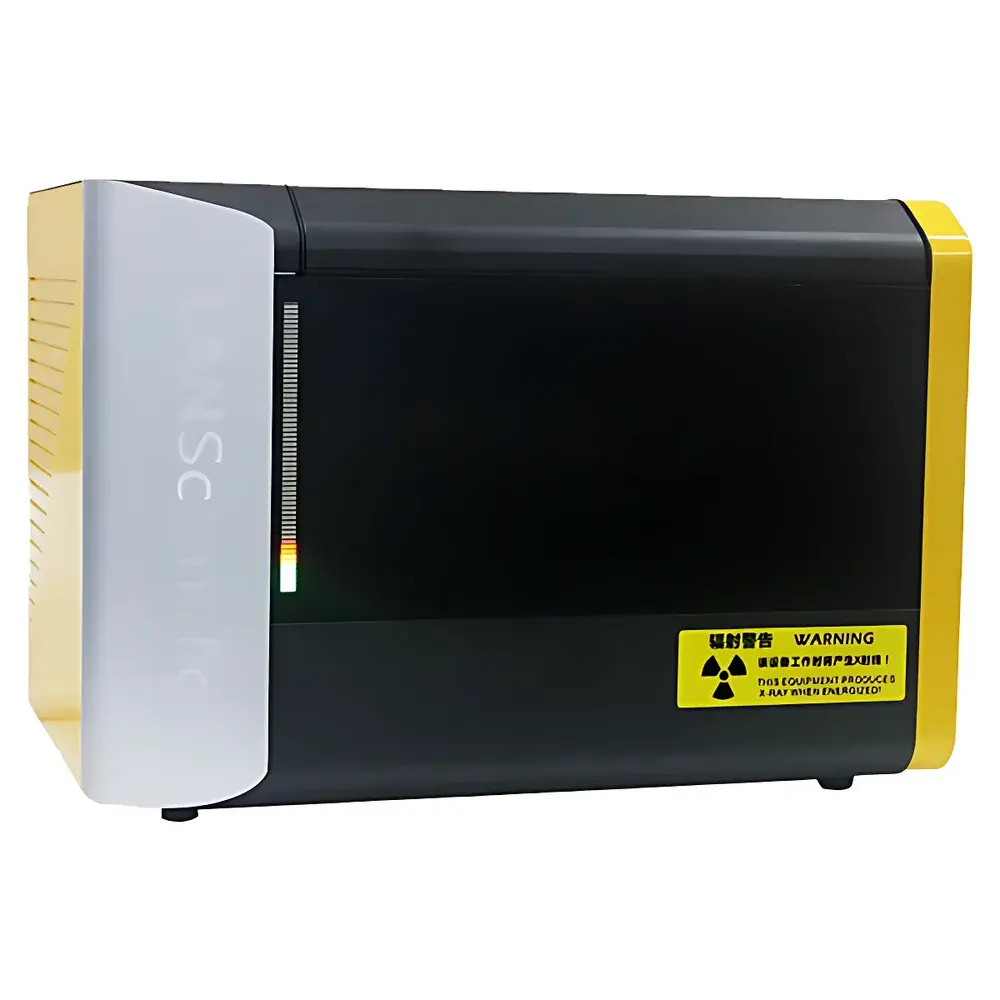
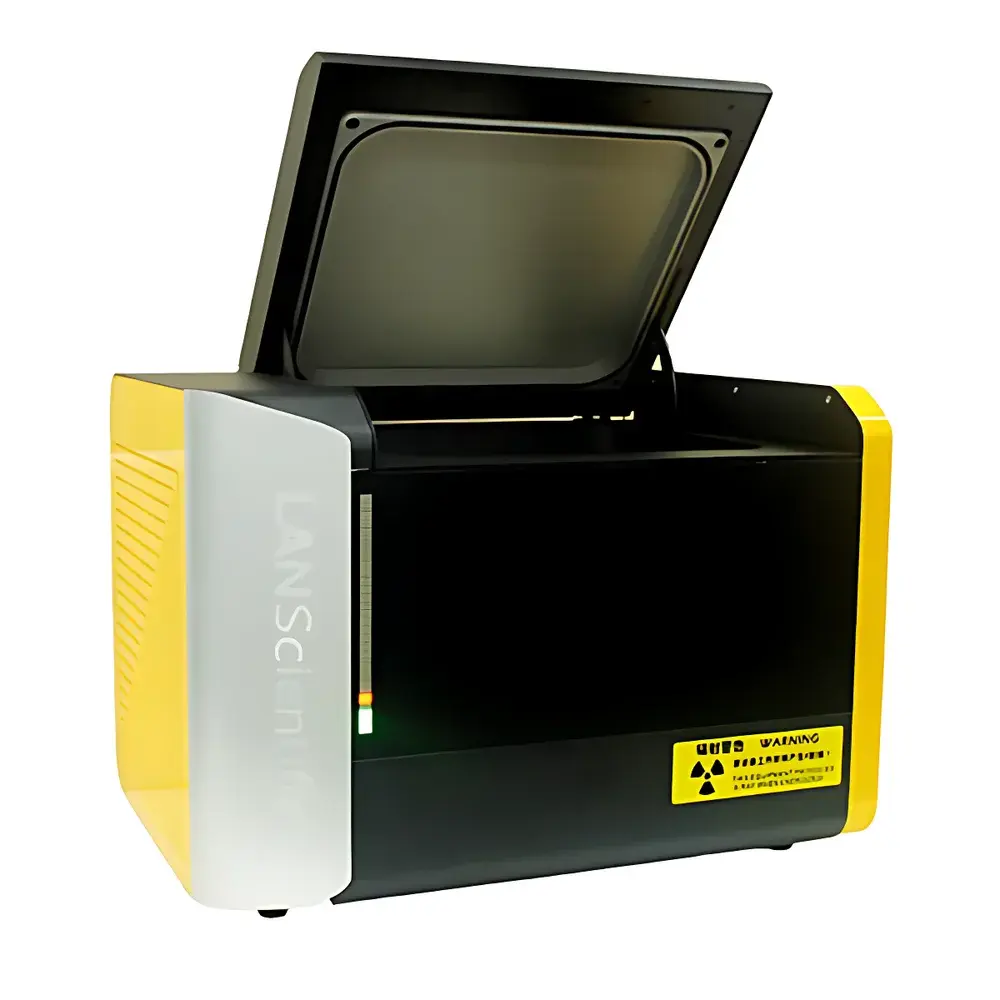
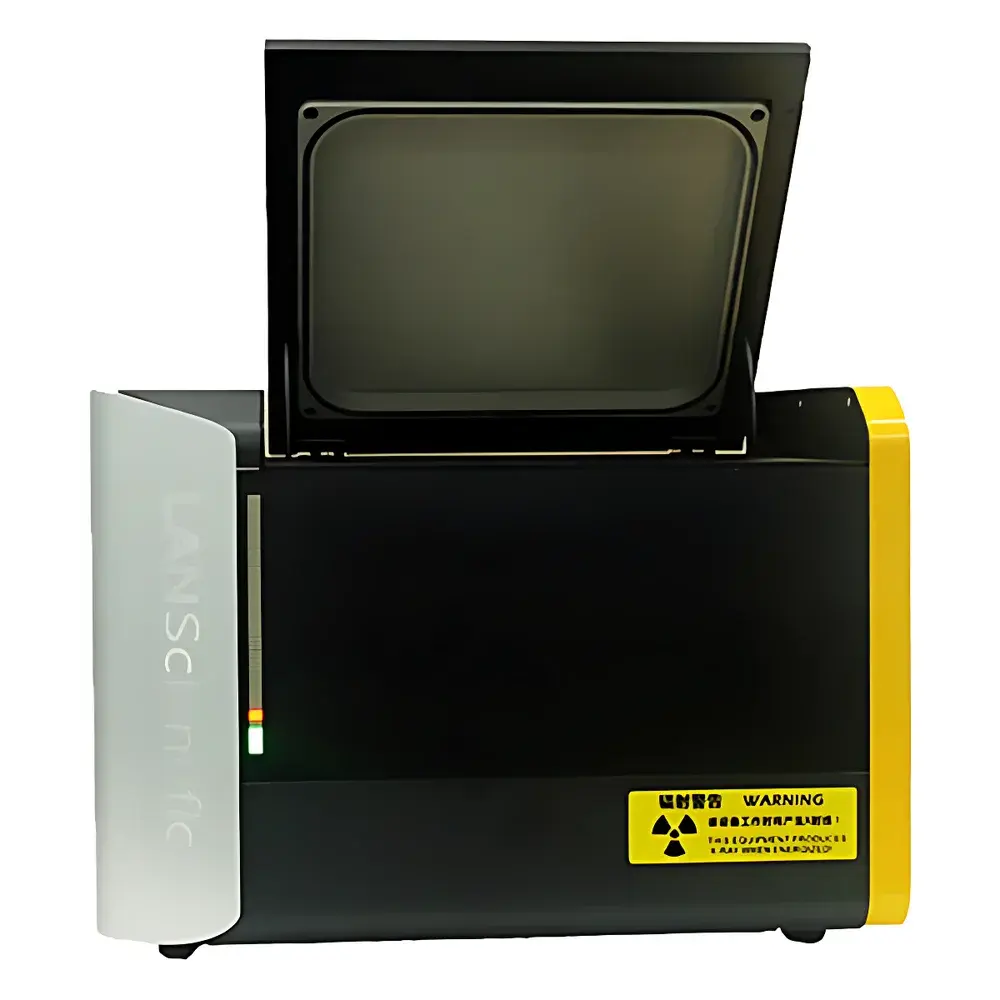
LANScientific ScopeX Desktop Energy Dispersive X-Ray Fluorescence Spectrometer for Aluminum Oxide Powder Analysis
| Brand | LANScientific |
|---|---|
| Origin | Jiangsu, China |
| Manufacturer Type | Direct Manufacturer |
| Origin Category | Domestic |
| Model | ScopeX Al₂O₃ Powder Analyzer |
| Form Factor | Benchtop |
| Instrument Type | Conventional ED-XRF |
| Application Scope | General-Purpose |
| Elemental Range | Na (11) to U (92) |
| Detection Limit | 1 ppm |
| Energy Resolution | <125 eV (Mn Kα) |
| Repeatability | ≤0.1% RSD |
| Detector | Peltier-cooled Silicon Drift Detector (SDD) |
Overview
The LANScientific ScopeX Desktop Energy Dispersive X-Ray Fluorescence (ED-XRF) Spectrometer is an industrial-grade benchtop analyzer engineered for rapid, non-destructive elemental quantification in aluminum oxide (Al₂O₃) powders and related ceramic, metallurgical, and refractory materials. Based on fundamental XRF physics—where primary X-rays eject inner-shell electrons from sample atoms, triggering characteristic fluorescent X-ray emission—the ScopeX delivers trace-to-major-element analysis without chemical digestion or vacuum chamber evacuation. Its optimized excitation geometry, high-efficiency SDD detector, and intelligent vacuum control enable reliable detection of light elements (Na, Mg, Al, Si, P, S) critical to alumina purity assessment, sintering behavior, and phase stability evaluation. Designed for routine QC labs and production environments, the instrument complies with ISO 8258 (control chart principles), ASTM E1621 (standard guide for ED-XRF elemental analysis), and supports GLP/GMP-aligned data integrity through audit-trail-capable software.
Key Features
- High-sensitivity Peltier-cooled Silicon Drift Detector (SDD) with <125 eV energy resolution at Mn Kα—enabling precise peak deconvolution for overlapping transitions (e.g., Al Kα/Kβ, Si Kα, P Kα, S Kα).
- Intelligent dual-mode vacuum system: automatic switching between air, He purge, and high-vacuum modes to optimize light-element sensitivity without manual intervention.
- Motorized multi-aperture collimator turret (5 mm, 3 mm, 1 mm, 0.5 mm) and programmable filter wheel—enabling automated optimization of excitation conditions per sample matrix and target element.
- Fully enclosed lead-shielded housing with interlocked safety door and radiation leakage monitoring—certified to GB18871-2002 (Basic Standards for Radiation Protection) and GBZ115-2002 (X-Ray Fluorescence Analyzers Safety Requirements).
- Benchtop footprint (W×D×H: 420 × 380 × 350 mm) with oversized 120 mm × 100 mm sample chamber—accommodating irregularly shaped powders (in cups or pellets), pressed discs, loose bulk samples, and coated substrates up to 30 mm height.
- Low-power microfocus X-ray tube (50 kV / 1 mA max) with selectable anode material (Rh or Mo)—minimizing Bremsstrahlung background while maximizing characteristic line yield for Al and O-rich matrices.
Sample Compatibility & Compliance
The ScopeX accepts solid powders (as-is or binder-pressed), fused beads, thin films, granules, and slurries in standardized sample cups (32 mm diameter). No sample dissolution or acid digestion is required—preserving stoichiometric integrity and eliminating contamination risk. It meets ISO/IEC 17025:2017 clause 7.2.2 for method validation of non-destructive testing and supports compliance with ISO 21047 (alumina content determination in bauxite and alumina products) and ASTM C702 (sample preparation of ceramic powders). All calibration models are traceable to NIST SRM reference materials (e.g., NIST 2782, 2783, 620). Instrument operation and reporting adhere to FDA 21 CFR Part 11 requirements for electronic records and signatures when configured with password-protected user roles and time-stamped audit logs.
Software & Data Management
Powered by LANScientific’s QuantMaster™ v4.2 software, the ScopeX provides intuitive workflow-driven analysis—from auto-alignment and spectrum acquisition to matrix-matched calibration and statistical reporting. The software includes preloaded methods for Al₂O₃ impurity profiling (Fe, Si, Na, Ca, Ti, Cr), ISO-compliant uncertainty estimation (k=2), and trend analysis across batch sequences. Data export supports CSV, Excel (.xlsx), PDF (with embedded spectra, calibration curves, and QA/QC flags), and XML for LIMS integration. Wireless connectivity via Wi-Fi 5 (802.11ac) and Bluetooth 5.0 enables remote diagnostics and over-the-air firmware updates. USB 3.0 port supports external storage and peripheral HID devices (barcode scanners, digital balances).
Applications
- Quality control of calcined alumina feedstock for catalyst supports, ceramics, and abrasives—quantifying Fe₂O₃, SiO₂, Na₂O, and CaO at ppm levels.
- In-process verification of Bayer process residues and red mud composition to monitor extraction efficiency and environmental compliance.
- Verification of dopant homogeneity (e.g., Cr³⁺ in ruby crystals, Ti⁴⁺ in sapphire) in single-crystal growth facilities.
- RoHS-compliant screening of heavy metals (Pb, Cd, Hg, Cr⁶⁺, Br) in recycled alumina-based packaging and electronics substrates.
- Research-grade elemental mapping of cross-sectioned Al₂O₃ composites using optional motorized XYZ stage (add-on).
- Refinery catalyst monitoring—tracking Ni, V, and S accumulation on spent alumina-supported hydroprocessing catalysts.
FAQ
Does the ScopeX require liquid nitrogen cooling for the detector?
No. It uses a thermoelectric Peltier cooler integrated into the SDD assembly, eliminating cryogenic handling, refills, and associated downtime.
Can it analyze oxygen content directly in Al₂O₃?
While O Kα (525 eV) falls within its detectable range, quantitative oxygen analysis requires rigorous matrix correction and certified O-containing reference standards; it is recommended for semi-quantitative screening only.
Is spectral deconvolution automated for overlapping peaks like Al Kα and Si Kα?
Yes. QuantMaster™ employs iterative least-squares fitting with fundamental parameter (FP) modeling and empirical peak shape libraries to resolve complex overlaps in alumina-silica systems.
What sample preparation is needed for loose powder analysis?
Powders should be homogenized and loaded into standard 32-mm polyethylene or Mylar-backed cups; optional hydraulic press (LAN-HP20) available for reproducible pellet density control.
How is calibration maintained across long-term operation?
The system supports daily drift correction using built-in reference foils and scheduled recalibration against CRM sets—logs all corrections in the audit trail per ISO/IEC 17025 requirements.





