
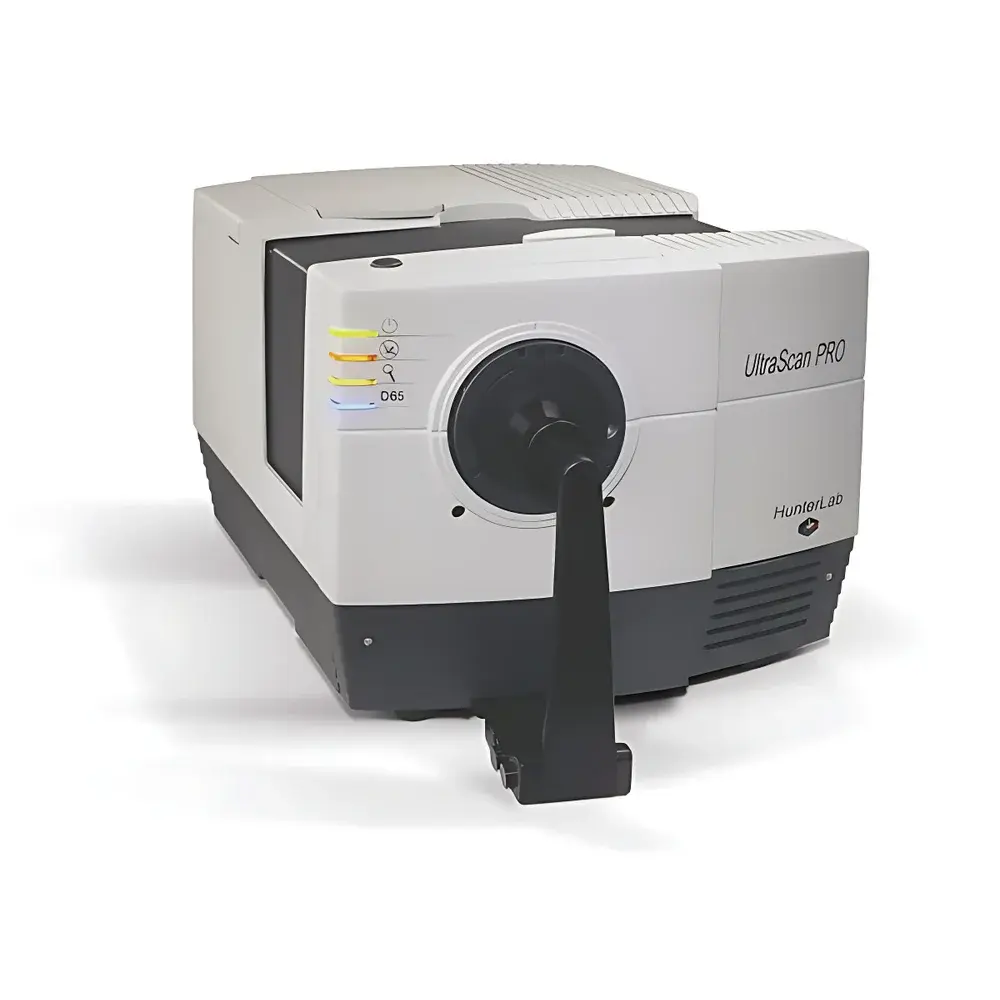
HunterLab UltraScan PRO Color Difference Meter
| Brand | HunterLab |
|---|---|
| Origin | USA |
| Model | UltraScan PRO |
| Instrument Type | Benchtop |
| Optical Geometry | d/8° integrating sphere |
| Light Source | Pulsed Xenon Lamp |
| Spectral Range | 350–1050 nm |
| Wavelength Reporting Interval | 5 nm |
| Spectral Resolution | <2 nm (1.37 nm) |
| Wavelength Accuracy | ±0.1 nm |
| Photometric Range | 0–200% |
| Photometric Repeatability | 0.03 ΔE*ab (std dev) |
| Measurement Time | ≤2 s |
| Aperture Options | 19 mm (LAV), 9 mm (MAV), 4 mm (SAV) |
| Compliance | CIE, ASTM E308, ASTM D2244, ASTM D6290, DIN 5033, JIS Z 8722, USP <1061>, FDA 21 CFR Part 11 (with EasyMatch-QC software) |
Overview
The HunterLab UltraScan PRO is a high-precision benchtop color measurement instrument engineered for rigorous spectral color analysis across the ultraviolet, visible, and near-infrared (UV-VIS-NIR) spectrum (350–1050 nm). Unlike conventional colorimeters limited to the visible range, the UltraScan PRO employs a dual-beam, dual-grating optical architecture with a 15.2 cm (6″) Spectraflect-coated integrating sphere and pulsed xenon illumination—enabling full-spectrum calibration and stable D65 illumination simulation without thermal drift. Its optical geometry conforms to CIE d/8° (diffuse/8°) with specular component included or excluded via motorized baffle, ensuring compliance with ISO 7724-1, ASTM E1164, and JIS Z 8722 for both reflectance and transmittance measurements. Designed specifically for demanding applications in synthetic fiber quality control—including spandex (elastane), polyester blends, and functional textiles—the instrument delivers traceable, reproducible color data essential for R&D, QC, and regulatory submissions in pharmaceuticals, coatings, plastics, and textile manufacturing.
Key Features
- Dual-beam, dual-grating spectrophotometer architecture for enhanced photometric stability and long-term wavelength fidelity
- Ultra-wide spectral coverage from 350 nm to 1050 nm—enabling quantification of UV-absorbing additives, NIR-responsive dyes, and metamerism in elastomeric materials
- Pulsed xenon lamp system with three independent flash channels; eliminates lamp aging effects and enables consistent D65 simulation across the full spectral range
- High-resolution detection: 512-element silicon photodiode array with effective bandwidth of 5 nm and spectral resolution <2 nm (1.37 nm FWHM)
- Three selectable measurement apertures (4 mm SAV, 9 mm MAV, 19 mm LAV) optimized for small yarn samples, fabric swatches, and bulk polymer pellets
- Large transmittance compartment accommodating up to 80 mm path-length cuvettes; ideal for liquid dyes, masterbatches, and solution-based colorants
- Integrated status LEDs and top-mounted trigger button for rapid, hands-free operation in production environments
- Comprehensive photometric range (0–200%) with 0.003% photometric resolution and repeatability of ≤0.03 ΔE*ab (10 readings on white tile)
Sample Compatibility & Compliance
The UltraScan PRO supports diverse sample forms—including opaque solids, translucent films, woven/nonwoven textiles, spun fibers, liquids, and powders—without requiring external accessories for standard configurations. Its d/8° geometry with automatic SCI/SCE mode switching ensures accurate assessment of surface texture effects critical for spandex filament evaluation and dye uptake uniformity. The instrument meets international standards for color measurement: CIE No. 15, ISO 7724-1/2/3, ASTM D2244 (color difference), ASTM D6290 (instrumental whiteness), ASTM E308 (computing tristimulus values), and USP for pharmaceutical excipient color qualification. When paired with HunterLab EasyMatch-QC software configured for audit trail and electronic signatures, the system satisfies FDA 21 CFR Part 11 requirements for regulated industries.
Software & Data Management
HunterLab EasyMatch-QC is the native color management platform supporting real-time pass/fail evaluation, statistical process control (SPC), tolerance mapping (ellipsoidal or rectangular), and multi-instrument network synchronization. It provides built-in calculation modules for yellowness index (ASTM E313), whiteness (CIE/ASTM E313/Ganz), APHA/Pt-Co/Hazen, Gardner, Saybolt, haze (ASTM D1003), opacity, total transmittance/reflectance, K/S ratio (Kubelka-Munk), metamerism index, and遮盖率 (hiding power) per ASTM D2805. All spectral data are stored in vendor-neutral CSV and XML formats. The software supports GLP/GMP-compliant workflows including user access levels, method locking, electronic signatures, and full audit trail generation for IQ/OQ/PQ documentation.
Applications
- Color consistency validation of spandex (elastane) filaments, yarns, and finished fabrics under UV-VIS-NIR illumination
- Quantitative assessment of dye migration, thermal yellowing, and photochemical degradation in polyurethane-based fibers
- Batch-to-batch comparison of pigment-loaded masterbatches used in synthetic fiber extrusion
- Whiteness and yellowness monitoring of optical brightener-treated textiles per ISO 105-Z08 and AATCC TM110
- APHA/Pt-Co color grading of solvent carriers and polymerization media in fiber manufacturing
- Transmittance profiling of clear elastomeric coatings and medical-grade tubing materials
- Metamerism screening for automotive interior textiles exposed to varying light sources (D65, A, F2)
FAQ
Does the UltraScan PRO support measurement of spandex-specific color metrics such as thermal yellowing index (TYI)?
Yes. TYI is calculated directly within EasyMatch-QC using ASTM D6869 methodology, leveraging spectral data from 350–400 nm to quantify UV-induced chromophore formation in polyurethane-based elastomers.
Can the instrument measure color through transparent packaging films commonly used for spandex storage?
Yes—using the transmittance mode with motorized port alignment and optional film holder, provided the film exhibits minimal scattering and >85% transmittance in the 400–700 nm range.
Is NIST-traceable calibration available for the UltraScan PRO?
Yes. HunterLab provides factory-calibrated ceramic tiles (including NIST SRM 2020a) and annual recalibration services with documented uncertainty budgets per ISO/IEC 17025.
How does the dual-beam design improve measurement robustness in high-volume QC labs?
By continuously referencing the light source against a stable internal reference channel, the dual-beam architecture compensates for lamp intensity fluctuations, detector drift, and ambient temperature shifts—reducing the need for frequent zero/white calibrations.
What spectral data export options are supported for integration into LIMS or MES systems?
CSV, XML, and HDF5 formats are natively supported; API-driven data push via TCP/IP or RESTful interface is available through EasyMatch-QC Enterprise Edition.





