
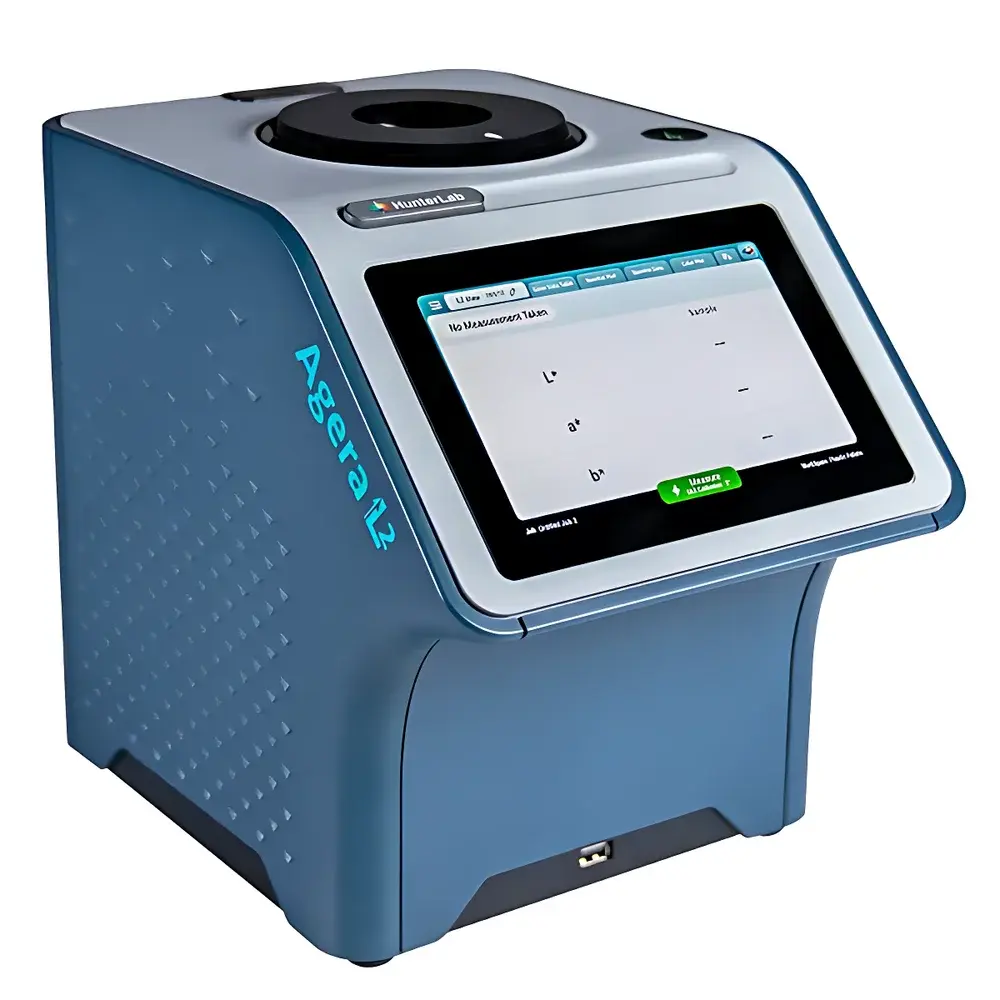
HunterLab Agera L2 Benchtop Spectrophotometric Color Difference Meter
| Brand | HunterLab |
|---|---|
| Origin | USA |
| Model | Agera L2 |
| Instrument Type | Benchtop |
| Optical Geometry | 45/0° |
| Light Source | Full-spectrum balanced LED array |
| Spectral Range | 400 nm – 700 nm |
| Repeatability | ΔE*₀₀ ≤ 0.03 |
| Sample Viewing Area | 30 mm diameter (up to 16× larger than standard 10–15 mm apertures) |
| Integrated Functionality | Simultaneous color + 60° gloss measurement |
| Imaging Capability | Built-in high-resolution sample imaging with real-time alignment verification |
| Compliance | Designed for ISO 11664, CIE No. 15, ASTM E308, ASTM D2244, and ISO 2813 |
Overview
The HunterLab Agera L₂ is a benchtop spectrophotometric color difference meter engineered for metrological rigor in industrial color quality control. It operates on the principle of diffuse reflectance spectroscopy under controlled 45/0° illumination geometry—where light is directed onto the sample at 45° from the normal, and the detector collects reflected radiation at 0° (normal incidence). This optical configuration minimizes directional bias from surface texture and ensures high correlation with human visual assessment under standardized D65 illuminant conditions. Unlike tristimulus meters, the Agera L₂ acquires full spectral data across the visible range (400–700 nm) using a thermally stabilized, balanced LED array that replicates the spectral power distribution of CIE Standard Illuminant D65 without UV or IR contamination. Its core innovation—“Visual Truth” technology—integrates CIE 1931 2° standard observer functions with modern spectral reconstruction algorithms to deliver ΔE*₀₀ values with ≤0.03 repeatability, validated per ASTM D2244 and ISO 11664-4.
Key Features
- Large-area 30 mm aperture: Provides up to 16× greater sampling area than conventional 10–15 mm instruments, significantly improving statistical representativeness for textured, patterned, or anisotropic surfaces such as woven textiles, embossed plastics, and matte-finish coatings.
- Integrated high-resolution imaging system: Captures true-color, macro-scale sample images before each measurement; supports real-time visual alignment verification and post-acquisition traceability of sample positioning, batch ID, and operator metadata.
- Simultaneous color and 60° gloss measurement: Delivers CIELAB (L*, a*, b*), ΔE*₀₀, and gloss units (GU) in a single acquisition cycle—eliminating sequential instrument repositioning and reducing inter-measurement variability.
- Thermally stabilized LED illumination: Ensures long-term spectral stability and eliminates lamp aging drift; no warm-up time required between measurements.
- Rugged benchtop architecture: Designed for continuous operation in QC laboratories and production environments compliant with IEC 61326-1 (EMC) and IEC 61010-1 (safety).
Sample Compatibility & Compliance
The Agera L₂ accommodates opaque, translucent, and low-reflectance materials—including plastic pellets, recycled polymer flakes, security films, retroreflective sheeting, pharmaceutical tablets, and coated paperboard—with reliable performance down to 20% diffuse reflectance. Its 45/0° geometry conforms to ISO 2813 for gloss measurement and ASTM D523 for specular gloss evaluation at 60°. For color assessment, it meets the requirements of ISO 11664 (CIE colorimetry standards), ASTM E308 (computation of color coordinates), and USP for pharmaceutical packaging color consistency. Data integrity is maintained through GLP/GMP-aligned audit trails, including timestamped image capture, user authentication logs, and instrument calibration history—all exportable in CSV, XML, or PDF/A-2 format.
Software & Data Management
The instrument is fully supported by HunterLab’s EasyMatch QC software (v5.0+), which provides configurable pass/fail tolerancing, multi-instrument fleet management, and automated report generation compliant with FDA 21 CFR Part 11 (electronic signatures, audit trail, data integrity controls). All spectral scans, CIELAB values, gloss readings, and aligned sample images are stored in a relational database with hierarchical folder structure, supporting version-controlled SOP enforcement and cross-shift comparison. Raw spectral data (.qtx files) are retained for retrospective analysis, spectral derivative computation, and metamerism index calculation per CIE TN 006.
Applications
The Agera L₂ serves critical color assurance workflows across regulated and high-volume manufacturing sectors: incoming raw material inspection for polymer resin batches; in-process color verification during extrusion and injection molding; final product release testing for food-grade packaging and medical device housings; batch-to-batch matching of safety-critical retroreflective materials (e.g., ASTM D4956 Class I–III); and stability monitoring of light-sensitive formulations in pharmaceutical and cosmetic R&D. Its large aperture and imaging capability make it especially valuable for heterogeneous samples—such as flake-based recyclates or laminated composites—where spatial averaging is essential for representative characterization.
FAQ
What does “45/0° geometry” mean for color measurement accuracy?
It refers to a fixed-angle illumination/detection configuration that isolates diffuse reflectance while suppressing directional effects from surface roughness or grain orientation—critical for correlating instrumental data with visual assessment under D65 lighting.
Can the Agera L₂ measure transparent or translucent samples?
No—it is optimized for opaque and semi-opaque reflective surfaces; transmission mode or d/8° sphere instruments are recommended for clear films or liquids.
Is calibration traceable to NIST standards?
Yes—each unit ships with a factory-calibrated ceramic tile certified against NIST SRM 2021, and optional annual recalibration services include NIST-traceable documentation.
Does the software support multi-language UI and localized reporting?
EasyMatch QC offers English, German, French, Spanish, Japanese, and Simplified Chinese interfaces, with customizable report templates adhering to regional regulatory formatting (e.g., EU Annex 11, China GMP Chapter 5).
How is data security managed for regulated environments?
Role-based access control, encrypted local database storage, electronic signature workflows, and immutable audit logs meet ALCOA+ principles and are validated per IQ/OQ protocols for GxP deployment.



