
SD-160 Ion Sputter Coater
| Origin | Beijing, China |
|---|---|
| Manufacturer Type | Distributor |
| Origin Category | Domestic |
| Model | SD-160 |
| Price Range | USD 1,400 – 7,200 (est.) |
| Target Materials (Standard) | Au |
| Optional | Ag, Pt |
| Target Dimensions | 50 mm × 0.1 mm |
| Control Mode | Manual |
| Chamber Dimensions | Ø150 mm × H120 mm |
| Sample Stage Diameter | 70 mm |
| Sputtering Gases | Ar, N₂, O₂ |
| Max Sputtering Current | 30 mA (rated), 50 mA (peak) |
| Sputtering Rate | >4 nm/min (Au on Si under standard Ar conditions) |
| Input Power | 220 V AC, 50 Hz (110 V option available) |
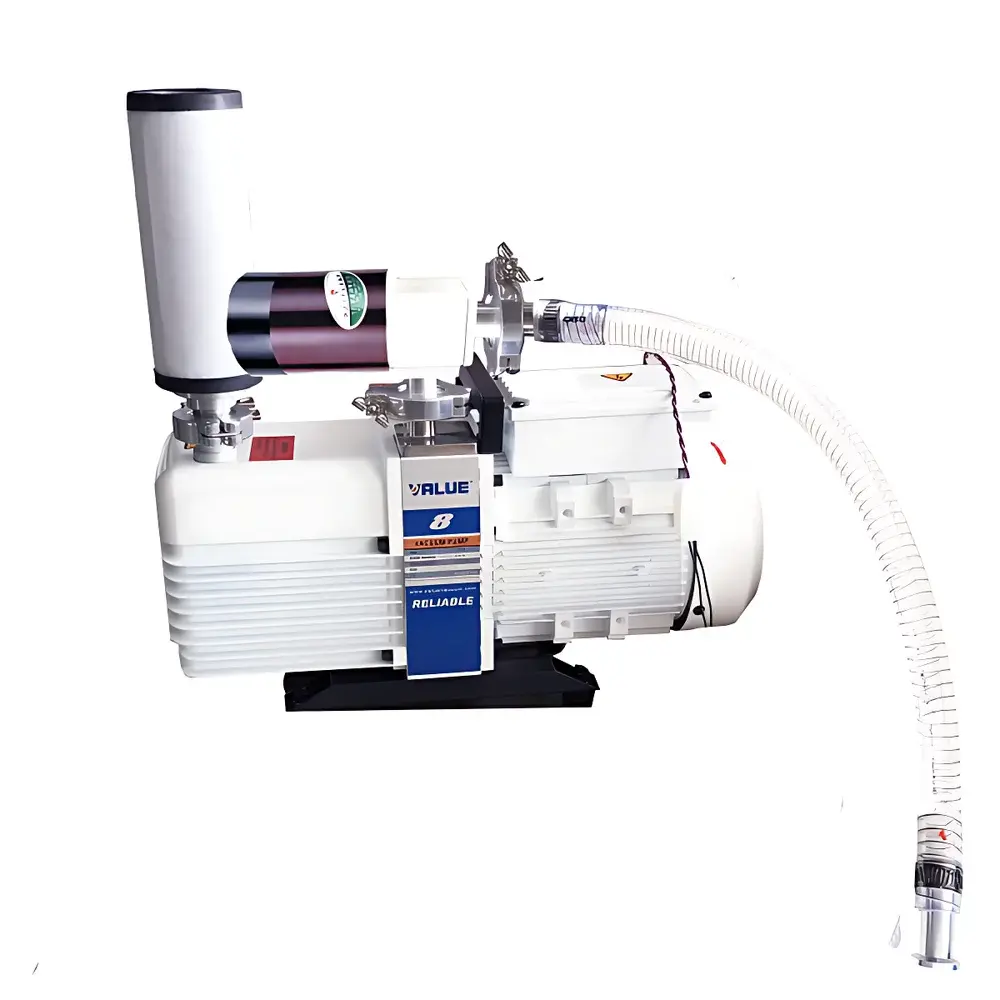
| Vacuum Pump | High-performance two-stage rotary vane pump (integrated) |
Overview
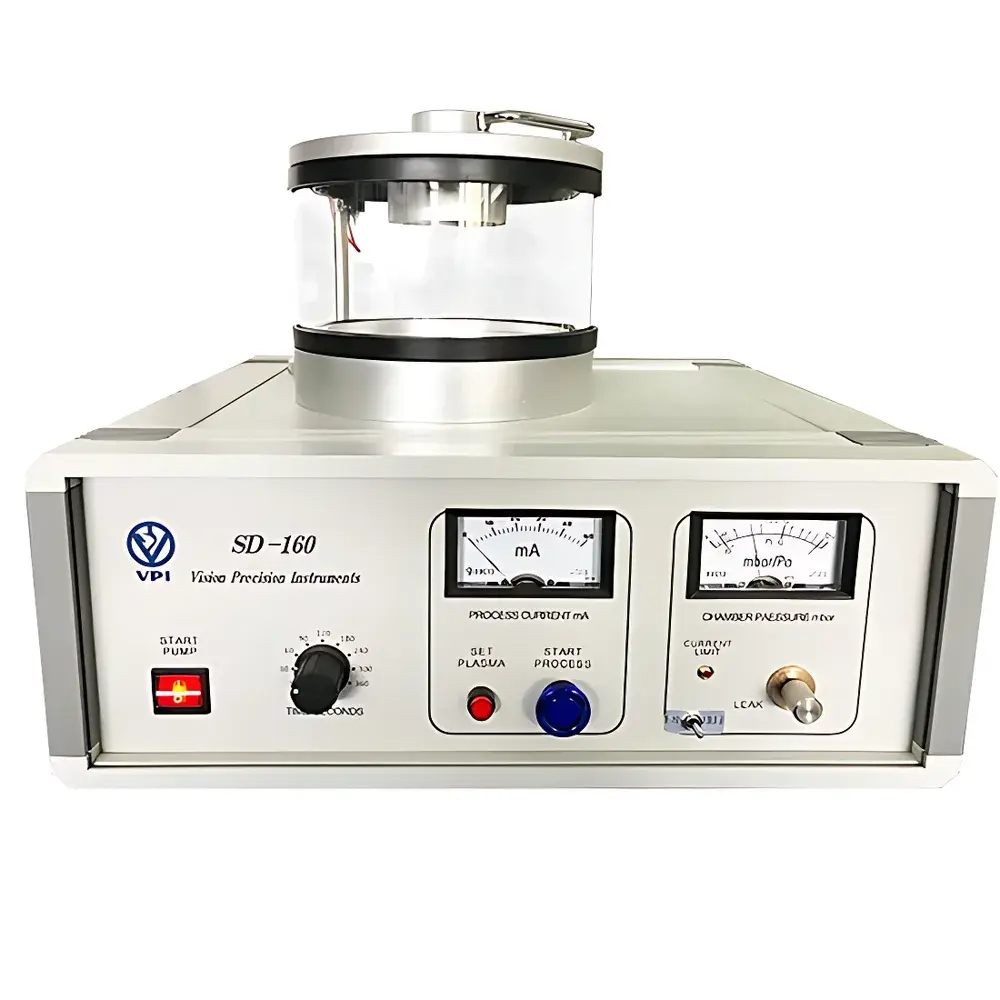
The SD-160 Ion Sputter Coater is a manually operated, direct-current (DC) diode sputtering system engineered for reliable, reproducible conductive thin-film deposition on non-conductive or beam-sensitive specimens prior to scanning electron microscopy (SEM) analysis. Based on fundamental DC magnetron sputtering physics—where energetic argon ions, accelerated in a cathode-anode electric field, bombard a metallic target to eject atoms that subsequently condense as a uniform nanoscale film—the SD-160 delivers controlled, low-damage metallization without requiring complex plasma ignition protocols or RF matching networks. Its design emphasizes operational stability and vacuum integrity: a large-volume cylindrical chamber (Ø150 mm × 120 mm H) ensures homogeneous gas distribution and minimizes edge effects during deposition, while the ceramic-sealed high-voltage feedthrough eliminates elastomer degradation common in long-term use. The integrated dual-gas control system enables precise selection and blending of inert (Ar) and reactive (N₂, O₂) sputtering atmospheres—critical for tailoring film stoichiometry in electrode fabrication or oxide layer formation.
Key Features
- Robust diode DC sputtering architecture with manual current regulation (0–30 mA typical, up to 50 mA peak) and real-time current monitoring via analog meter
- Large-diameter sample chamber (Ø150 mm) and 70 mm rotating sample stage—accommodates standard SEM stubs (Ø25 mm, Ø32 mm, Ø50 mm) and custom substrates up to Ø70 mm
- Dual independent gas inlet lines with high-stability solenoid valves for Ar, N₂, and O₂—enabling sequential or mixed-gas sputtering protocols
- Vacuum system featuring a high-efficiency two-stage rotary vane pump capable of reaching base pressures <5 × 10⁻² Pa (<3.8 × 10⁻⁴ Torr) within ≤90 seconds
- Optimized target geometry: 50 mm × 0.1 mm gold foil target (standard); interchangeable Ag, Pt, and other conductive targets supported via standardized mounting interface
- Integrated timer (0–300 s, ±1 s resolution) and miniature vacuum isolation valve for process repeatability and chamber venting control
- Reinforced borosilicate glass bell jar with proprietary edge-sealing rubber gasket—designed to prevent microfractures (“chipping”) during repeated thermal cycling and mechanical handling
Sample Compatibility & Compliance
The SD-160 supports a broad spectrum of beam-sensitive and insulating specimens including biological tissues (e.g., plant cuticles, insect exoskeletons), polymers (PET, PMMA, PDMS), ceramics, glasses, and geological sections. Its low-energy sputtering regime (≤30 mA at 2–4 kV) minimizes subsurface heating and ion implantation damage—essential for preserving ultrastructural fidelity in cryo-SEM workflows. All internal wetted surfaces are stainless steel or anodized aluminum, ensuring compatibility with ISO 14644-1 Class 5 cleanroom environments when installed with appropriate exhaust filtration. While the SD-160 itself does not carry CE or UL certification, its electrical architecture complies with IEC 61010-1 safety requirements for laboratory equipment when operated within specified voltage (220 V AC ±10%, 50 Hz) and grounding conditions. For GLP/GMP-regulated labs, optional audit-trail-capable digital controllers (not included in base configuration) may be retrofitted to support 21 CFR Part 11-compliant data logging.
Software & Data Management
The SD-160 operates via fully manual controls—no embedded firmware or software interface is provided in the standard configuration. Process parameters (sputtering time, gas type, current setting, chamber pressure) must be recorded externally by the operator. This analog design ensures electromagnetic immunity in high-field EM facilities and eliminates firmware obsolescence risks. For laboratories requiring traceable process documentation, third-party USB-connected vacuum gauges (e.g., MKS Baratron series) and programmable power supplies can be integrated via external relay control—enabling CSV-exported logs aligned with ASTM E2719-19 guidelines for SEM sample preparation validation.
Applications
- Routine SEM sample preparation: Au or Pt coating of non-conductive specimens to suppress charging artifacts and enhance secondary electron yield
- Electrode fabrication for electrochemical testing: Controlled deposition of Ag or Pt films onto carbon substrates or polymer electrolytes
- TEM grid enhancement: Ultra-thin conductive layers on holey carbon films to improve beam stability during high-resolution imaging
- Materials science research: Reactive sputtering of metal nitrides (TiN, CrN) or oxides (ITO, NiO) using N₂/O₂ admixtures for functional thin-film studies
- Archaeometric and paleontological analysis: Low-damage metallization of fragile fossilized organic remains without carbonization or topographic distortion
FAQ
What vacuum level is required before initiating sputtering?
A base pressure ≤5 × 10⁻² Pa is recommended to minimize residual gas contamination and ensure stable plasma ignition.
Can the SD-160 deposit non-metallic films such as SiO₂ or Al₂O₃?
No—this is a DC diode sputter coater optimized for conductive targets only; RF or reactive sputtering capability is not supported.
Is rotation of the sample stage motorized?
No—the stage is manually rotatable but lacks powered rotation; uniformity relies on chamber geometry and gas flow symmetry.
What maintenance intervals are recommended for the vacuum pump?
Oil change every 200 operating hours; full pump inspection annually or after 1,000 hours—per manufacturer specifications for the integrated rotary vane unit.
Does the SD-160 meet ISO/IEC 17025 requirements for accredited testing labs?
The instrument itself is not certified, but its performance characteristics (repeatability ±3% film thickness over 10 consecutive runs, verified by quartz crystal microbalance or AFM step-height measurement) support method validation per ISO/IEC 17025 Clause 7.2.2.



