
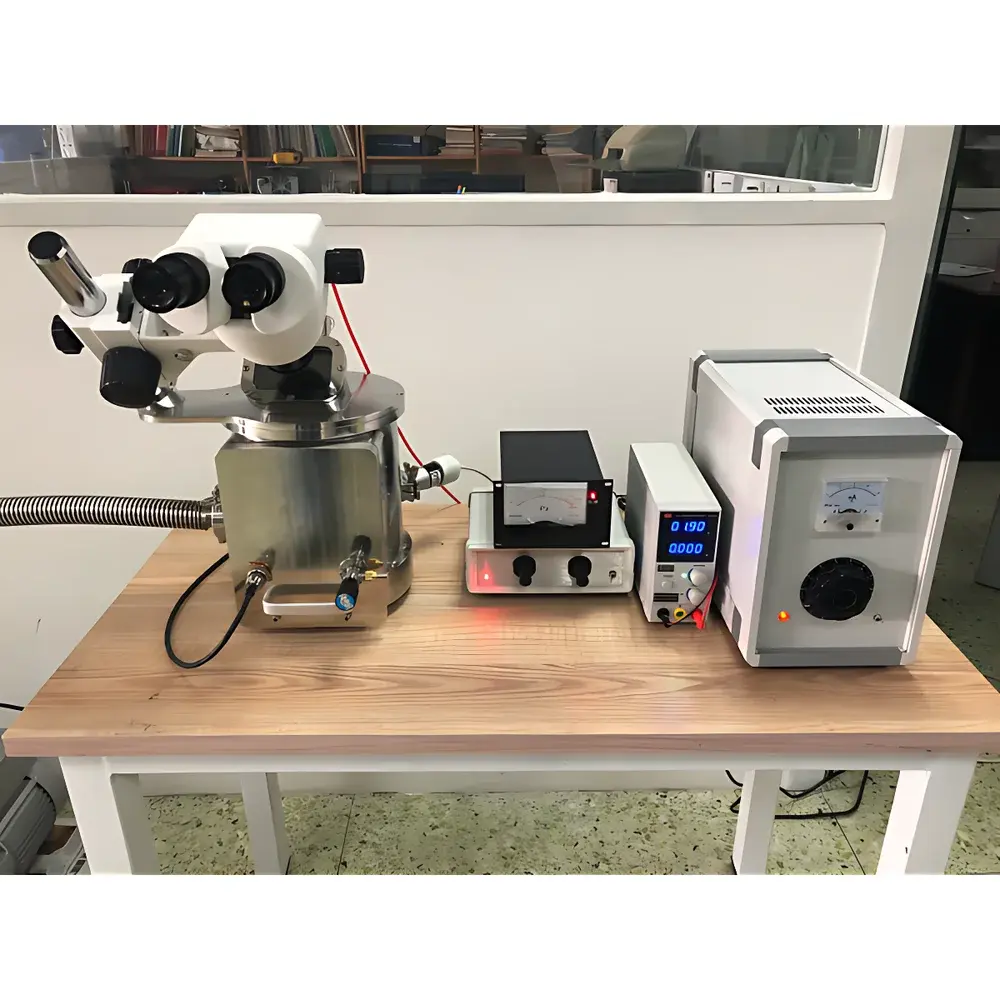
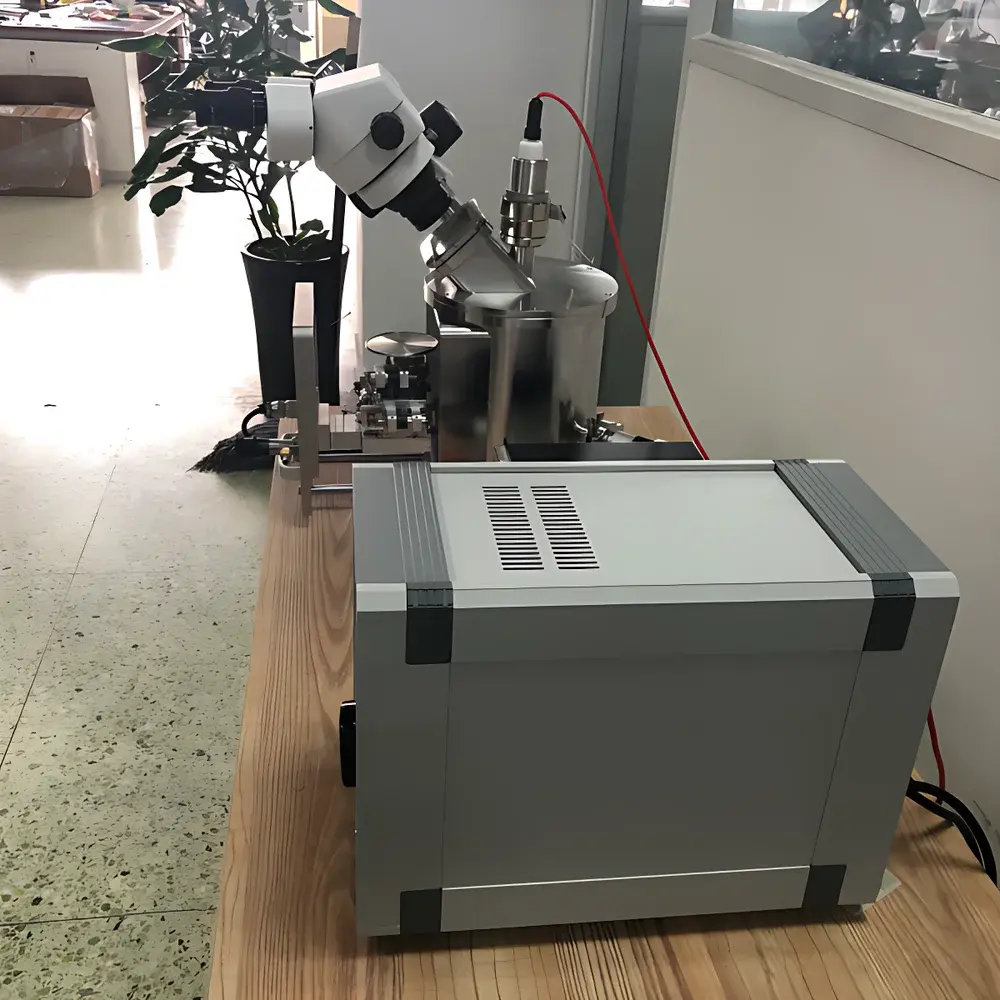
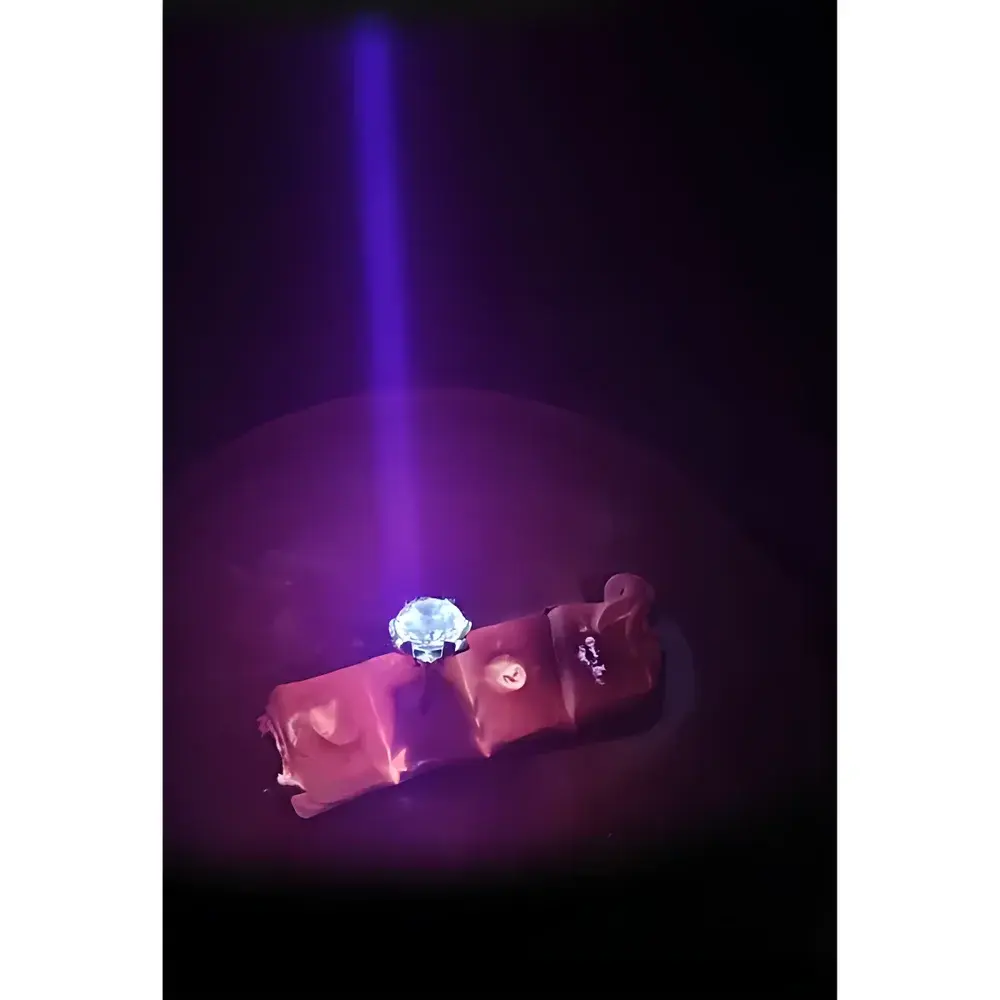
VPI YB-ST5000 Cathodoluminescence Imaging System for Gemological Identification and Geological Microanalysis
| Brand | VPI (Boyuan Micronano) |
|---|---|
| Origin | Beijing, China |
| Manufacturer Type | Authorized Distributor |
| Country of Origin | China |
| Model | YB-ST5000 |
| Power Input | 220 V, 50 Hz, 1000 W |
| High Voltage Supply | -30 kV, max. -3 mA |
| Electron Gun | Cold-cathode type with beam focusing control |
| Minimum Beam Spot Diameter | ≤1 mm |
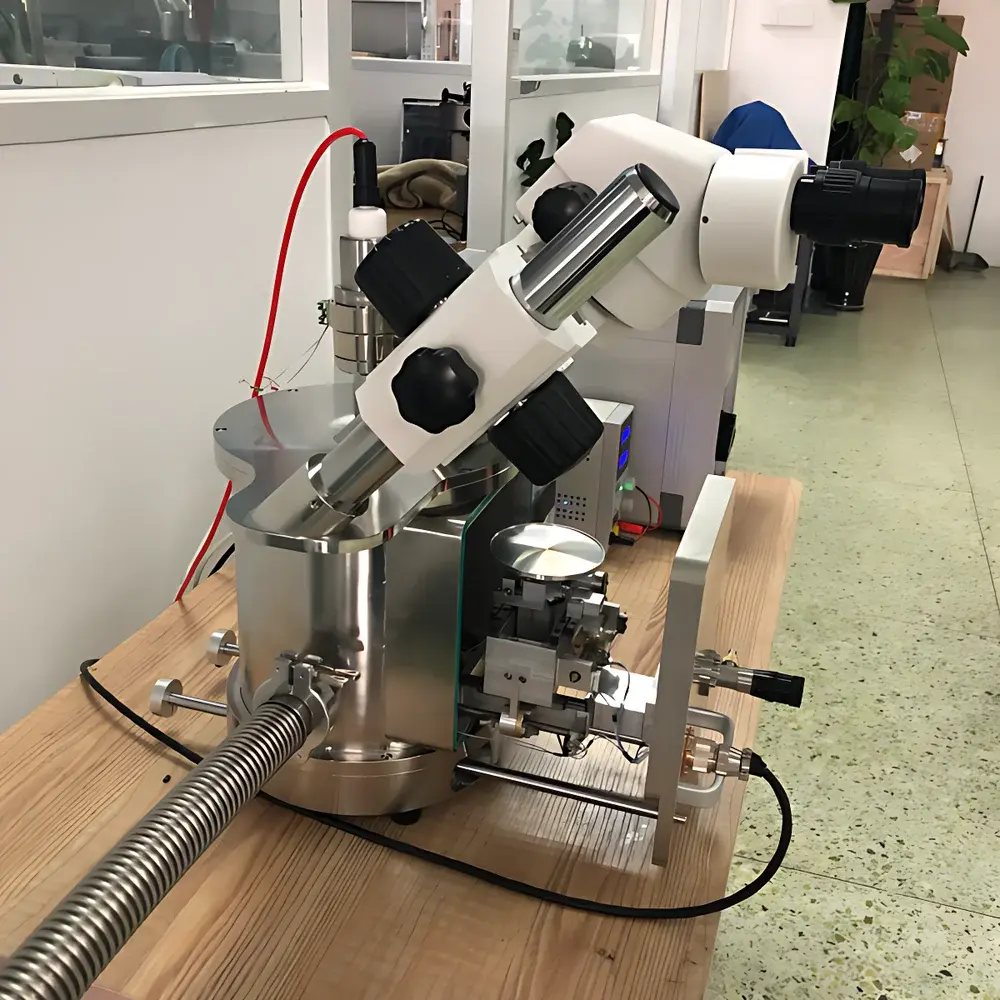
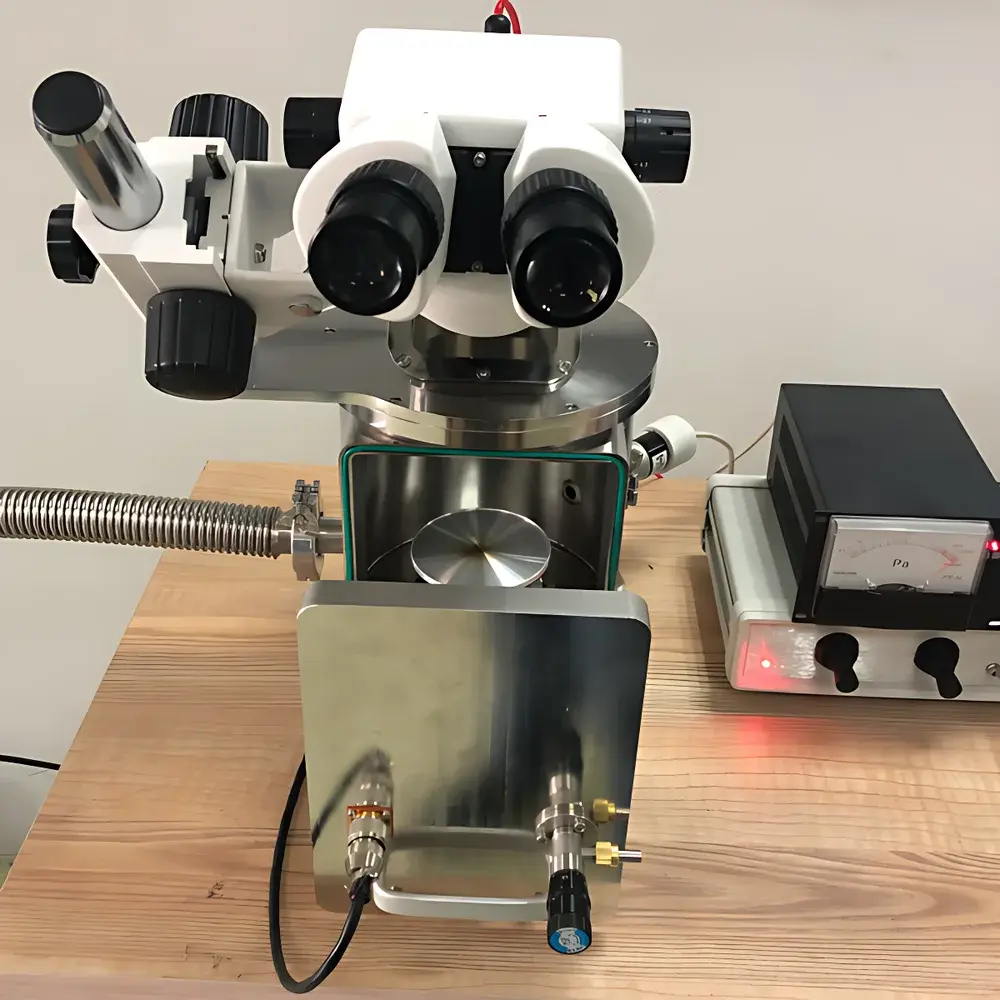
| Sample Chamber | Stainless-steel cylindrical chamber (≥180 mm diameter, ≥150 mm depth) with motorized XYZ stage (±30 mm lateral, 0–50 mm vertical, 360° rotation) |
| Observation Window | Lead-glass viewport with optional trinocular stereo microscope (10×–80×), camera port included |
| Vacuum System | Rotary vane pump (2 L/min) with CCD-based vacuum monitoring |
| Control PC | HP 280 Pro G4 MT (Intel Core i7, 8 GB RAM, 2 GB discrete GPU, 2 TB HDD, 21.5″ display, Windows 7) |
Overview
The VPI YB-ST5000 Cathodoluminescence (CL) Imaging System is a benchtop electron-beam–induced luminescence platform engineered for high-spatial-resolution microstructural and compositional analysis of insulating and semiconducting materials. Operating on the principle of cathodoluminescence—where incident electrons from a cold-cathode gun excite lattice-bound electrons in a vacuum environment, resulting in photon emission upon radiative recombination—the system enables non-destructive, sub-millimeter-scale mapping of luminescent response across geological specimens, gemstones, ceramics, and functional thin films. Unlike optical microscopy or conventional photoluminescence setups, CL provides direct correlation between crystallographic defects, trace-element distribution, strain fields, and band-edge transitions—making it indispensable for provenance studies of natural gemstones, diagenetic history reconstruction in sedimentary rocks, and quality assessment of synthetic crystalline materials.
Key Features
- Cold-cathode electron gun with digitally controlled beam focusing: Enables stable, low-noise excitation without filament replacement or thermal drift, supporting long-duration acquisition sessions.
- Adjustable beam spot size (≤1 mm minimum): Facilitates targeted excitation of micro-domains such as growth zonations in quartz, twinning boundaries in calcite, or inclusion-rich regions in corundum.
- Large-diameter stainless-steel sample chamber (≥180 mm × ≥150 mm): Accommodates bulk rock slabs, polished thin sections (standard 26 mm × 46 mm), and irregularly shaped gem roughs without sectioning.
- Fully motorized XYZ sample stage with continuous 360° rotation: Allows multi-angle CL imaging, tilt-series acquisition, and automated mosaic stitching for extended-field-of-view characterization.
- Dual-mode observation: Integrated lead-glass viewport enables real-time visual alignment; optional trinocular stereo microscope (10×–80×) supports high-fidelity documentation of luminescence patterns and spatial heterogeneity.
- Vacuum architecture with rotary vane pump and CCD-based pressure monitoring: Maintains operational vacuum levels suitable for stable CL signal generation (typically 10⁻²–10⁻¹ mbar range) while providing visual feedback for process validation.
Sample Compatibility & Compliance
The YB-ST5000 accepts electrically insulating and moderately conductive samples—including silicates, carbonates, phosphates, oxides, and nitrides—without mandatory metal coating, provided surface charging is mitigated via low-beam-current operation or charge compensation techniques. It complies with IEC 61000-6-3 (EMC emissions) and IEC 61010-1 (safety requirements for electrical equipment for measurement, control, and laboratory use). While not certified to GLP or FDA 21 CFR Part 11 out-of-the-box, its hardware architecture supports audit-trail-capable software upgrades and metadata-rich image export (TIFF + XML sidecar files), facilitating integration into ISO/IEC 17025-accredited geological testing laboratories.
Software & Data Management
Control and acquisition are managed via a dedicated Windows 7–based application suite running on the integrated HP workstation. The software provides real-time CL intensity histogramming, RGB false-color mapping, region-of-interest (ROI) spectral profiling (when coupled with optional spectrometer modules), and time-resolved acquisition modes. All images retain embedded acquisition metadata (beam voltage, current, dwell time, stage coordinates, vacuum status). Export formats include 16-bit TIFF, CSV-intensity matrices, and standardized OME-TIFF for interoperability with open-source platforms such as Fiji/ImageJ and commercial packages like Thermo Scientific Avizo.
Applications
- Geological provenance & diagenesis: Differentiation of hydrothermal vs. metamorphic quartz based on Al–Ti CL signatures; identification of authigenic overgrowths in sandstone cements.
- Gemological identification: Discrimination of natural vs. synthetic ruby/sapphire using Cr³⁺-related red CL bands and Fe²⁺-quenched zones; detection of beryllium diffusion treatments in corundum.
- Ceramic & glass science: Mapping of phase segregation in alumina–zirconia composites; evaluation of thermal history via CL intensity gradients in feldspathic glazes.
- Materials failure analysis: Localization of dislocation networks in GaN wafers; visualization of crack propagation paths in SiC power devices under bias stress.
- Archaeometric research: Non-invasive analysis of pigment stratigraphy in ancient glass tesserae and ceramic glazes without sampling.
FAQ
Is conductive coating required for non-conductive geological samples?
No—low-current operation (<1 µA) combined with optimized chamber grounding minimizes surface charging on most silicates and carbonates. For highly resistive samples (e.g., amber, sulfur), brief low-voltage ion flood may be applied externally.
Can the system be upgraded for spectral CL analysis?
Yes—the optical path includes C-mount and SM1-threaded ports compatible with modular monochromators (e.g., Acton SP2300) and CCD/CMOS spectrometers (200–1100 nm range). Integration requires external trigger synchronization and calibration against NIST-traceable standards.
What vacuum level is maintained during operation?
The rotary vane pump achieves and sustains ~1 × 10⁻² mbar, sufficient for stable CL emission from wide-bandgap minerals and gemstones. Optional turbomolecular pumping can extend performance to <1 × 10⁻⁴ mbar for ultra-high-resolution semiconductor studies.
Is Windows 7 support still viable for long-term deployment?
While the shipped configuration uses Windows 7, the control firmware and acquisition drivers are compatible with Windows 10 LTSB and Windows 11 IoT Enterprise—enabling migration to modern OS platforms with extended security lifecycle support.





