
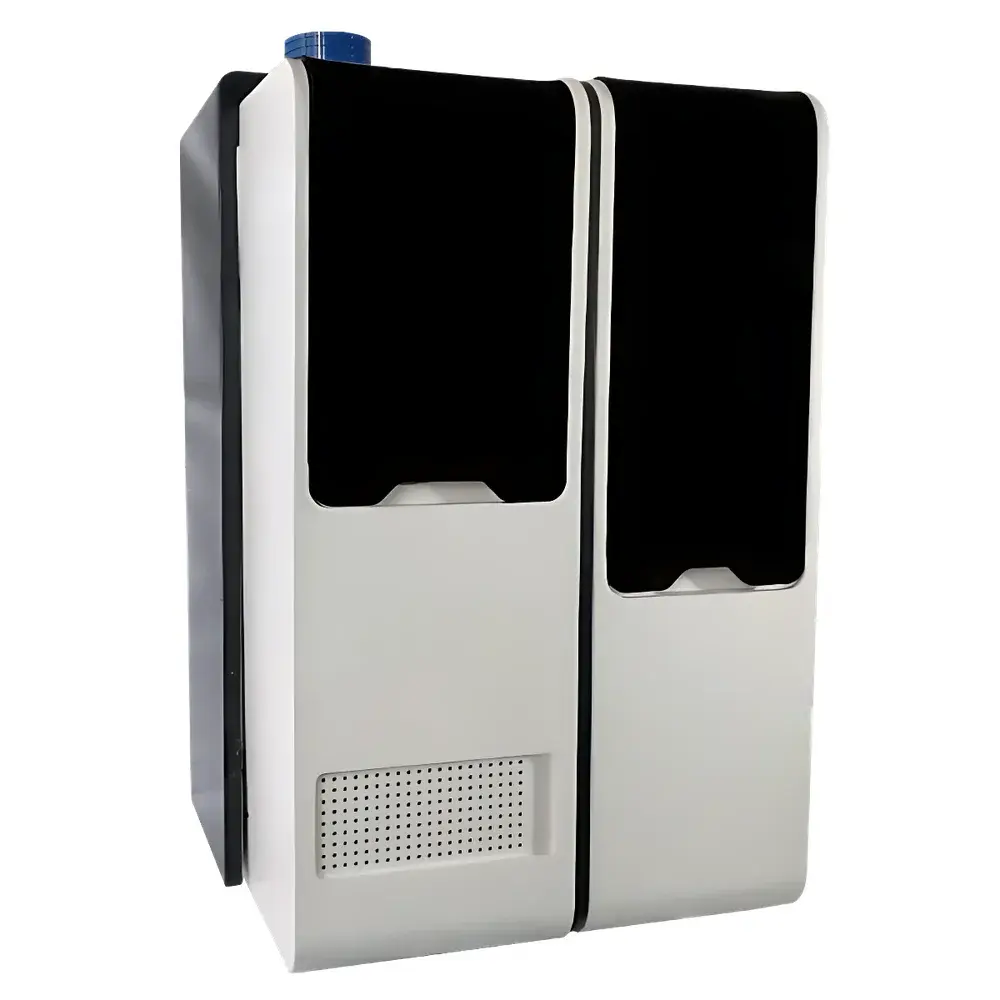
Brookfield BSIO-200 Automated Free Silica Sample Preparation System
| Brand | Brookfield |
|---|---|
| Origin | Beijing, China |
| Manufacturer Type | Direct Manufacturer |
| Country of Origin | China |
| Model | BSIO-200 |
| Pricing | Available Upon Request |
Overview
The Brookfield BSIO-200 Automated Free Silica Sample Preparation System is a purpose-built laboratory workstation engineered for the precise, reproducible, and fully automated execution of the焦磷酸法 (pyrophosphoric acid digestion method) as specified in GBZ/T 192.4–2007 — the People’s Republic of China National Occupational Health Standard for Determination of Free Silica Content in Workplace Airborne Dust. Unlike generic digestion or sample prep platforms, the BSIO-200 implements a closed-loop, chemistry-specific workflow optimized exclusively for silica quantification via selective dissolution of non-crystalline matrix components while preserving crystalline quartz and cristobalite phases. The system operates on a validated physicochemical principle: controlled thermal condensation of orthophosphoric acid into pyrophosphoric acid (H4P2O7) at elevated temperature, followed by timed, temperature-regulated digestion of dust filter samples under inert atmosphere conditions. This ensures stoichiometric conversion and minimal loss of target analytes—critical for regulatory compliance in occupational hygiene monitoring.
Key Features
- Fully integrated single-chassis architecture eliminates external pumps, chillers, or auxiliary digesters—reducing footprint, cross-contamination risk, and calibration drift between subsystems.
- Independent per-sample thermal control: Each of up to 8 processing stations maintains programmable temperature profiles (range: ambient to 280 °C ±1.5 °C) with real-time PID feedback, enabling parallel yet individually optimized digestion cycles.
- Automated filtration module with gravimetric liquid dosing (±0.2 mL accuracy), heated filtration manifold (maintained at 60 °C ±2 °C), and vacuum-assisted membrane filtration using certified 0.45 µm PTFE membranes.
- In-situ pyrophosphoric acid synthesis: Integrated reagent reservoir and thermal reactor convert analytical-grade 85% orthophosphoric acid into standardized pyrophosphoric acid under N2 purge—eliminating manual preparation and associated variability.
- Embedded industrial touchscreen interface (10.1″ capacitive LCD) running deterministic real-time OS; all process parameters—including temperature ramps, hold times, acid volumes, filtration vacuum levels, and cooling rates—are logged with ISO/IEC 17025-compliant timestamping and user ID tagging.
- Chemically resistant construction: Frame and fluidic pathways fabricated from PFA-lined 316L stainless steel and high-purity PEEK; compatible with concentrated H3PO4, hot pyrophosphoric acid, and deionized water rinse sequences.
- Integrated low-noise fume extraction: Sealed negative-pressure ducting with activated carbon + HEPA filtration (EN 1822 H13 rated) captures acidic vapors and particulates at source, meeting OSHA 1910.1200 and GBZ 2.1–2019 exposure limits.
Sample Compatibility & Compliance
The BSIO-200 accepts standard 37 mm or 25 mm mixed-cellulose ester (MCE) or polyvinyl chloride (PVC) air sampling filters loaded per NIOSH Method 7500 or GBZ/T 192.1–2007. It supports sample masses ranging from 0.5 mg to 15 mg total dust loading. All operational protocols align strictly with GBZ/T 192.4–2007 Section 6 (Reagents), Section 7 (Apparatus), and Section 8 (Procedure), including mandatory pre-digestion ashing (if required), exact pyrophosphoric acid volume (1.5 mL ±0.05 mL), digestion time (150 min ±2 min at 245–250 °C), and post-digestion filtration under constant vacuum. Audit trails generated by the onboard data logger satisfy GLP documentation requirements and support 21 CFR Part 11-compliant electronic records when paired with validated networked backup.
Software & Data Management
The embedded control software provides role-based access (Administrator, Technician, Reviewer), configurable method templates, and encrypted local storage of raw parameter logs (CSV/SQLite). Exported datasets include full thermographic profiles, reagent lot traceability, operator authentication tokens, and digital signatures for method validation reports. Optional Ethernet/Wi-Fi connectivity enables integration with LIMS via ASTM E1384-compliant HL7 messaging or direct SQL push to enterprise databases. All firmware updates undergo IEC 62304 Class B software lifecycle validation.
Applications
The BSIO-200 serves laboratories conducting occupational exposure assessments in mining, foundry operations, ceramics manufacturing, abrasive blasting, and construction sectors. It is routinely deployed by provincial CDCs, third-party occupational health testing labs, environmental monitoring agencies, and pharmaceutical cleanroom QA/QC departments requiring silica content verification in HVAC filter media or facility wipe samples. Its reproducibility (RSD <3.2% across n=12 replicate analyses per ISO 5725-2) supports trend analysis in longitudinal worker health surveillance programs.
FAQ
Does the BSIO-200 comply with international silica testing standards beyond GBZ/T 192.4–2007?
Yes—the instrument’s thermal control fidelity, reagent delivery precision, and filtration consistency meet the performance criteria referenced in ISO 16258-1:2016 and NIOSH Manual of Analytical Methods (NMAM) 7602, though method adaptation requires lab-specific validation.
Can the system handle samples collected on gelatin filters or other non-standard substrates?
No—it is calibrated and validated exclusively for MCE and PVC membrane filters per GBZ/T 192.4–2007; alternative substrates require full re-validation per ISO/IEC 17025 Clause 5.4.2.
Is remote monitoring or unattended overnight operation supported?
Yes—scheduled runs with automatic shutdown, thermal cooldown sequencing, and email/SMS alerts upon cycle completion or fault detection are enabled via optional network module.
What maintenance intervals are recommended for the acid-handling fluidics?
PFA tubing and PEEK valves require replacement every 500 digestion cycles or annually, whichever occurs first; full system performance verification is advised quarterly per manufacturer’s PQ protocol.
Does the instrument generate a final report compliant with CNAS accreditation requirements?
Yes—raw data export includes all metadata required for CNAS-CL01:2018 Annex A.1 traceability, including uncertainty budget inputs per GUM (JCGM 100:2008).



