
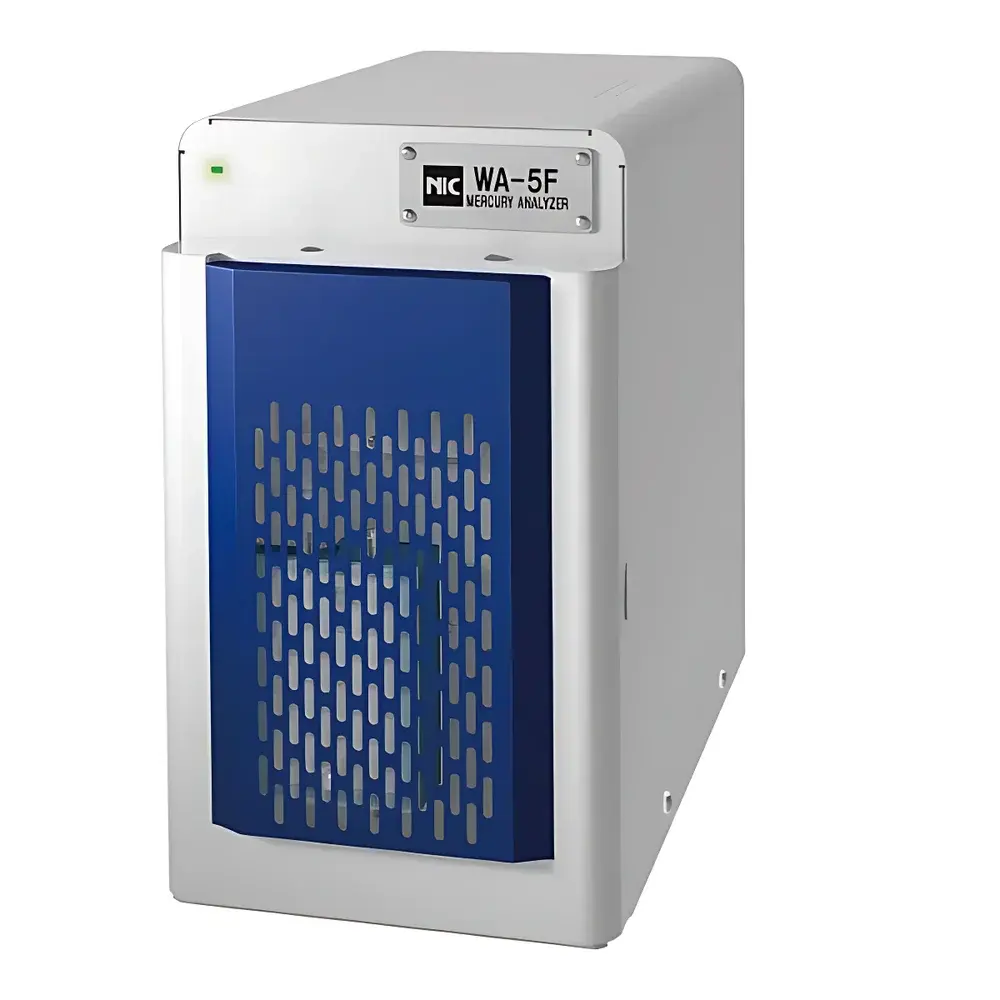
Brookfield WA-5F Gas-Phase Mercury Analyzer
| Brand | Brookfield |
|---|---|
| Origin | Beijing, China |
| Manufacturer Type | Direct Manufacturer |
| Regional Category | Domestic (China) |
| Model | WA-5F |
| Instrument Type | Benchtop Laboratory Analyzer |
| Measurement Principle | Cold Vapor Atomic Fluorescence Spectrometry (CVAFS) |
| Detection Limit | 0.1 pg |
| Quantification Range | 0.001–1000 ng |
| Sample Matrix Compatibility | Ambient Air, Natural Gas, Shale Gas, LPG, LNG |
| Compliant Methods | UOP 1033-19, ASTM D6350-14, ISO 6978-2:2005, JLPGA-S-07, ISO 20552, USEPA IO-5 |
Overview
The Brookfield WA-5F Gas-Phase Mercury Analyzer is a benchtop cold vapor atomic fluorescence spectrometry (CVAFS) instrument engineered for precise, trace-level quantification of total gaseous mercury (TGM) in diverse gas matrices—including ambient air, natural gas, shale gas, liquefied petroleum gas (LPG), and liquefied natural gas (LNG). Unlike single-stage amalgamation systems, the WA-5F implements a rigorously validated dual gold amalgamation protocol aligned with international regulatory frameworks. This architecture ensures selective pre-concentration, matrix interference suppression, and high reproducibility across variable sample compositions. The system operates without external carrier gas cylinders: an integrated, self-regenerating air-purification module delivers ultra-clean, mercury-free carrier gas on demand—reducing logistical overhead and enabling consistent operation in both fixed laboratories and field-deployed settings.
Key Features
- Dual-stage gold amalgamation: First-stage trapping occurs in field-deployable NIC gold-coated sand traps; second-stage trapping and thermal desorption occur within the WA-5F’s internal analytical trap—ensuring quantitative recovery and elimination of volatile organic or halogen-based interferences.
- Ultra-low detection capability: Achieves a method detection limit (MDL) of 0.1 pg Hg, supporting compliance with stringent environmental monitoring requirements at ppt-level sensitivity.
- Wide linear dynamic range: Accurately quantifies mercury concentrations from 0.001 ng to 1000 ng per sample—enabling direct analysis of both background ambient air and high-concentration industrial process streams without dilution or reconfiguration.
- Benchtop footprint & portability: Weighing only 13 kg with minimal bench space requirement, the WA-5F supports flexible deployment in QC labs, mobile monitoring units, and upstream gas processing facilities.
- Reusable NIC gold traps: Manufactured in-house using proprietary 40-year-developed gold compound synthesis and thermal-stable coating processes—resistant to acid exposure, thermal shock, and oxidative degradation over ≥100 analytical cycles.
Sample Compatibility & Compliance
The WA-5F is validated for use with gaseous samples conforming to multiple internationally recognized standard methods, including UOP 1033-19 (for mercury in natural gas), ASTM D6350-14 (for mercury in refinery gases), ISO 6978-2:2005 (natural gas—determination of mercury), JLPGA-S-07 (Japanese LPG specification), ISO 20552 (mercury in fuel gases), and USEPA Method IO-5 (ambient air monitoring). Its dual amalgamation workflow satisfies data integrity requirements under GLP and GMP-aligned quality systems. While not inherently 21 CFR Part 11 compliant out-of-the-box, the system supports audit-trail-enabled software integration when paired with validated third-party LIMS platforms meeting FDA and EMA regulatory expectations.
Software & Data Management
The WA-5F interfaces via USB or RS-232 with proprietary acquisition software that records full thermal desorption profiles, peak integration parameters, calibration history, and operator metadata. All raw spectral data, trap temperature ramps, and fluorescence intensity time-series are stored in vendor-neutral CSV and ASCII formats. Software supports customizable reporting templates aligned with ISO/IEC 17025 documentation requirements—including uncertainty estimation per EURACHEM/CITAC guidelines. Calibration verification checks (e.g., blank spikes, continuing calibration verification standards) are programmable and logged with time-stamped digital signatures.
Applications
- Environmental monitoring of TGM emissions from coal-fired power plants, waste incinerators, and chlor-alkali facilities.
- Upstream and midstream gas quality assurance: mercury speciation screening prior to cryogenic processing or catalyst protection in LNG liquefaction trains.
- Regulatory compliance testing for pipeline gas transmission networks under ISO 14687 and EN 16726 specifications.
- Research-grade studies on mercury redox cycling in atmospheric chemistry, including oxidation kinetics and particulate-bound mercury partitioning.
- QA/QC in mercury recovery unit performance validation across gold mining and metal refining operations.
FAQ
Does the WA-5F require external argon or nitrogen carrier gas?
No. The instrument employs an integrated, electrochemically purified indoor air supply system that generates carrier-grade air (<0.1 pg/m³ Hg background) without compressed gas cylinders.
Can the gold traps be reused, and how many cycles are supported?
Yes—NIC gold-coated sand traps are designed for ≥100 analytical cycles when regenerated according to manufacturer-specified thermal conditioning protocols.
Is the WA-5F suitable for continuous real-time monitoring?
It is optimized for discrete, high-precision batch analysis—not continuous streaming. For unattended operation, it supports automated sequential analysis of up to 12 pre-loaded traps via optional carousel accessory.
What maintenance intervals are recommended for optimal CVAFS detector stability?
Optical alignment verification every 6 months; quartz cell cleaning every 200 analyses; annual PM including lamp output calibration and photomultiplier tube gain assessment.
How does the dual amalgamation design improve accuracy compared to single-stage CVAAS systems?
Dual-stage trapping eliminates co-desorbed interferents (e.g., H₂S, SO₂, hydrocarbons) through selective thermal release kinetics and spatial separation—yielding >98.5% recovery across all certified reference materials tested per ISO 17034 criteria.





