
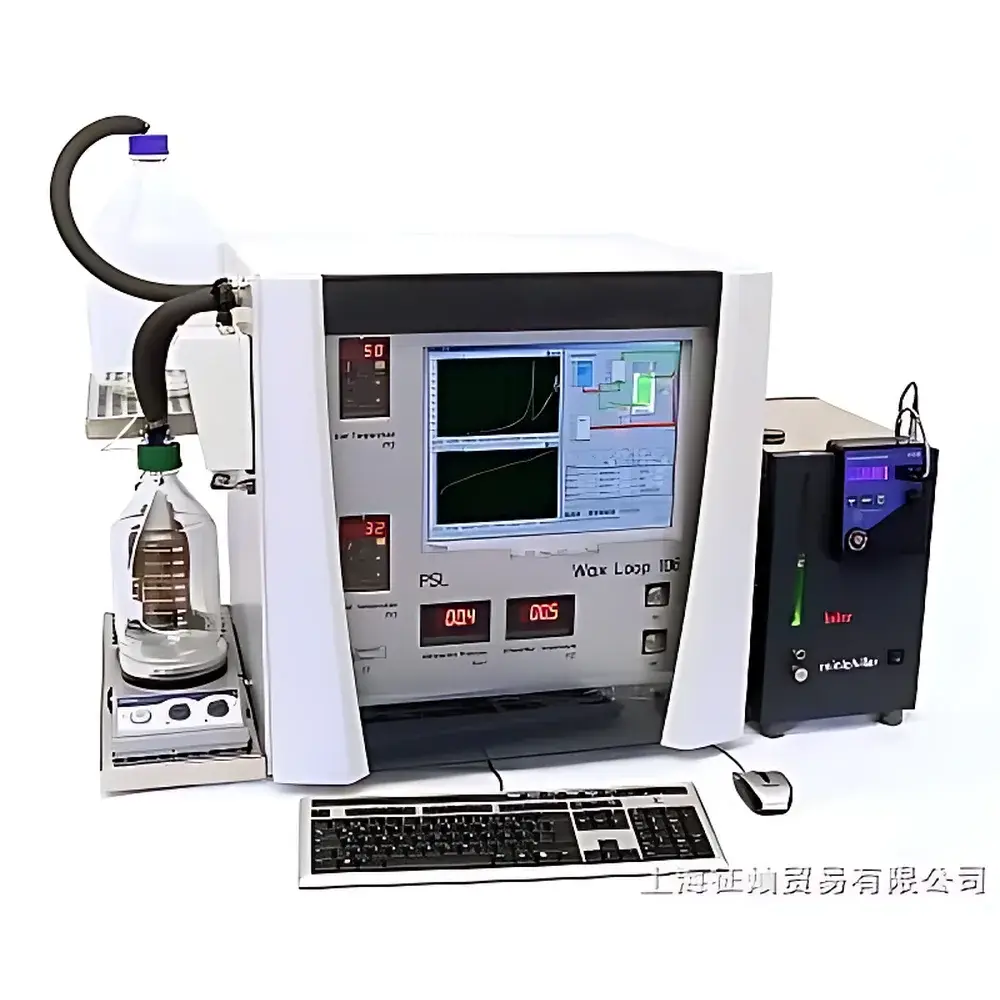
PSL WL Wax Flow Loop Tester
| Origin | Germany |
|---|---|
| Manufacturer Type | Distributor |
| Origin Category | Imported |
| Model | WL |
| Pricing | Upon Request |
Overview
The PSL WL Wax Flow Loop Tester is an engineered bench-scale flow-loop system designed to quantitatively assess wax deposition behavior in crude oil under dynamically controlled thermal, hydraulic, and rheological conditions. It operates on the principle of simulating real-world pipeline hydrodynamics—using precise temperature gradients, regulated pressure differentials, and programmable shear rates—to induce, monitor, and quantify paraffin crystallization, wax adhesion, and deposit accumulation on representative pipe wall materials. Unlike static cold-finger or viscometric screening methods, this instrument replicates transient cooling profiles and flow-induced shear stresses encountered during production, transportation, and shutdown–restart cycles. Its core application domain spans upstream and midstream petroleum operations, where wax management directly impacts pipeline integrity, pigging frequency, and operational continuity.
Key Features
- Modular flow-loop architecture with interchangeable test sections (stainless steel, carbon steel, coated, or polymer-lined pipes) enabling material-specific wax adhesion evaluation.
- Independent dual-zone thermal control: test loop (–10 °C to +80 °C) and sample inlet/preheat zone (RT+5 °C to +80 °C), supporting steep thermal gradients critical for wax nucleation onset detection.
- Programmable pressure regulation up to 5 bar (72.5 psi), synchronized with real-time pressure logging for correlating deposit morphology with thermodynamic driving force.
- Flow rate control from 0.3 to 30 mL/min, delivering shear rates scalable across laminar to transitional flow regimes—essential for evaluating shear-dependent inhibition mechanisms.
- Integrated high-torque stirrer (100–2000 rpm) for homogeneous pre-conditioning and dispersion stability prior to loop injection.
- Automated cleaning cycle using solvent-compatible pump sequences and heated flush protocols, minimizing carryover between tests and ensuring assay reproducibility.
- Compact footprint (130 × 60 × 70 cm) and 2900 W / 220 V power configuration optimized for laboratory integration without dedicated HVAC or utility upgrades.
Sample Compatibility & Compliance
The WL Wax Flow Loop accommodates native crude oils, diluted blends, and formulated waxy model fluids (e.g., n-alkane/toluene systems). A 50 mL sample volume suffices for full-cycle testing—including deposition, hold time, restart, and yield stress assessment—reducing consumable cost and waste generation. The system supports both open-loop (discharge to waste reservoir) and closed-loop (recirculation) configurations, allowing extended-duration experiments aligned with ASTM D7143 (Standard Test Method for Determining Wax Appearance Temperature of Crude Oils) and ISO 10438-3 (Petroleum and natural gas industries — Process safety systems — Part 3: Control systems for petroleum and natural gas industries). All thermal, pressure, and flow data are timestamped and logged in compliance with GLP/GMP traceability requirements; audit trails and user-access logs meet FDA 21 CFR Part 11 electronic record criteria when paired with validated software modules.
Software & Data Management
The embedded control software enables fully automated experiment sequencing—including multi-step temperature ramps, pressure holds, flow transitions, and timed restart protocols. Real-time visualization displays live curves of temperature vs. time, pressure vs. time, and differential pressure across the test section—serving as a direct proxy for deposit thickness growth. Post-run analysis tools calculate cumulative deposit mass (via calibrated ΔP–flow correlations), apparent yield stress (from restart torque vs. shear rate sweeps), and inhibition efficiency (% reduction in deposit mass relative to blank). Export formats include CSV, Excel, and PDF reports compatible with LIMS integration. All raw datasets are stored with metadata (operator ID, calibration status, ambient conditions) to support regulatory review and method validation per ISO/IEC 17025.
Applications
- Screening and ranking of commercial wax inhibitors and dispersants across concentration gradients (0.1–1000 ppm).
- Determination of optimal inhibitor dosage for field-specific crudes via dose–response deposition curves.
- Evaluation of restart feasibility after shutdown: measuring minimum restart pressure, yield stress evolution, and slurry rheology.
- Assessment of pipe wall material compatibility—comparing wax adhesion on API 5L X65, epoxy-coated, or internally lined substrates.
- Validation of thermodynamic wax models (e.g., PC-SAFT, Multiflash) against experimental deposition onset temperatures and mass accumulation rates.
- Supporting API RP 14E corrosion–wax interaction studies where deposition alters local flow regime and electrochemical environment.
FAQ
What sample volume is required for a complete wax deposition and restart test?
A minimum of 50 mL of conditioned crude oil is sufficient to execute full-cycle testing—including precooling, deposition phase, hold period, and forced restart—with integrated cleaning.
Can the system operate under sub-ambient temperatures?
Yes—the test loop temperature range extends to –10 °C, enabling simulation of arctic or deepwater pipeline conditions where wax precipitation kinetics are significantly accelerated.
Is the software compliant with FDA 21 CFR Part 11 for regulated laboratories?
When deployed with validated user authentication, electronic signatures, and immutable audit trail modules, the system meets Part 11 requirements for electronic records and signatures.
How is deposit mass quantified without destructive sectioning?
Deposit mass is derived indirectly but robustly from calibrated differential pressure measurements across the test section, correlated to known deposit density and geometry via NIST-traceable reference standards.
Does the system support custom pipe geometries?
Yes—standard test sections are 1/2″ and 3/4″ nominal bore stainless steel tubes; custom diameters, lengths, surface finishes, and material inserts can be integrated upon request.





