
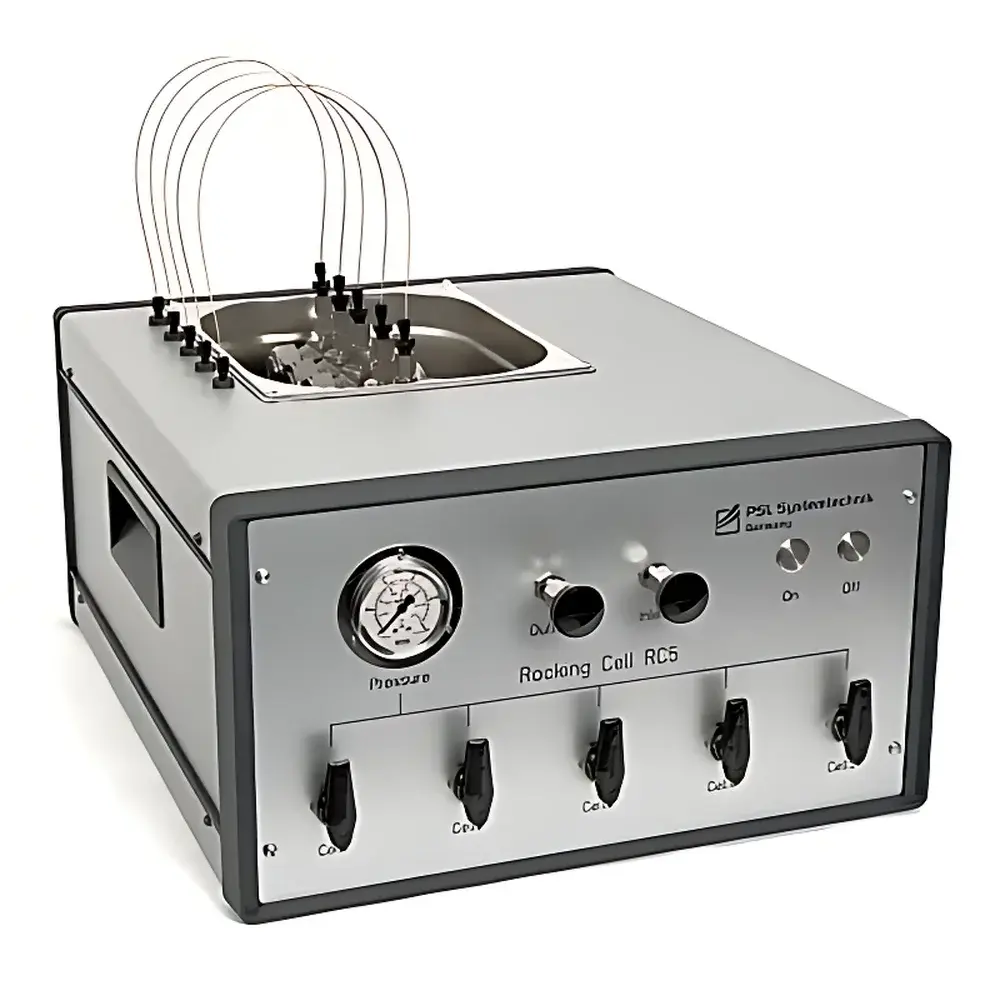
PSL RC5 Hydrate Rocking Cell
| Origin | Germany |
|---|---|
| Manufacturer Type | Distributor |
| Origin Category | Imported |
| Model | RC5 |
| Price | Upon Request |
Overview
The PSL RC5 Hydrate Rocking Cell is a precision-engineered laboratory instrument designed for dynamic gas hydrate formation and inhibition studies under controlled thermobaric conditions. It operates on the principle of mechanical agitation via controlled oscillatory motion—specifically, axial rocking of cylindrical test cells containing aqueous inhibitor solutions and pressurized gas phases. This motion induces reproducible shear and turbulent mixing between liquid and gas phases, simulating hydrodynamic conditions encountered in subsea pipelines and flow assurance systems. Unlike static autoclave-based hydrate reactors, the RC5 system enables real-time observation of nucleation onset, growth kinetics, and inhibition efficacy by maintaining continuous mechanical perturbation while monitoring pressure and temperature transients with high temporal resolution. Its core architecture supports both fundamental research into hydrate thermodynamics and applied screening of kinetic inhibitors (KHIs) and thermodynamic inhibitors (THIs), making it suitable for R&D laboratories, flow assurance teams, and regulatory testing facilities engaged in natural gas transportation safety.
Key Features
- Modular design supporting 5 to 10 independently operated rocking cells, scalable without hardware modification
- Precisely controllable rocking frequency range: 1–20 cycles per minute (min⁻¹)
- Adjustable rocking angle from 1° to 45°, enabling systematic variation of shear intensity and interfacial renewal rate
- Maximum operating pressure: 200 bar (2900 psi), compatible with methane, ethane, CO₂, and multi-component natural gas simulants
- Temperature control range: –10 °C to +60 °C, achieved via integrated glycol–water cooling bath with programmable ramping profiles
- Stainless-steel test cells (40.13 cm³ internal volume) secured magnetically for rapid loading, cleaning, and cell replacement
- Data acquisition interval configurable from 1 second to 30 seconds, synchronized across all channels
- Robust thermal insulation and vibration-dampened mounting ensure stable baseline measurements during extended experiments (up to 30 days)
Sample Compatibility & Compliance
The RC5 accommodates aqueous electrolyte solutions, polymer-based KHIs (e.g., PVCap, PVMeOx), low-molecular-weight THIs (e.g., methanol, MEG), and complex inhibitor blends. Each cell is sealed with metal–graphite gaskets rated for repeated use at full pressure and temperature extremes. The system complies with ISO 13703:2020 (Petroleum and natural gas industries — Flow assurance — Hydrate testing methods) and supports experimental protocols aligned with ASTM D7483 (Standard Test Method for Determination of Hydrate Formation Temperature Using High-Pressure Differential Scanning Calorimetry) when coupled with complementary instrumentation. All pressure transducers and PT100 sensors are NIST-traceable; data logging meets GLP/GMP requirements for auditability, including timestamped metadata, operator ID, and version-controlled method files.
Software & Data Management
WinRC software provides full instrument control, real-time visualization, and post-processing analytics. Users define multi-step test sequences—including dynamic rocking, static hold, and re-initiated agitation—with independent setpoints for temperature, pressure, frequency, and angle. The software logs time-synchronized data streams for pressure (±0.1 bar), temperature (±0.05 °C), rocking position, and elapsed duration. Export formats include CSV, HDF5, and XML for integration with MATLAB, Python (Pandas/NumPy), or LIMS platforms. Audit trails record user actions, parameter changes, and calibration events in accordance with FDA 21 CFR Part 11 requirements. Automated detection algorithms identify hydrate formation onset based on characteristic pressure drop deviations from ideal gas behavior, enabling objective endpoint determination without subjective visual interpretation.
Applications
- Dynamic evaluation of kinetic hydrate inhibitors (KHIs) under pipeline-relevant shear conditions
- Determination of minimum effective inhibitor concentration (MEIC) across varying subcooling degrees
- Comparative assessment of novel anti-agglomerants (AAs) versus conventional inhibitors
- Quality control testing of commercial inhibitor batches for batch-to-batch consistency
- Hydrate risk mapping for deepwater field development planning
- Validation of thermodynamic models (e.g., CSMGem, Multiflash) using experimentally derived induction times and growth rates
FAQ
What is the maximum number of test cells that can operate simultaneously?
Up to ten rocking cells can be installed and controlled independently within a single RC5 chassis.
Can the system be integrated with external gas blending or online spectroscopy units?
Yes—the RC5 features standard ¼″ VCR ports and analog/digital I/O interfaces for synchronization with mass flow controllers, FTIR cells, or Raman probes.
Is WinRC software validated for regulated environments?
WinRC includes electronic signature support, role-based access control, and full audit trail generation compliant with 21 CFR Part 11 and EU Annex 11.
What maintenance intervals are recommended for long-term operation?
Gasket inspection every 50 cycles; pressure sensor recalibration annually or after 200 bar exposure events; cooling bath fluid replacement every 12 months.
Does the system support automated shutdown upon hydrate detection?
Yes—user-defined pressure deviation thresholds trigger immediate rocking cessation, heating activation, and alarm notification via email or SNMP.




