
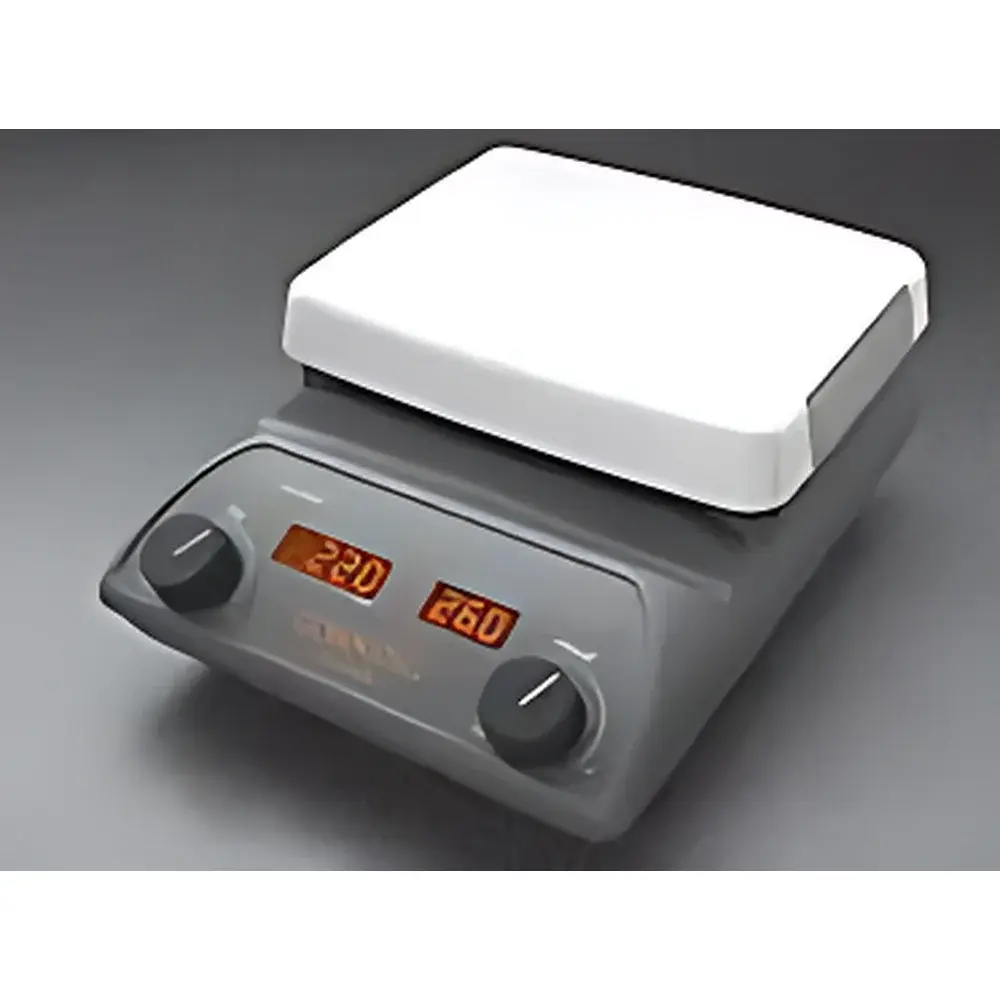
Corning PC-220 / PC-410D Digital Magnetic Hotplate Stirrer
| Brand | Corning |
|---|---|
| Origin | USA |
| Model | PC-220 / PC-410D |
| Heating Range | 5–550 °C (200 °C with optional external temperature controller) |
| Stirring Speed | 60–1150 rpm |
| Top Plate Material | Pyroceram® glass-ceramic |
| Top Plate Sizes | 5" × 7" (12.7 × 17.8 cm, 226 cm²) or 10" × 10" (25.4 × 25.4 cm, 645 cm²) |
| Safety Certifications | UL / cUL listed |
| Optional Accessory | External Temperature Controller (Cat. No. 6795PR) |
| Height | 12.2 cm (4.875") |
| Overheat Protection | Dual-sensor thermal cutoff + surface overtemperature LED indicator |
Overview
The Corning PC-220 and PC-410D Digital Magnetic Hotplate Stirrers are precision-engineered laboratory instruments designed for simultaneous heating and magnetic stirring of samples in glass or stainless-steel vessels. These units operate on the principle of electromagnetic induction for heating and rotating magnetic field coupling for agitation—enabling uniform thermal distribution and consistent rotational torque across a wide range of viscosities and vessel geometries. Engineered for routine QC, R&D, and teaching labs, they integrate microprocessor-based feedback control to maintain setpoint stability under dynamic load conditions—including aqueous solutions, viscous polymers, semi-solid suspensions, and heterogeneous reaction mixtures. Their Pyroceram® glass-ceramic top plates provide exceptional thermal shock resistance, chemical inertness, and long-term dimensional stability—critical for reproducible heating profiles and extended service life in demanding environments.
Key Features
- Microprocessor-controlled dual-loop regulation for independent, stable control of plate temperature (5–550 °C) and stir speed (60–1150 rpm)
- Pyroceram® glass-ceramic surface offering high thermal conductivity, low thermal mass, and resistance to scratches, acids, alkalis, and thermal cycling
- White matte finish enhances visual contrast for colorimetric assays and improves operator visibility of sample status
- Dual thermal safety architecture: surface-mounted overtemperature LED indicator activates at >60 °C; redundant thermal cutoff sensor de-energizes heater if internal temperature exceeds safe thresholds
- Enhanced magnetic coupling system with high-strength neodymium magnets—optimized for efficient drive transmission even with large or asymmetric stir bars
- Compact low-profile design (12.2 cm height) enables integration under fume hoods, inside incubators, or within constrained benchtop workflows
- Optional external temperature controller (Cat. No. 6795PR) provides direct solution-phase temperature monitoring and closed-loop regulation—essential for exothermic reactions, enzymatic assays, or USP/Ph. Eur.-compliant dissolution testing
Sample Compatibility & Compliance
These hotplate stirrers accommodate standard laboratory glassware including beakers (50 mL–4 L), Erlenmeyer flasks, and jacketed reactors. The non-magnetic Pyroceram® surface ensures compatibility with all ferromagnetic and paramagnetic stir bars—including PTFE-coated, AlNiCo, and high-torque elliptical designs. Units comply with UL 61010-1 and CAN/CSA C22.2 No. 61010-1 for electrical safety in laboratory environments. When used with the 6795PR controller, systems support GLP/GMP data integrity requirements through real-time digital logging of temperature and rpm—facilitating audit-ready documentation per FDA 21 CFR Part 11 when integrated with compliant LIMS or ELN platforms.
Software & Data Management
While standalone operation requires no software, the PC-410D variant supports analog output (0–5 V or 4–20 mA) for external data acquisition systems. The optional 6795PR external temperature controller features a bright LED display showing both bath temperature and stir speed, with user-configurable alarm thresholds. All models record operational history via non-volatile memory—including cumulative run time, maximum temperature reached, and last-used setpoints—supporting preventive maintenance scheduling and ISO/IEC 17025 traceability protocols.
Applications
- Heating and homogenizing reagent solutions prior to HPLC or ICP-MS analysis
- Controlled-temperature synthesis of metal-organic frameworks (MOFs) and nanomaterials
- Dissolution testing per USP using calibrated probe placement with 6795PR
- Buffer preparation and pH adjustment workflows requiring precise thermal equilibration
- Cell culture media warming without thermal degradation of growth factors
- Viscosity-dependent mixing optimization in polymer processing R&D
FAQ
What is the maximum recommended vessel size for the 5″ × 7″ top plate?
For optimal thermal uniformity and magnetic coupling, use vessels ≤2 L on the smaller plate; the 10″ × 10″ variant supports up to 4 L containers.
Can the unit maintain temperature setpoint accuracy in high-viscosity media?
Yes—the microprocessor dynamically adjusts power delivery to compensate for thermal load shifts caused by viscosity changes, ensuring ±2 °C stability at setpoint under steady-state conditions.
Is the Pyroceram® surface compatible with hydrofluoric acid exposure?
No—while highly resistant to most laboratory chemicals, Pyroceram® is susceptible to etching by HF and strong alkaline melts above 400 °C; consult Corning’s Chemical Resistance Guide (Doc. #CRG-2023) for full compatibility data.
Does the 6795PR controller support calibration traceability?
Yes—it accepts NIST-traceable RTD probes and stores calibration coefficients with date/time stamps, enabling compliance with ISO/IEC 17025 Clause 6.5.2.
How often should preventive maintenance be performed?
Inspect magnetic coupling efficiency and surface integrity every 6 months; verify thermal sensor drift annually using a calibrated reference thermometer per ASTM E74-22.



