
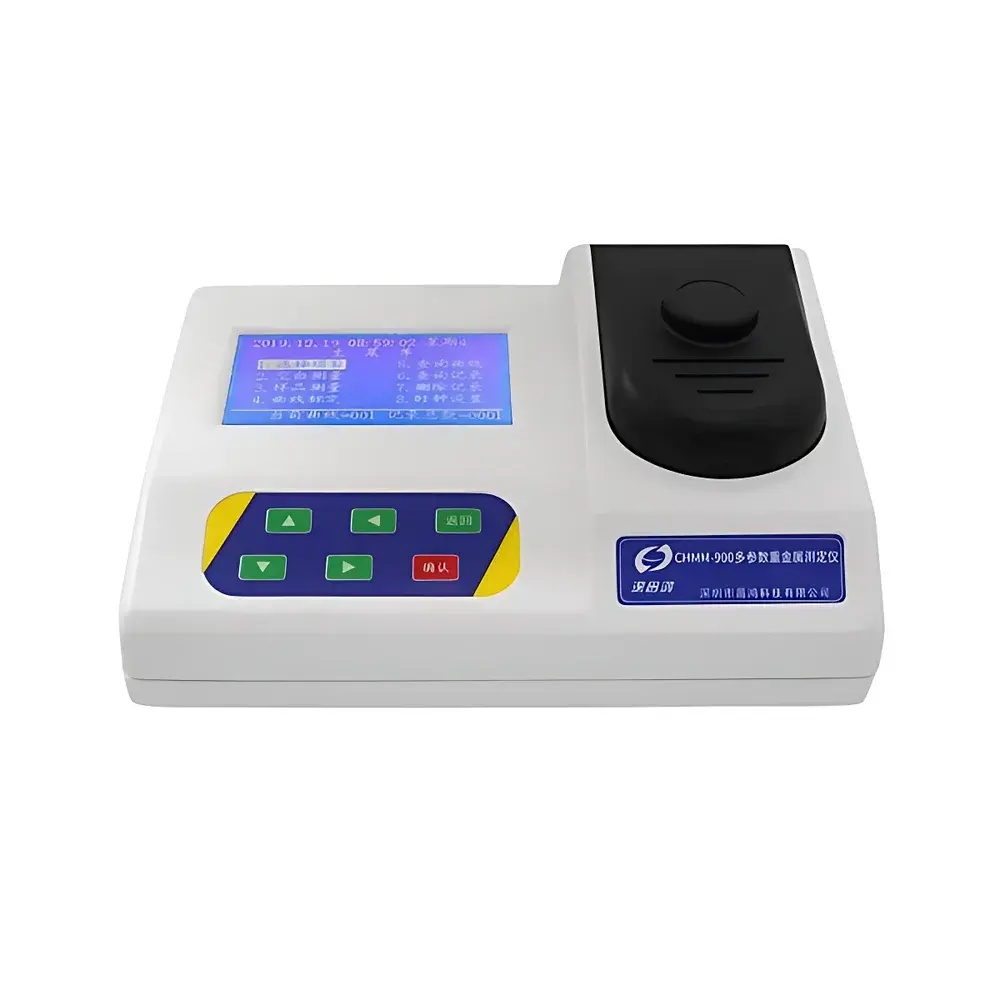
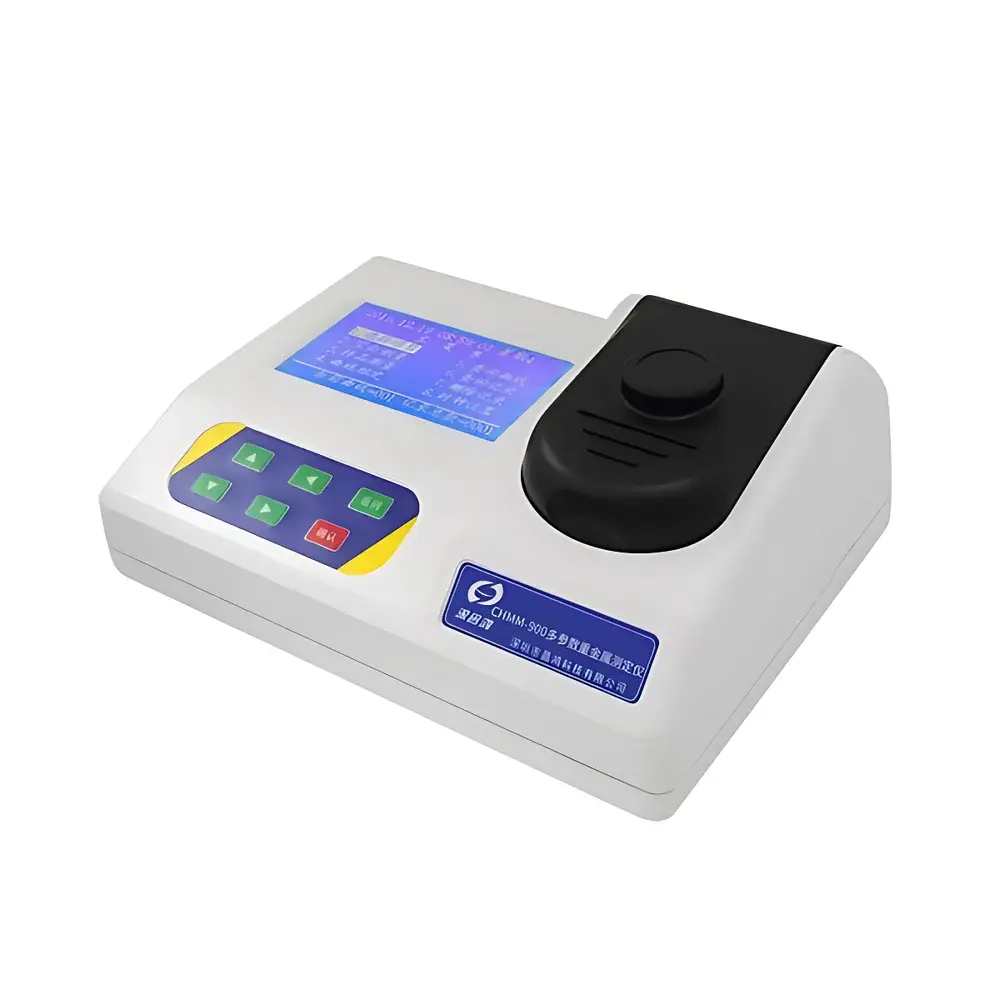
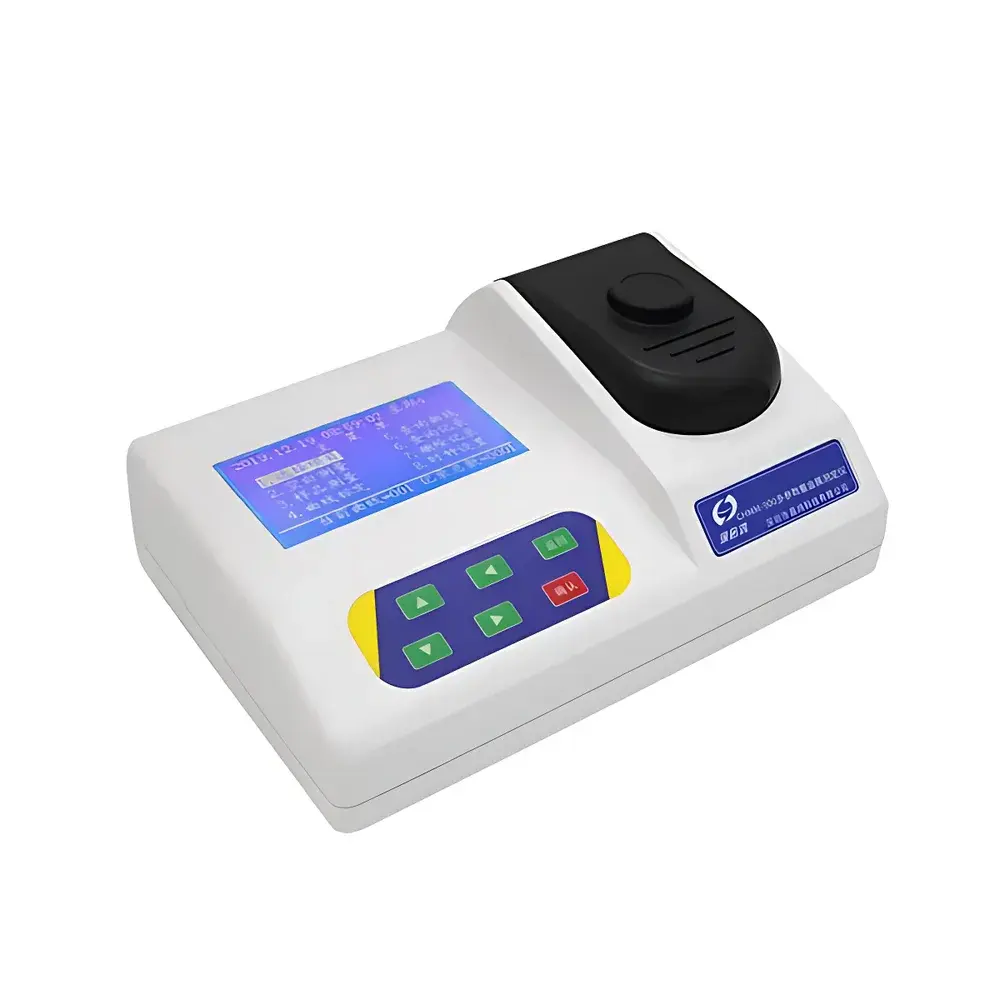
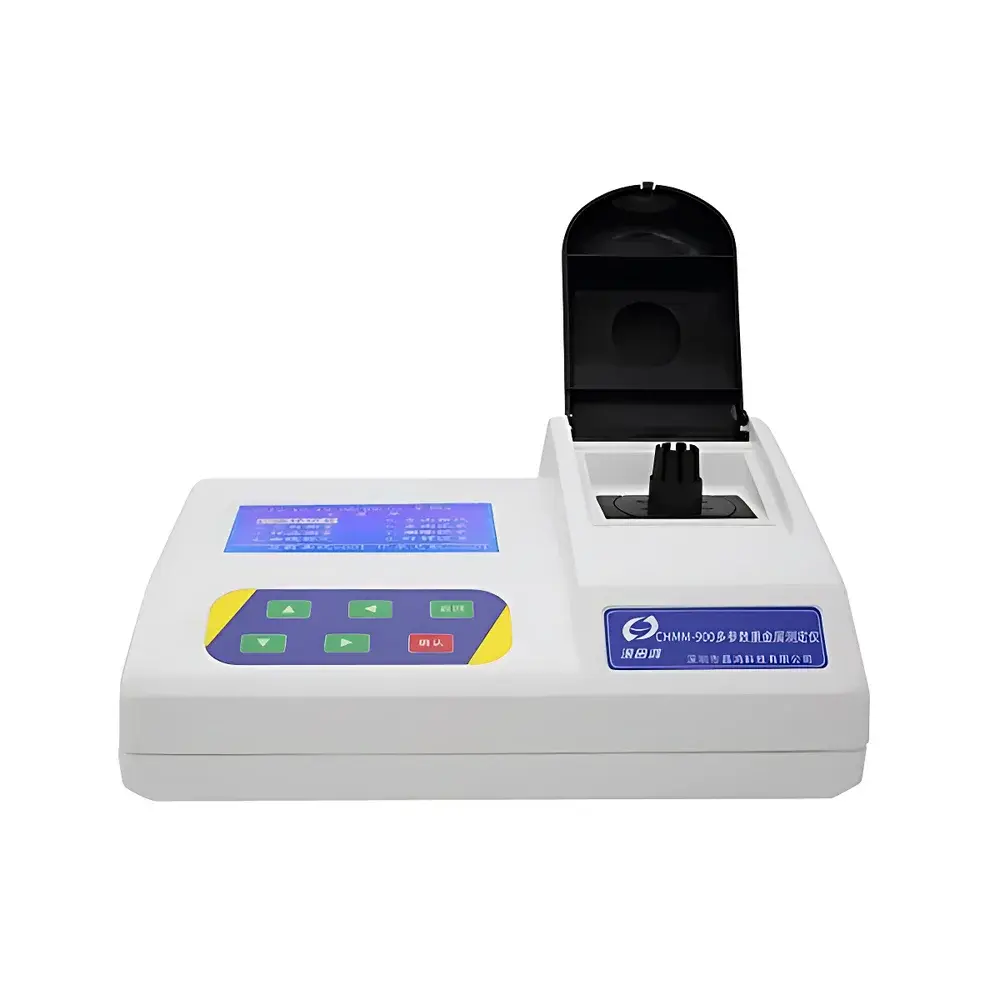
Shenchanghong CHMM-900 Multi-Parameter Heavy Metals Analyzer
| Brand | Shenchanghong |
|---|---|
| Origin | Guangdong, China |
| Manufacturer Type | Direct Manufacturer |
| Origin Category | Domestic (China) |
| Model | CHMM-900 |
| Instrument Type | Benchtop Laboratory Analyzer |
| Detection Principle | Colorimetric Photometry |
| Detectable Metals | Cu, Ni, Cr(VI), Mn, Fe, Zn, Pb, Cd, Hg (Configurable Multi-Parameter) |
| Analysis Time | ≤10 min per sample |
| Accuracy | ≤±5% FS (for water samples) |
| Repeatability | ≤3% RSD |
| Optical Stability | Absorbance drift <0.002 A within 20 min |
| Resolution | 0.01 mg/L |
| Measurement Ranges | Ni (0.01–1.00), Cu (0.02–10.00), Cr(VI) (0.01–1.00), Mn (0.02–5.00), Fe (0.05–10.00), Zn (0.20–5.00), Pb (0.01–0.50), Cd (0.05–0.50), Hg (0.002–0.05) mg/L (all ranges configurable per parameter selection) |
| Dimensions (W×D×H) | 266 × 200 × 130 mm |
| Weight | 1.0 kg |
| Operating Environment | 5–40 °C, RH ≤85%, AC 220 V ±10%, 50 Hz ±0.5 Hz, low-vibration, low-EMI, no direct sunlight |
Overview
The Shenchanghong CHMM-900 Multi-Parameter Heavy Metals Analyzer is a benchtop photometric instrument engineered for rapid, reliable quantification of trace heavy metals and inorganic ions in aqueous environmental matrices. It operates on the principle of colorimetric photometry—where target analytes react with specific chromogenic reagents to form stable, light-absorbing complexes whose absorbance at defined wavelengths is linearly proportional to concentration. This method complies with internationally recognized standard test procedures including EPA Method 200.7 (ICP-OES reference), ISO 8692 (water quality—determination of heavy metals), and ASTM D3559 (lead in water by colorimetry), serving as a validated alternative for laboratories requiring cost-effective, non-instrumental elemental screening without reliance on atomic absorption or ICP-based platforms. Designed for routine compliance monitoring, the CHMM-900 supports simultaneous or sequential analysis of up to nine heavy metal species—including Cu, Ni, Cr(VI), Mn, Fe, Zn, Pb, Cd, and Hg—each with independently selectable calibration ranges and optimized reaction protocols.
Key Features
- High-stability optical architecture featuring imported long-life (≥100,000 h), high-luminance LED sources coupled with precision narrow-band interference filters—ensuring minimal spectral crosstalk and robust immunity to ambient light interference.
- Integrated 16-bit low-power microcontroller system enabling precise timing control of reagent addition, incubation, and photometric readout—critical for reproducible color development kinetics across diverse matrix types.
- Large-backlit LCD display with intuitive Chinese-language menu navigation; full operational guidance, real-time status prompts, and on-screen error diagnostics reduce operator dependency and training overhead.
- Dual-curve calibration capability: pre-loaded factory-certified calibration curves for all supported parameters plus dedicated user-defined curve memory—enabling method validation, matrix-matched standardization, and long-term method transfer across instruments.
- Chemically resistant ABS polymer housing rated for continuous exposure to acidic, alkaline, and oxidizing reagents commonly used in heavy metal digestion and derivatization (e.g., HNO₃/H₂SO₄ mixtures, KMnO₄, diphenylcarbazide).
- Compact footprint (266 × 200 × 130 mm) and lightweight design (1.0 kg) facilitate deployment in mobile labs, field stations, and space-constrained QA/QC environments without sacrificing analytical integrity.
Sample Compatibility & Compliance
The CHMM-900 is validated for direct analysis of untreated and pretreated aqueous samples across regulatory categories: drinking water (WHO Guidelines, GB 5749–2022), surface water (EPA Region 10 criteria), groundwater (ISO 5667-3), wastewater (GB/T 16488–1996), and industrial effluents (EU IED Annex I). Sample preparation follows standardized acid digestion (for total metal determination) or direct colorimetric assay (for dissolved/speciated forms such as Cr(VI)), consistent with US EPA Methods 200.2 and 7196A. All measurement protocols are documented in accordance with GLP principles; instrument performance verification includes daily blank checks, multi-point linearity verification (r² ≥ 0.999), and periodic inter-laboratory comparison per ISO/IEC 17043. Data integrity safeguards include timestamped result logging and manual audit trail annotation—supporting alignment with FDA 21 CFR Part 11 requirements where electronic records are retained.
Software & Data Management
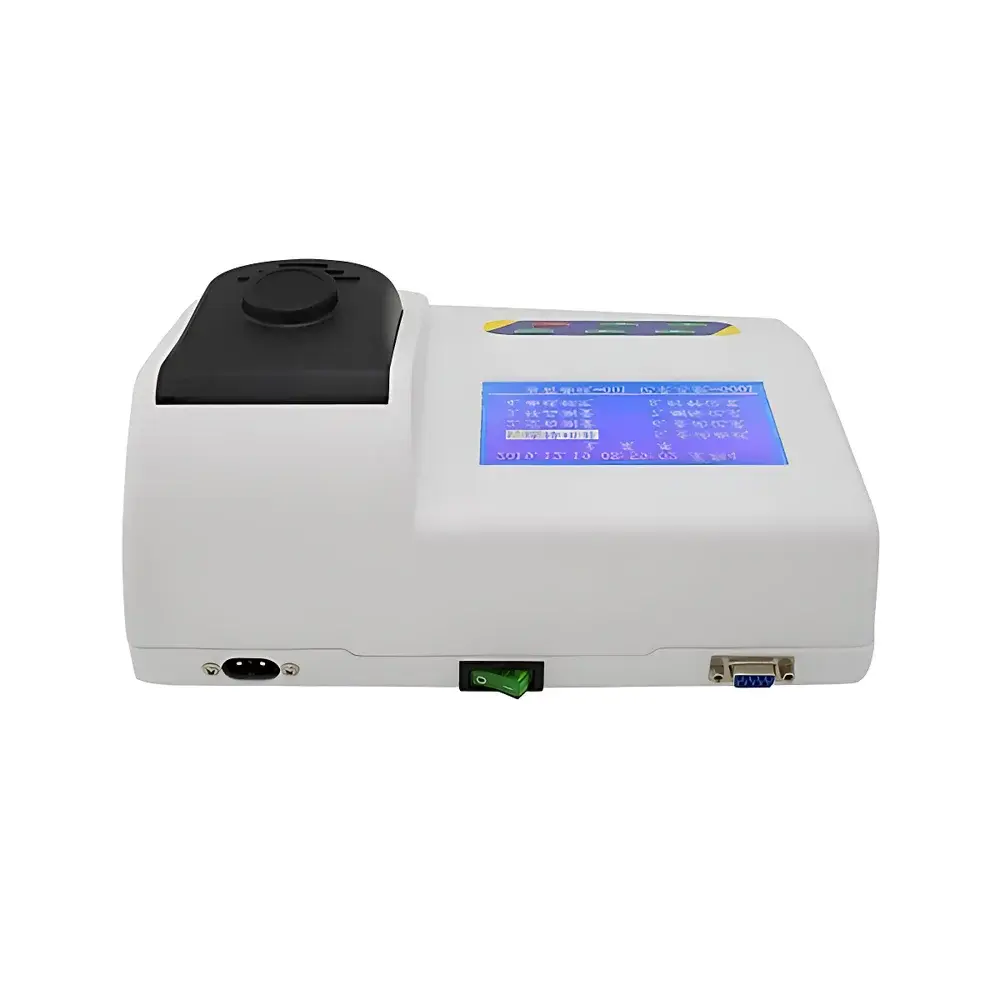
While the CHMM-900 operates as a standalone analyzer with embedded firmware, it supports RS-232 serial output for seamless integration into laboratory information management systems (LIMS) or custom data acquisition platforms. All measurements are stored internally with sample ID, date/time stamp, operator code, calibration curve ID, and raw absorbance values—retaining ≥500 test records without external storage. Exported data conform to ASCII-delimited formats compatible with Microsoft Excel, LabChart, and industry-standard statistical process control (SPC) software. Firmware updates are performed via USB interface using manufacturer-provided utilities, with version-controlled release notes and change logs maintained for regulatory traceability. No cloud connectivity or proprietary software installation is required—ensuring full data sovereignty and compatibility with air-gapped laboratory networks.
Applications
- Routine compliance testing for municipal water utilities against national discharge limits (e.g., China’s GB 8978–1996, EU WFD Annex X).
- Pre-treatment and post-treatment monitoring in electroplating, battery manufacturing, and metal finishing facilities.
- Field-deployable screening for environmental remediation projects—especially in brownfield site assessment and sediment pore-water characterization.
- Educational use in university environmental science laboratories for teaching quantitative analytical chemistry, method validation, and uncertainty estimation.
- Supporting ISO 14001-certified EMS programs through documented, repeatable heavy metal verification at intake, process, and outfall points.
FAQ
What regulatory standards does the CHMM-900 comply with?
The instrument’s methodology aligns with ISO 8692, ASTM D3559, and EPA Method 200.7 for comparative validation; its operational documentation supports GLP/GMP-aligned quality systems.
Can the CHMM-900 measure total metals or only dissolved fractions?
It measures dissolved species directly; for total recoverable metals, users must perform standardized acid digestion (e.g., EPA 3010B or GB/T 5750.6–2023) prior to analysis.
Is calibration curve customization supported?
Yes—users may generate, store, and recall up to five independent calibration curves per parameter using certified reference materials traceable to NIST or CNAS-accredited standards.
What maintenance is required to ensure long-term photometric stability?
Annual verification of LED intensity and filter transmission is recommended; optical path cleaning with lint-free swabs and spectroscopic-grade ethanol every 200 assays maintains baseline repeatability.
Does the CHMM-900 support multi-user access control or audit trails?
It provides operator ID entry and time-stamped record generation; full electronic signature and role-based access require integration with external LIMS—consistent with 21 CFR Part 11 Annex 11 implementation guidelines.
Related Products







