
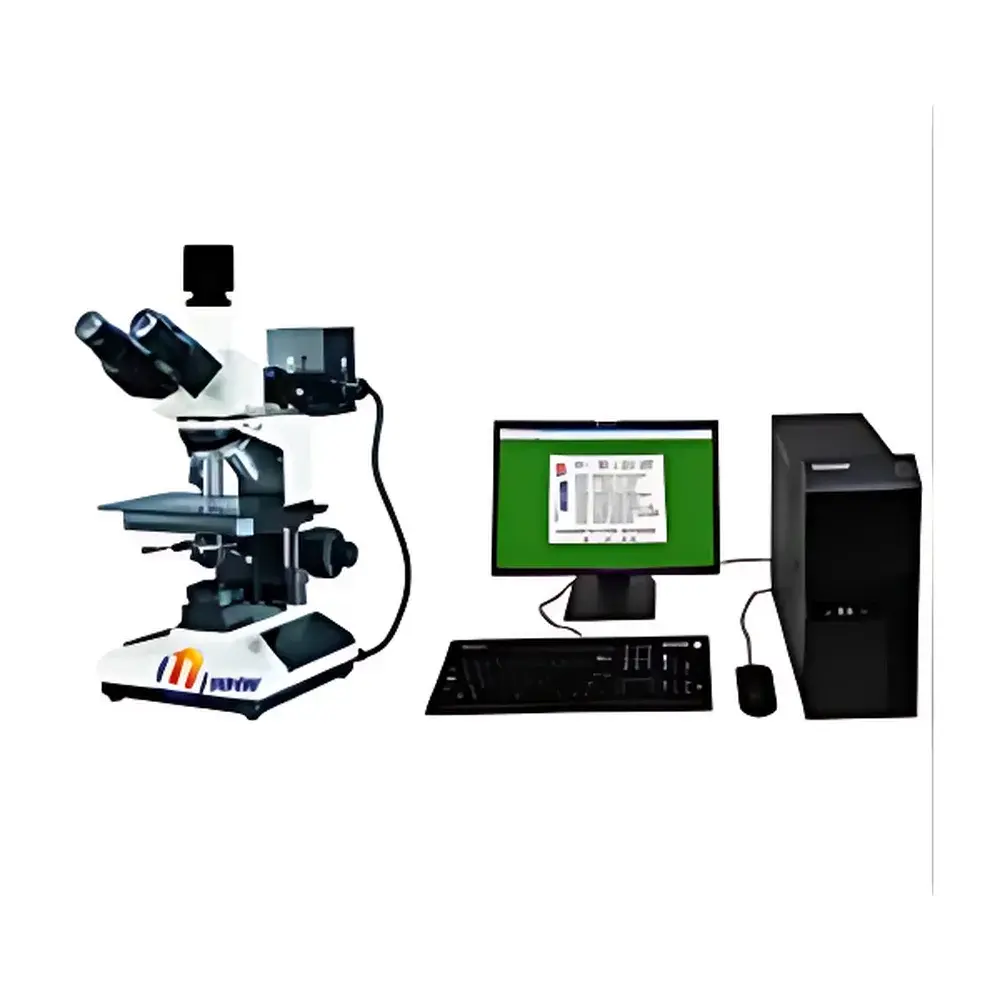
YANRUN MMAS-6 Metallurgical Microscope Measurement & Analysis System
| Brand | YANRUN |
|---|---|
| Origin | Shanghai, China |
| Manufacturer Type | Direct Manufacturer |
| Product Type | Upright Metallurgical Microscope |
| Image Analysis System Included | Yes |
| Total Magnification Range | 50× to 600× |
| Eyepieces | Wide-Field WF10X (Φ18 mm) |
| Objective Lenses | 5X, 10X, 40X, 60X (Long Working Distance Plan Achromatic, Cover-Slip Free) |
Overview
The YANRUN MMAS-6 Metallurgical Microscope Measurement & Analysis System is an upright, dual-illumination optical instrument engineered for high-fidelity microstructural characterization of both opaque and transparent specimens. It operates on standard brightfield, darkfield, and polarized light contrast principles—optimized for metallurgical, materials science, and quality control applications where precise grain size evaluation, phase distribution mapping, inclusion analysis, and coating thickness assessment are required. The system integrates a robust mechanical platform with a modular optical architecture—including long working distance (LWD) plan achromatic objectives designed for cover-slip-free observation—and a fully synchronized trinocular head enabling simultaneous visual inspection and digital imaging at 100% beam-splitting efficiency. Its dual-path illumination (epi- and trans-illumination) supports versatile sample preparation protocols across metallography, geology, electronics, and advanced ceramics.
Key Features
- Upright trinocular optical design with 30° inclined viewing tube, adjustable interpupillary distance, and built-in rotatable analyzer for polarized light observation.
- Wide-field eyepieces: WF10X (Φ18 mm field number), optionally upgradeable to WF16X (Φ11 mm); calibrated 10X reticle eyepiece (0.1 mm/division) for centering and preliminary measurement.
- Four-position objective turret (ball-bearing indexed); standard LWD plan achromatic objectives: 5X/0.12, 10X/0.25, 40X/0.60, 60X/0.75 (spring-loaded); optional upgrades include 20X, 50X, 80X, and oil-immersion 100X/1.25 NA objectives.
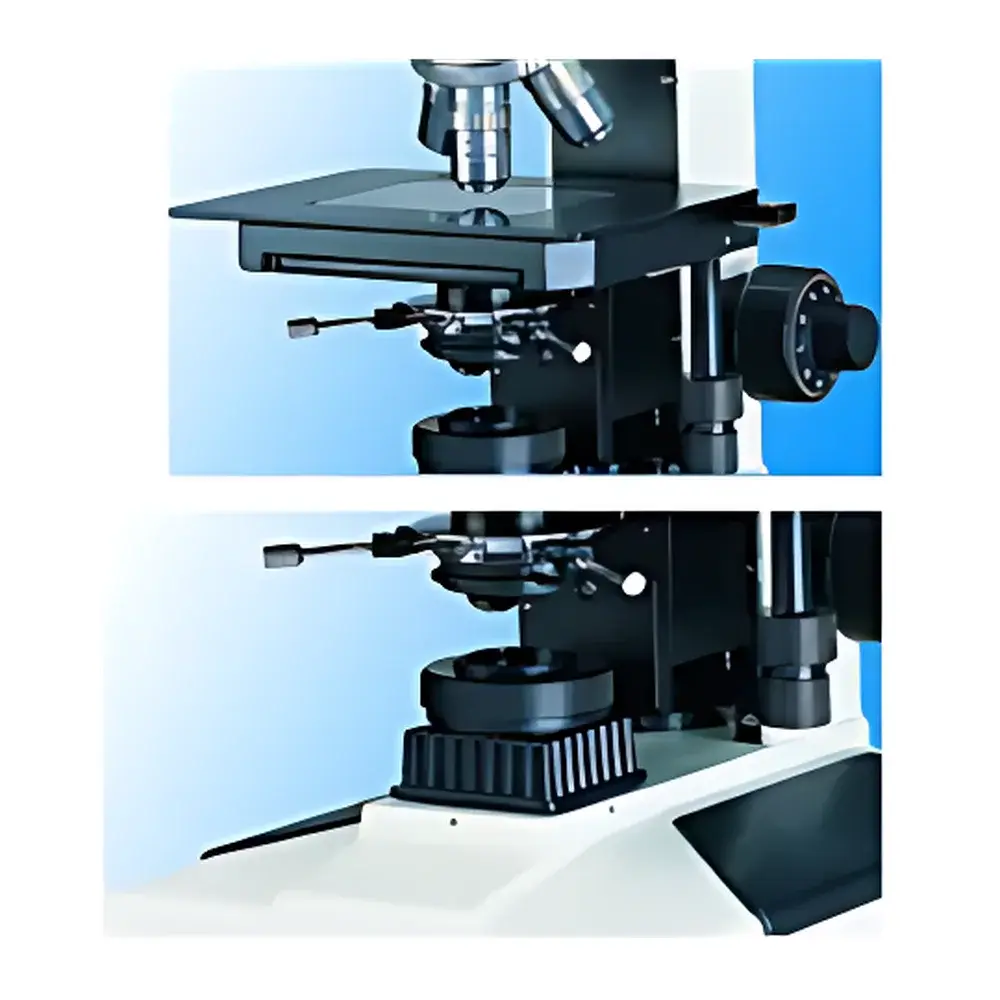
- Dual independent illumination systems: 6 V / 20 W halogen epi-illuminator with adjustable brightness, field and aperture diaphragms, push-pull polarizer, and selectable color filters (green, blue, yellow) plus ground glass diffuser; transmitted-light Abbe condenser (NA 1.25), height-adjustable, with blue filter and ground glass.
- Large dual-layer mechanical stage (185 × 140 mm), 75 × 50 mm travel range, coaxial coarse/fine focus mechanism with 2 µm fine-focus graduation, tension adjustment, locking lever, and upper/lower limit stops.
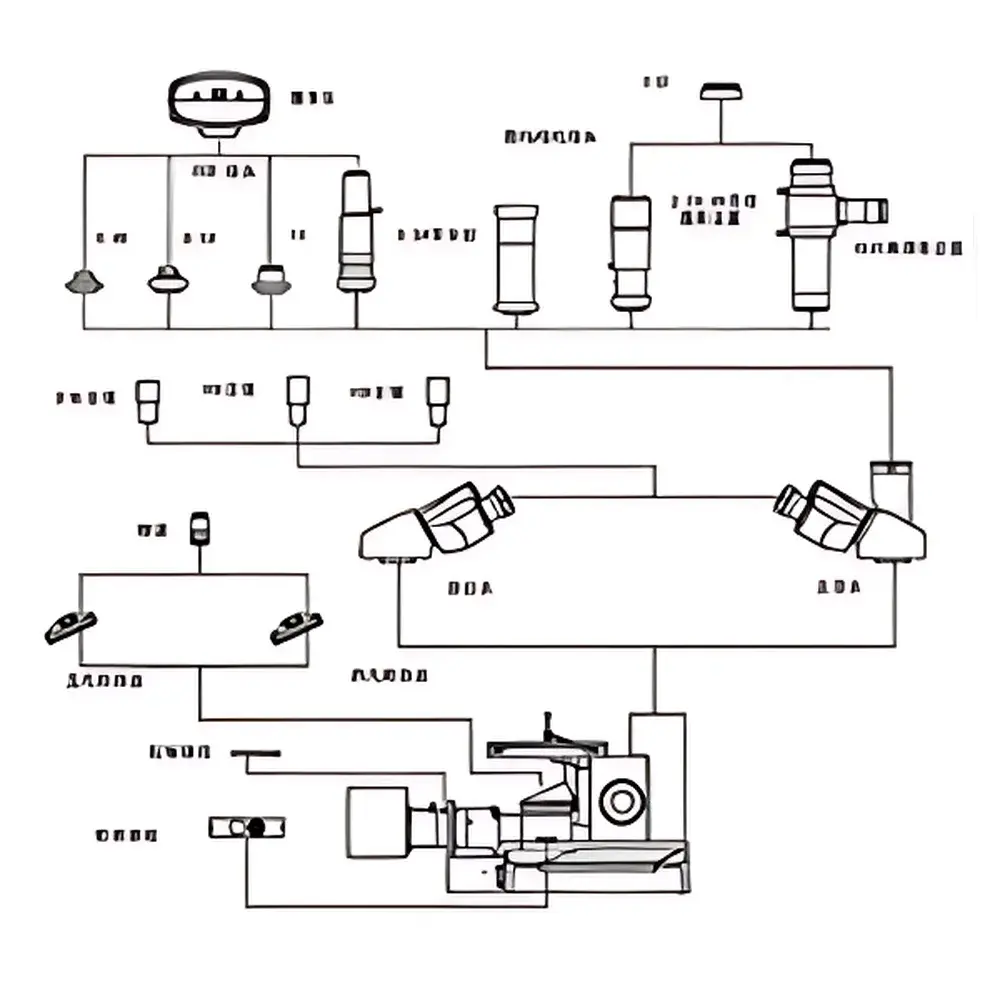
- Integrated MOS (Multi-Optical System) optical train ensuring high transmission efficiency, minimal chromatic aberration, and uniform illumination across the full field of view.
Sample Compatibility & Compliance
The MMAS-6 accommodates standard metallographic specimens (up to 30 mm in height), polished or etched cross-sections, thin sections for mineralogical analysis, semiconductor wafers, and coated substrates. Its long working distance objectives permit unobstructed access for micro-hardness indentation, thermal stage integration, or in-situ manipulation. The system conforms to core metrological requirements outlined in ASTM E112 (grain size determination), ISO 643 (steel microstructure classification), and GB/T 6394 (Chinese national standard for metallographic grain size). All optical components meet ISO 10110 surface quality specifications. When configured with validated hardware (e.g., calibrated CCD camera, certified stage micrometer), the full measurement chain supports GLP-compliant documentation and traceable reporting per ISO/IEC 17025 laboratory accreditation frameworks.
Software & Data Management
The proprietary MMAS (Metallurgical Microscope Analysis System) software suite provides a regulated, standards-based workflow for quantitative image analysis. It includes over 400 preconfigured modules aligned with ASTM, ISO, GB, and JIS metallographic standards—including automatic grain size rating (ASTM E112, E1382), inclusion quantification (ASTM E45), phase fraction analysis, and carbide network assessment. Core functionalities include geometric measurement (line, polygon, circle, angle, area), multi-image stitching, focus stacking (Z-stack compositing), and 3D topographic reconstruction via structured light projection (optional module). Reports are generated in PDF or editable DOCX formats with embedded metadata (acquisition parameters, calibration logs, operator ID, timestamp). Audit trail functionality complies with FDA 21 CFR Part 11 requirements when deployed with user authentication, electronic signatures, and immutable log archiving.
Applications
- Quality assurance in foundries, forging plants, and heat treatment facilities for microstructure verification against material specifications.
- Failure analysis laboratories conducting fracture surface evaluation, corrosion morphology mapping, and intergranular attack assessment.
- R&D departments in aerospace, automotive, and energy sectors performing weld zone characterization, precipitation hardening analysis, and creep damage quantification.
- Academic institutions teaching metallurgy, materials engineering, and geological sciences using standardized image libraries and automated grading tools.
- Electronics manufacturing for solder joint inspection, PCB trace integrity analysis, and thin-film uniformity validation.
FAQ
What types of samples can be observed with the MMAS-6?
The system supports opaque metallic specimens (e.g., steel, aluminum, titanium alloys), transparent thin sections (minerals, polymers), and semi-transparent coatings or layered structures—using either epi- or trans-illumination as appropriate.
Is the MMAS software compliant with regulatory documentation requirements?
Yes—when deployed with role-based access control, electronic signature capability, and audit-trail logging enabled, the MMAS software meets documentation integrity criteria under FDA 21 CFR Part 11 and ISO/IEC 17025.
Can the system be upgraded with higher-magnification objectives?
Yes—the standard four-objective turret accepts optional five-position turrets and extended LWD objectives up to 100X/0.85 dry or 100X/1.25 oil immersion, subject to mechanical clearance and condenser compatibility.
Does the MMAS-6 support automated stage positioning or motorized focus?
Motorized XYZ stage and autofocus modules are available as OEM-integrated options, enabling repeatable multi-site acquisition and Z-stack generation for volumetric analysis.
What file formats does the MMAS software export?
Raw images are saved in TIFF or BMP; analytical results and reports export to PDF, XLSX, and DOCX with embedded calibration metadata and measurement uncertainty annotations.



