
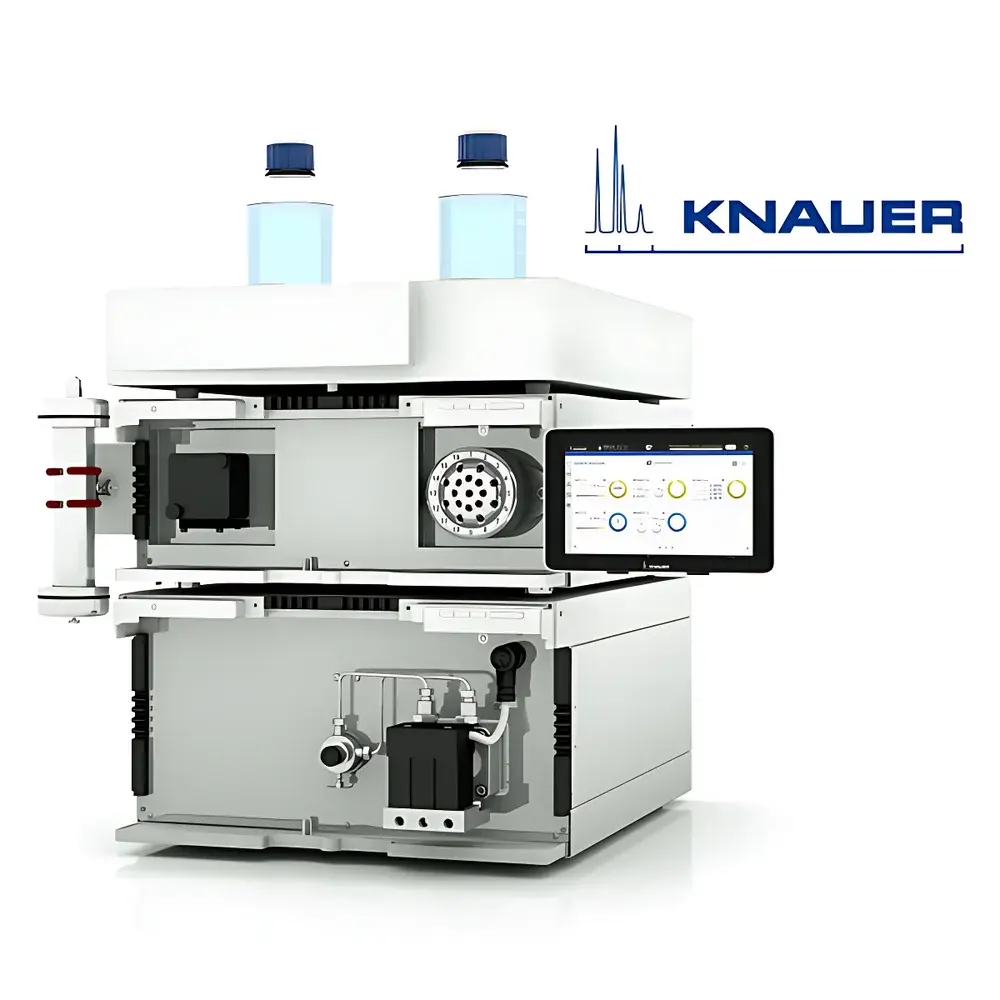
Knauer AZURA Preparative Medium-Pressure Liquid Chromatography System
| Brand | Knauer |
|---|---|
| Origin | Germany |
| Manufacturer Type | Authorized Distributor |
| Product Category | Imported Instrument |
| Model | AZURA P 2.1S / P 4.1S Series |
| Application Level | Laboratory-Scale Preparative |
| Instrument Type | Medium- to Low-Pressure Preparative LC |
| Flow Rate Range | 0–800 mL/min |
| Flow Accuracy | RSD ≤ 0.1% |
| Flow Precision (Repeatability) | RSD ≤ 1.0% |
| Maximum Operating Pressure | 30 MPa |
| UV Wavelength Range | 190–700 nm (±2.5 nm accuracy) |
| Wavelength Repeatability | ±0.3 nm |
| Baseline Noise | ≤3 × 10⁻⁵ AU (at 254 nm, 1 s time constant) |
| Data Acquisition Rate | 50 Hz |
Overview
The Knauer AZURA Preparative Medium-Pressure Liquid Chromatography System is an engineered solution for scalable, reproducible purification of organic small molecules, natural products, peptides, fermentation metabolites, and functional organic materials. Designed as a direct replacement for labor-intensive flash chromatography and manual column packing, this system operates on the principle of medium-pressure liquid chromatography (MPLC), delivering controlled solvent delivery, real-time UV detection, and programmable fraction collection at pressures up to 30 MPa. Its modular architecture supports method development from analytical scouting through gram-scale isolation—bridging the gap between analytical HPLC and industrial preparative systems. The system complies with fundamental requirements for GLP-compliant laboratory environments and serves as a validated platform for early-stage compound purification in pharmaceutical discovery, natural product chemistry, and synthetic methodology development.
Key Features
- Titanium-alloy high-pressure pump modules engineered for chemical resistance across extreme pH ranges (pH 0–14) and high-ionic-strength mobile phases—including TFA, HFIP, phosphoric acid, and ammonium acetate buffers.
- Automated plunger wash function integrated into each pump head to prevent crystallization and seal degradation during prolonged use with volatile or salt-containing solvents.
- Modular flow path design: Interchangeable pump heads enable seamless upgrade from 100 mL/min (P 2.1S) to 800 mL/min (P 4.1S), supporting method translation from mg- to multi-gram scale without hardware replacement.
- Dual-wavelength UV/Vis detector with thermoelectrically stabilized flow cell, offering wavelength accuracy of ±2.5 nm and repeatability of ±0.3 nm—critical for co-elution assessment and peak purity analysis.
- Low baseline noise (≤3 × 10⁻⁵ AU) and high-speed data acquisition (50 Hz) ensure robust integration of narrow, overlapping peaks common in complex natural extract separations.
- Multi-port automated fraction collector with configurable valve options (6-, 12-, or 16-position) and intelligent vial recognition for unattended operation across heterogeneous container formats.
Sample Compatibility & Compliance
The AZURA preparative system accommodates standard stationary phases including silica gel (60–200 µm), reversed-phase C18 (10–25 µm), polymeric resins (e.g., Amberlite, Sephadex), and ion-exchange media. It supports column diameters from 10 mm to 100 mm ID and bed heights up to 30 cm—compatible with both packed and slurry-packed columns. All wetted components comply with USP Class VI and FDA 21 CFR Part 11-ready firmware architecture. System validation documentation (IQ/OQ/PQ protocols) is available upon request. The platform meets core requirements of ISO/IEC 17025 for testing laboratories and supports audit trails, electronic signatures, and user-access-level configuration per GMP/GLP workflows.
Software & Data Management
Controlled via AZURA Control Center software (Windows-based), the system provides full method scripting, real-time chromatogram overlay, peak tracking, and fraction triggering based on time, volume, or UV threshold. Raw data are stored in vendor-neutral .cdf format compliant with Waters Empower and Agilent OpenLab import standards. Audit trail functionality logs all parameter changes, user logins, and sequence modifications with timestamped, non-erasable records. Optional integration with LIMS via OPC UA enables centralized sample tracking and batch reporting across multi-instrument laboratories.
Applications
- Purification of synthetic intermediates and APIs under non-GMP research conditions
- Isolation of bioactive constituents from plant extracts, marine organisms, and microbial broths
- Desalting and buffer exchange of synthetic and recombinant peptides (up to 50 residues)
- Separation of regioisomers and diastereomers where resolution exceeds analytical HPLC capacity
- Material science applications: purification of conjugated oligomers, MOF precursors, and ligand-functionalized nanoparticles
- Method scouting for downstream process-scale chromatography (e.g., transfer to ÄKTA or Jasco systems)
FAQ
What column dimensions and particle sizes are supported?
Standard configurations support columns from 10 × 100 mm to 100 × 300 mm (ID × length), with particle sizes ranging from 10 µm (C18) to 200 µm (flash silica). Custom-packed columns up to 150 mm ID may be operated with optional high-flow manifolds.
Can the system be used for pH-gradient or salt-gradient elution?
Yes—the titanium pump and PEEK/PEEK-silicone fluidic path tolerate pH 0–14 and ionic strengths up to 2 M NaCl; gradient mixing is performed via high-precision dual-pump low-dead-volume blending.
Is remote monitoring or unattended overnight operation possible?
Fully supported: The system includes Ethernet connectivity, SMTP-based email alerts for completion or error states, and scheduled start/stop via Windows Task Scheduler integration.
Does Knauer provide method development support or application notes?
Yes—comprehensive application notes for natural product isolation, peptide purification, and chiral separation are publicly available on the Knauer website; method optimization consulting is offered through regional application specialists.
How is calibration traceability maintained for flow and UV performance?
Flow accuracy is verified using gravimetric measurement per ISO 5725; UV wavelength and photometric accuracy are validated using NIST-traceable holmium oxide and potassium dichromate reference standards.






