
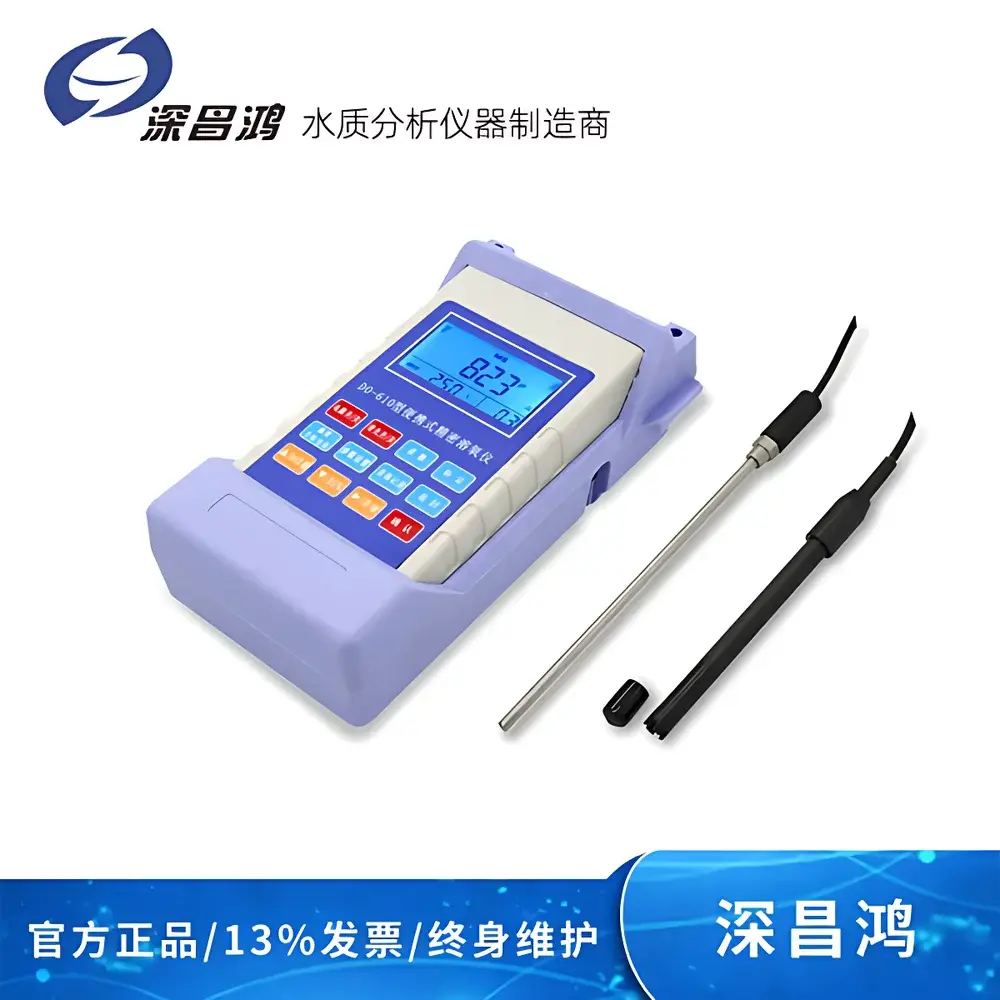
Shenchanghong DO-610 Portable Dissolved Oxygen Meter
| Brand | Shenchanghong |
|---|---|
| Origin | Guangdong, China |
| Manufacturer Type | Direct Manufacturer |
| Product Origin | Domestic (China) |
| Model | DO-610 |
| Instrument Type | Portable |
| Measurement Principle | Electrochemical Clark-type Polarographic Sensor |
| Measurement Range | DO: 0.0–20.0 mg/L (or 0–200% saturation) |
| Temperature | 0–100 °C |
| Accuracy | ±3% of reading (DO), ±1 °C (temperature) |
| Repeatability | ±5% |
| Detection Limit | 0.01 mg/L |
| Automatic Temperature Compensation Range | 0–40 °C |
| Calibration Points | 1-point or 2-point (air-saturated water or zero-oxygen solution) |
| Salinity Compensation Range | 0–35 g/L |
| Atmospheric Pressure Setting Range | 0.5–1.5 atm |
| Power Supply | One 9 V alkaline battery |
| Dimensions | 75 × 140 × 38 mm |
| Weight | <220 g |
| Data Storage Capacity | 99 measurement records with timestamp and metadata (DO, % sat, T, salinity, pressure) |
Overview
The Shenchanghong DO-610 Portable Dissolved Oxygen Meter is an engineered field-deployable instrument designed for precise, real-time quantification of dissolved oxygen (DO) concentration in aqueous environments using the Clark-type polarographic electrochemical principle. This method relies on a cathodic reduction of molecular oxygen at a noble metal electrode (typically gold or platinum) under a fixed applied potential, generating a diffusion-limited current proportional to the partial pressure of O₂ in the sample. The sensor incorporates a gas-permeable membrane and internal electrolyte, enabling selective detection while minimizing interference from redox-active species. Unlike optical (luminescence-based) DO sensors, the DO-610 employs a robust, low-maintenance polarographic probe that does not require membrane replacement during routine operation—reducing consumable costs and calibration drift over extended deployments. Its compact form factor, sub-220 g mass, and single 9 V battery power architecture make it suitable for unattended spot-checking across diverse hydrological contexts, including effluent streams, surface water bodies, aquaculture ponds, and laboratory benchtop verification.
Key Features
- Integrated polarographic DO sensor with factory-calibrated stability and no routine membrane replacement required
- Simultaneous measurement of dissolved oxygen (mg/L and % saturation), temperature (°C), and user-configurable salinity and barometric pressure compensation
- Microprocessor-controlled operation with intuitive one-hand keypad interface and LCD with backlight
- Auto-ranging display showing DO in dual units (mg/L and % saturation) with automatic unit conversion
- One- or two-point calibration protocol compliant with ASTM D888-22 (Standard Test Methods for Dissolved Oxygen in Water)
- Programmable salinity coefficient (0–35 g/L) and atmospheric pressure offset (0.5–1.5 atm) to correct for site-specific ionic strength and elevation effects
- Data hold and auto-lock function for stable field readings under variable lighting or flow conditions
- Non-volatile memory storing up to 99 full measurement records—including DO value, saturation %, temperature, salinity setting, pressure setting, and timestamp
- Rugged ABS housing with IP67-rated ingress protection against dust and temporary immersion
Sample Compatibility & Compliance
The DO-610 is validated for use in freshwater, seawater, wastewater, and process water matrices within pH 4–9 and conductivity <10 mS/cm. It meets essential performance criteria outlined in ISO 5814:2012 (Water quality — Determination of dissolved oxygen — Electrochemical probe method) and aligns with QA/QC requirements for environmental monitoring under China’s HJ 506-2009 standard. While not certified for GLP or FDA 21 CFR Part 11 compliance (as a non-networked portable device), its calibration traceability, data integrity features (timestamped storage, no data loss on power interruption), and documented uncertainty budget (±3% DO, ±1 °C T) support auditable field reporting in municipal water utilities, ecological survey programs, and academic research protocols.
Software & Data Management
The DO-610 operates as a standalone field instrument with no proprietary software dependency. All stored measurements are accessible directly via the front-panel display and can be manually transcribed or exported using optional USB-to-serial adapters (not included). No cloud connectivity, firmware updates, or driver installation is required—ensuring operational continuity in remote or offline settings. Each record includes contextual metadata critical for regulatory documentation: DO concentration, % saturation, temperature, configured salinity, and barometric pressure setting. Battery status indicator and low-power auto-shutdown (after 10 minutes idle) extend field usability without compromising measurement fidelity.
Applications
- Wastewater treatment plant process control: monitoring aeration basin DO levels to optimize energy consumption and nitrification efficiency
- Aquaculture management: assessing oxygen stress thresholds in fish hatcheries and shrimp ponds
- Environmental impact assessments: profiling DO stratification in lakes, rivers, and estuaries during seasonal surveys
- Academic teaching labs: introducing fundamental principles of electrochemical sensing, mass transport limitations, and Henry’s law applications
- Drinking water distribution system verification: confirming residual oxygen post-disinfection and during storage tank audits
- Field validation of online DO analyzers used in industrial cooling towers or bioreactors
FAQ
Does the DO-610 require oxygen membrane replacement?
No—the integrated polarographic sensor uses a sealed, maintenance-free membrane assembly rated for continuous operation over 12 months under typical field conditions.
Can the instrument compensate for high-altitude measurements?
Yes—users may manually enter local barometric pressure (0.5–1.5 atm) to correct saturation calculations per ISO 5814 Annex B.
Is temperature measurement independently calibrated?
Yes—the built-in thermistor is factory-traceable to NIST standards and provides ±1 °C accuracy across 0–100 °C.
How is calibration verified in the field?
Using air-saturation (100% DO at known temperature/salinity/pressure) or chemical zeroing with sodium sulfite solution per ASTM D888 Section 9.
What happens to stored data during battery replacement?
All 99 records are retained in non-volatile memory; no data loss occurs when swapping the 9 V battery.
Related Products







