
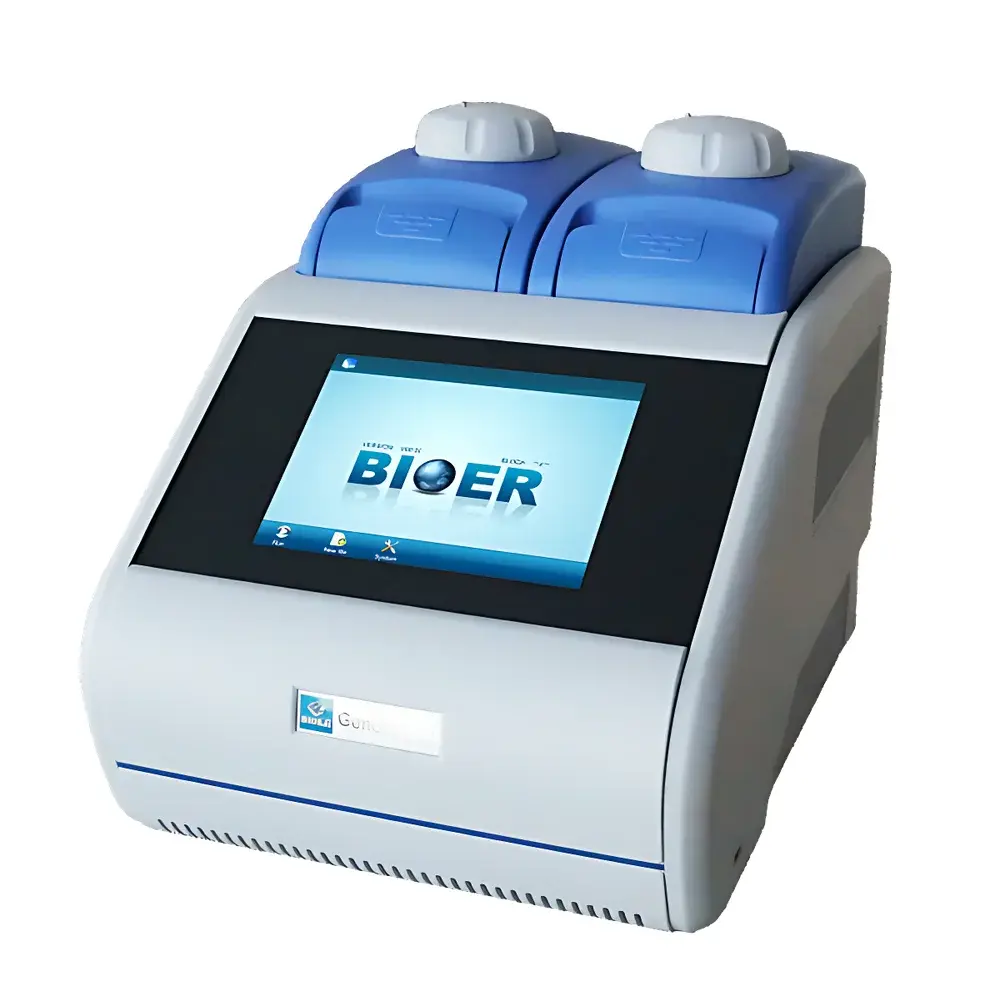
Bioer GeneTouch Plus Dual-Block Gradient PCR Thermal Cycler
| Brand | Bioer |
|---|---|
| Origin | Zhejiang, China |
| Model | B-48DA |
| Instrument Type | Dual-Block Gradient PCR Thermal Cycler |
| Sample Capacity | 2 × 48-well (0.2 mL tubes or 8-tube strips) |
| Heating Rate | >4 °C/s |
| Temperature Accuracy | ≤ ±0.1 °C |
| Block Uniformity | ≤ ±0.2 °C across wells |
| Temperature Range | 4–105 °C |
| Gradient Range | 1–30 °C |
| Max Cycles | 99 with 2-level nesting |
| Time Increment/Decrement | 0–9 min 59 sec |
| Temp Increment/Decrement | 0.1–9.9 °C |
| Control Modes | Block mode and simulated tube mode |
| Interface | RS232, USB, LAN, Bluetooth |
| Power Input | AC 100–240 V, 50/60 Hz, 600 W |
| Dimensions | 457 × 316 × 309 mm (L×W×H) |
| Safety & Compliance | Supports power-fail recovery, intelligent hot lid control, TAS thermal uniformity technology |
Overview
The Bioer GeneTouch Plus Dual-Block Gradient PCR Thermal Cycler is an engineered solution for high-precision nucleic acid amplification in research, clinical diagnostics, and quality control laboratories. Designed around a dual independent Peltier-based thermal block architecture, it implements real-time gradient temperature control across two physically separate 48-well modules—enabling simultaneous optimization of annealing conditions for multiple primer sets or parallel validation of assay parameters. Its core thermal regulation leverages solid-state thermoelectric elements combined with vacuum-assisted heat dissipation, minimizing thermal lag and edge-effect artifacts commonly observed in conventional single-block systems. The instrument operates under both BLOCK and simulated TUBE temperature control modes, ensuring compatibility with standard 0.2 mL PCR consumables while delivering ISO/IEC 17025-aligned thermal reproducibility (≤ ±0.1 °C accuracy, ≤ ±0.2 °C well-to-well uniformity). This architecture supports critical applications including touchdown PCR, long-range PCR, nested PCR, and RT-PCR workflows without hardware reconfiguration.
Key Features
- Dual independent 48-well Peltier blocks with fully programmable gradient profiles (1–30 °C range per block)
- Vacuum-integrated heat sink system enabling rapid thermal transitions (>4 °C/s heating rate) and stable gradient maintenance
- TAS (Thermal Accuracy Stabilization) technology to suppress edge-effect thermal drift and ensure consistent amplification efficiency across all wells
- 6.5-inch capacitive touch display with intuitive bilingual interface (English/Chinese), supporting gesture-based navigation and real-time thermal profile visualization
- Comprehensive protocol flexibility: up to 99 cycles with 2-level nesting for nested PCR; time increment/decrement (0–9:59) for long PCR; temperature increment/decrement (0.1–9.9 °C) for touchdown PCR
- Intelligent hot lid control—automatically deactivates when block temperature falls below user-defined threshold or upon program completion—to prevent condensation and sample evaporation
- Robust data integrity safeguards: built-in power-fail recovery, audit-trail-capable event logging, and non-volatile memory retention of all user protocols and system settings
Sample Compatibility & Compliance
The GeneTouch Plus accommodates standard 0.2 mL PCR tubes and 8-tube strips without adapters, eliminating interstitial air gaps that compromise thermal coupling. Its block geometry and surface finish are calibrated to ASTM E2549-17 specifications for thermal uniformity testing in nucleic acid amplification devices. The system complies with IEC 61010-1:2010 safety requirements for laboratory equipment and meets electromagnetic compatibility standards per EN 61326-1:2013. For regulated environments, the instrument supports GLP/GMP-aligned operation through optional firmware-enabled features including user access levels, electronic signature support, and 21 CFR Part 11-compliant audit trail generation when integrated with validated LIMS or ELN platforms via LAN or USB export.
Software & Data Management
Local operation is managed through the embedded firmware interface, which stores up to 1,000 user-defined protocols with version timestamps and operator IDs. Raw thermal log files (CSV format) and run reports—including cycle-by-cycle temperature deviation metrics—are exportable via USB mass storage or network transfer. Optional Bioer PC Connect software (Windows/macOS) enables remote monitoring, batch protocol deployment, and comparative analysis of thermal performance across instruments. All communication interfaces—RS232, USB Device/Host, 10/100 Mbps Ethernet, and Bluetooth 4.2—support TLS-secured data transmission where enabled by host infrastructure. System firmware updates are delivered as signed binary packages to ensure integrity and traceability.
Applications
- Optimization of primer annealing temperatures using dual-gradient screening across two independent reaction sets
- High-fidelity amplification of GC-rich or repetitive genomic regions via precise ramp-rate control and touchdown cycling
- Validation of multiplex PCR assays requiring differential thermal profiles within a single run
- Preparation of templates for Sanger sequencing, NGS library construction, and qPCR standard curve generation
- RT-PCR workflow execution using Bioer’s certified one-step and two-step reverse transcription kits (e.g., BSB07M1, BSB05M1)
- Quality assurance testing in molecular diagnostic labs operating under CAP or CLIA guidelines
FAQ
Does the GeneTouch Plus support remote scheduling and monitoring?
Yes—via LAN or Bluetooth connectivity, users can initiate runs, monitor real-time block temperature, and receive completion alerts using the Bioer PC Connect application or third-party LabVantage/STARLIMS integrations.
Can the dual blocks run different programs simultaneously?
No—the instrument executes a single thermal profile across both blocks, but each block applies its own gradient offset, enabling independent optimization within one run.
Is the system compatible with third-party PCR consumables?
Yes—it accepts any 0.2 mL thin-wall PCR tubes or 8-tube strips meeting ANSI/SBS dimensional standards (e.g., Axygen, Thermo Fisher, Eppendorf).
What safety certifications does the instrument hold?
It conforms to IEC 61010-1:2010 (safety), EN 61326-1:2013 (EMC), and RoHS 2011/65/EU directives. CE marking is affixed per EU Machinery Directive 2006/42/EC.
How is data integrity ensured during power interruption?
The system retains active protocol state and thermal history in non-volatile memory and resumes from the exact cycle and step upon power restoration—without manual reinitialization.




