
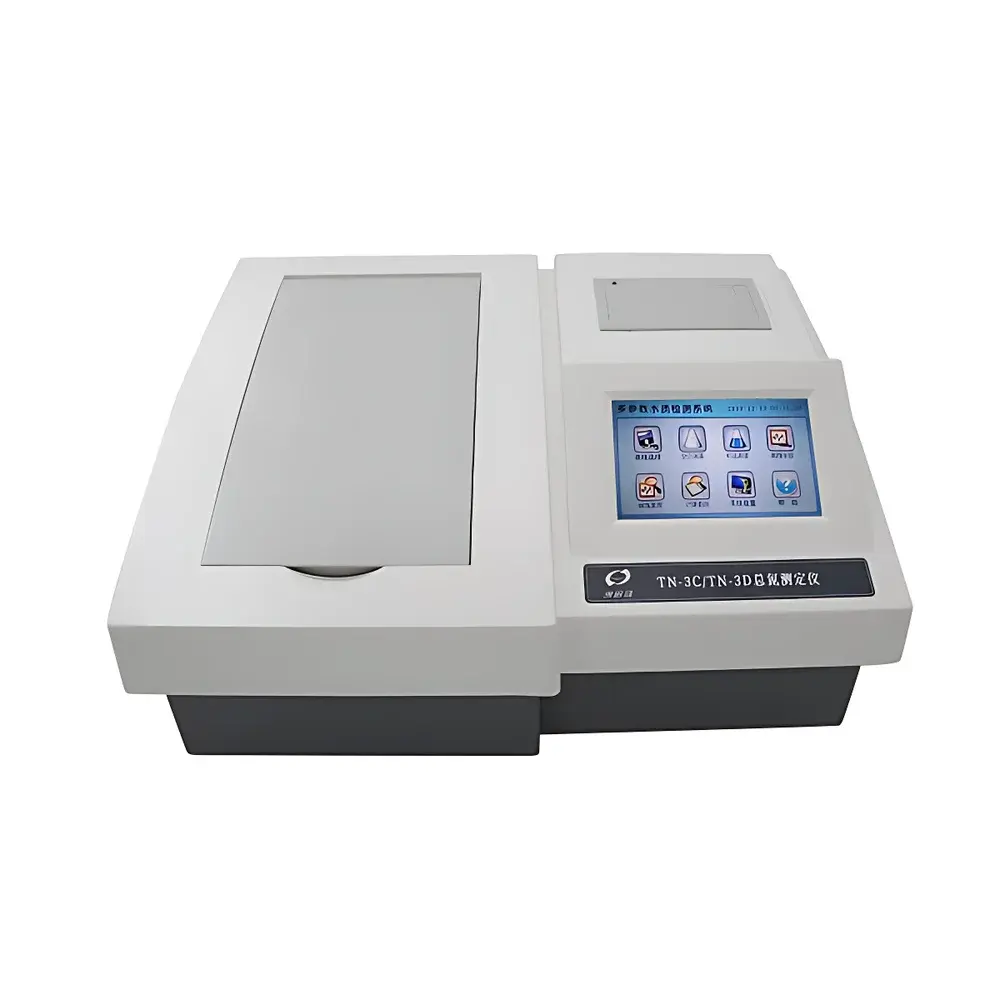
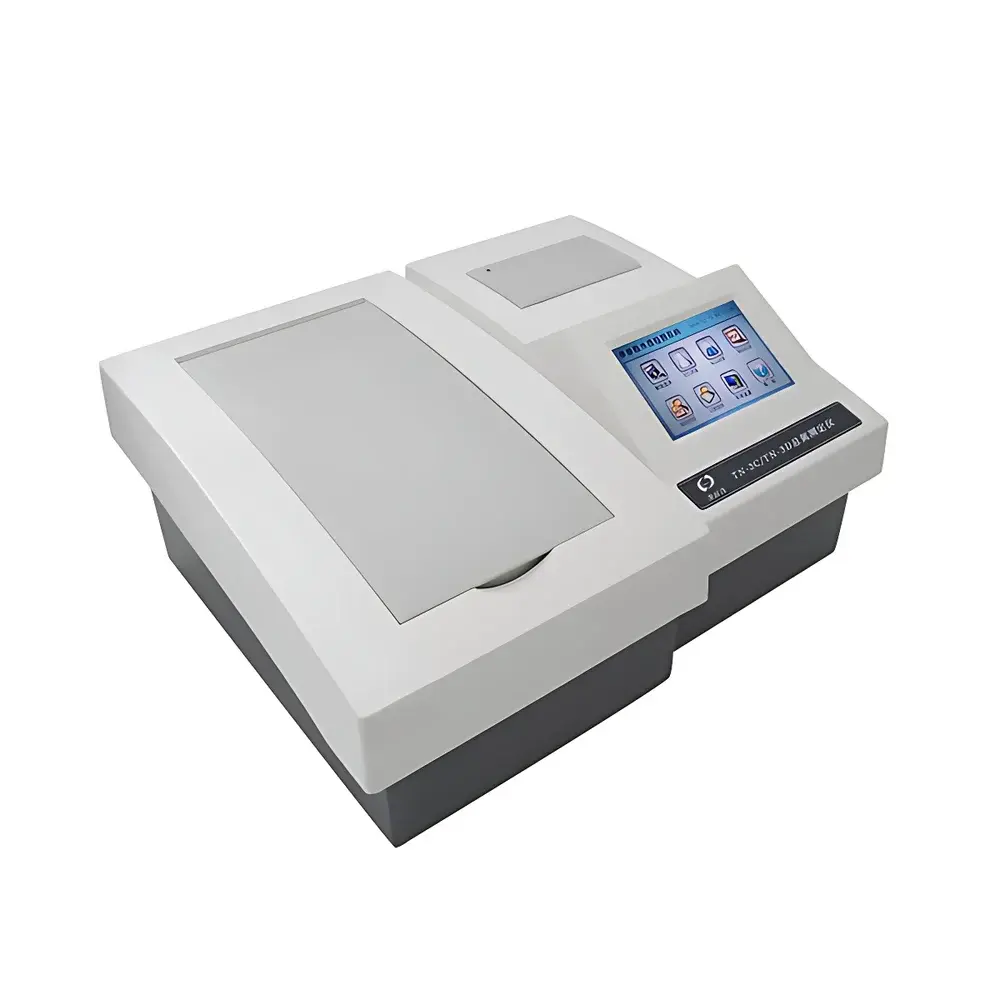
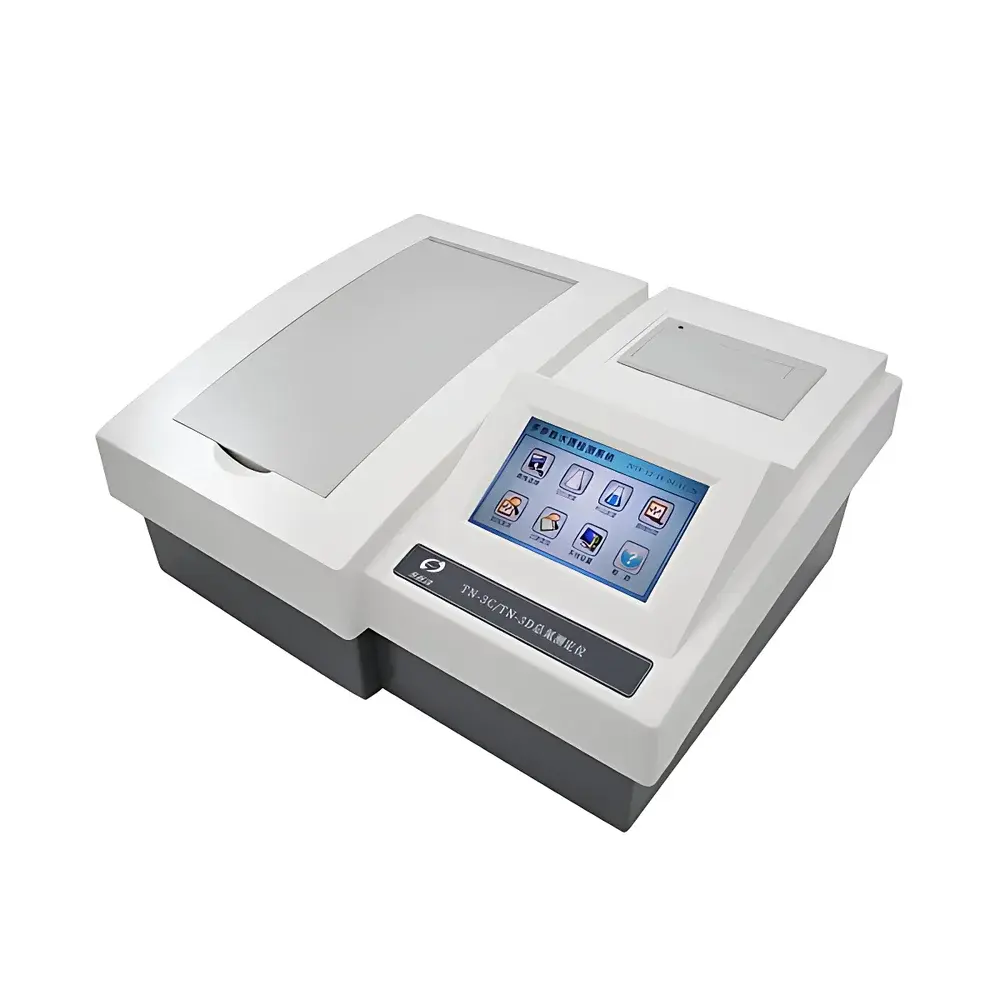
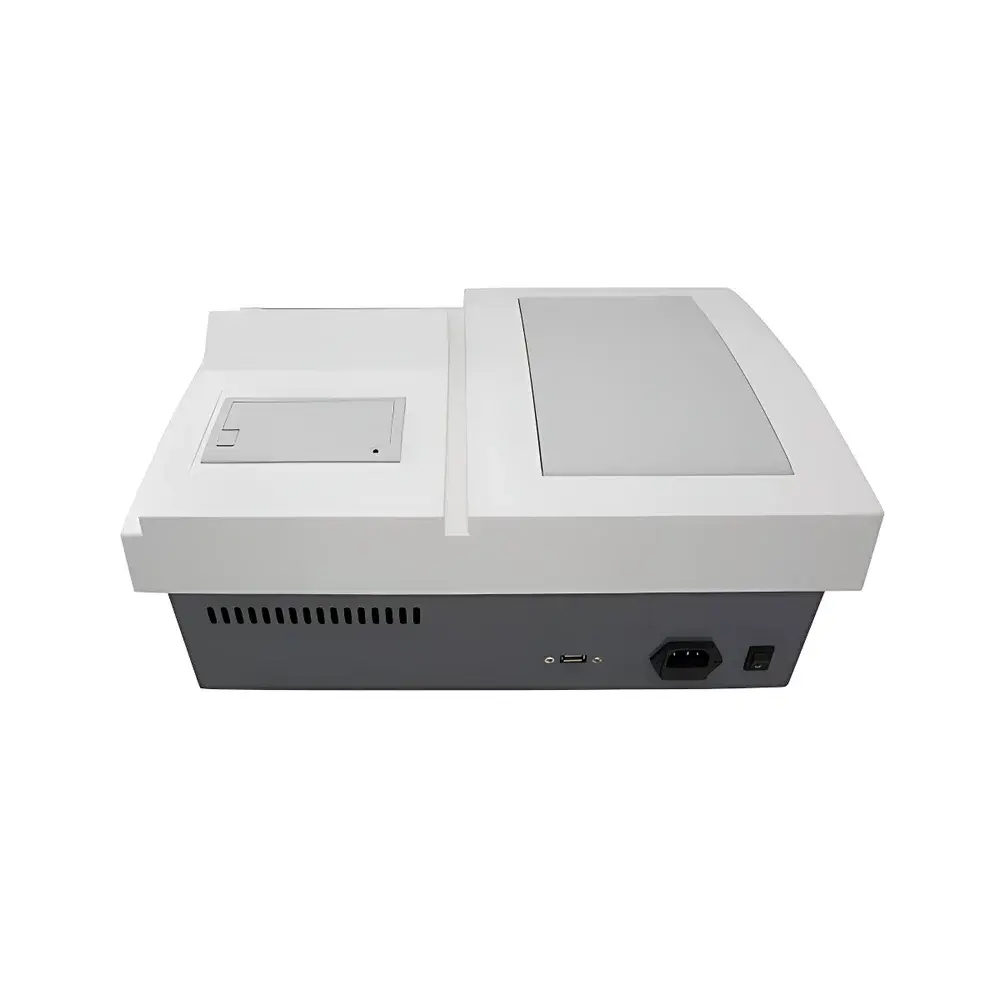
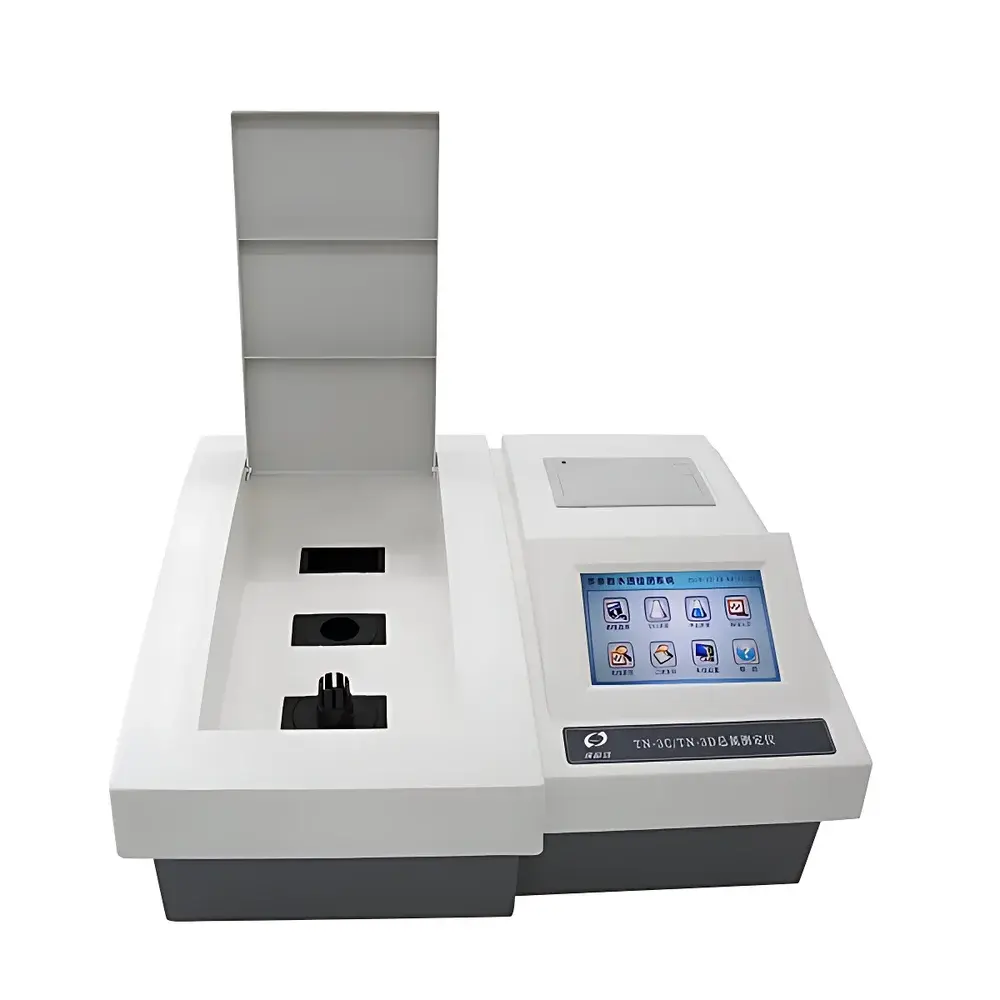
Shenchanghong TN-3C/TN-3D Total Nitrogen Analyzer
| Brand | Shenchanghong |
|---|---|
| Origin | Guangdong, China |
| Manufacturer Type | Manufacturer |
| Product Type | Domestic |
| Model | TN-3C / TN-3D |
| Measurement Parameter | Total Nitrogen (TN) |
| Instrument Category | Laboratory Analyzer |
| Measurement Principle | Alkaline Potassium Persulfate Digestion + UV Spectrophotometry |
| Measurement Range | 0.05–100 mg/L |
| Accuracy | ±5% of reading |
| Repeatability | ≤3% RSD |
| Detection Limit | Not specified (method-dependent |
| Temperature Control Precision | ±0.5 °C |
| Temperature Range | Ambient to 200 °C (digestion setpoint: 125 °C) |
| Digestion Time | 30 min (programmable: 1–9999 min) |
| Optical Stability | Drift < 0.002 A in 20 min |
| Sample Throughput | 16 samples per batch |
| Display | 7-inch color TFT touchscreen with bilingual Chinese/English UI |
| Data Storage | TN-3C — 300 calibration curves + 1,000 measurement records |
| Connectivity | USB port for PC export and firmware update |
| Power Supply | AC 220 V ±10%, 50 Hz, <500 W |
| Dimensions (Analyzer) | 400 × 310 × 158 mm |
| (Digestor DIS-16B) | 355 × 260 × 135 mm |
| Weight (Analyzer) | 4 kg |
| (Digestor) | 5.5 kg |
| Operating Environment | 5–40 °C, RH ≤85%, non-condensing, low EMI/vibration |
Overview
The Shenchanghong TN-3C and TN-3D Total Nitrogen Analyzers are dedicated laboratory instruments engineered for accurate, reproducible quantification of total nitrogen (TN) in aqueous environmental samples. These analyzers implement the standardized alkaline potassium persulfate digestion method (aligned with ISO 11905-1, HJ 636–2012, and EPA Method 351.2), followed by ultraviolet (UV) spectrophotometric detection at 220 nm and 275 nm. The dual-wavelength correction compensates for interference from dissolved organic matter and nitrate absorbance overlap, ensuring robustness in complex matrices such as municipal wastewater, industrial effluents, groundwater, and surface water. Unlike integrated benchtop systems, the TN-3C/D architecture decouples digestion and photometric measurement—eliminating thermal crosstalk and preserving optical stability during high-temperature digestion cycles. This separation is critical for long-term precision in regulatory-compliant water quality testing.
Key Features
- Modular design: Independent digestion unit (DIS-16B) and spectrophotometric analyzer prevent heat-induced drift in optical path integrity.
- Cold-light, narrow-band interference optical system with stabilized UV LED sources ensures <0.002 A baseline drift over 20 minutes—meeting ISO 7027-1 requirements for photometric stability.
- Programmable temperature control (ambient to 200 °C) with ±0.5 °C accuracy and multi-point calibration eliminates sensor nonlinearity errors common in generic heating blocks.
- Bilingual 7-inch capacitive touchscreen interface supports intuitive workflow navigation, real-time status feedback, and context-sensitive help—reducing operator training time and procedural error.
- Integrated self-calibration and curve recovery functions mitigate long-term signal drift and safeguard data continuity after power interruption or accidental reset.
- Dual safety architecture in the digestor: automatic shutdown at >200 °C plus programmable timer-based termination ensures compliance with OSHA and IEC 61010-1 lab safety standards.
- TN-3D variant includes upgraded optical electronics and enhanced signal processing algorithms, delivering improved repeatability (≤2.5% RSD) and extended calibration curve capacity (3,500 curves).
Sample Compatibility & Compliance
The TN-3C/D series is validated for use with untreated and filtered liquid samples conforming to standard environmental sampling protocols (e.g., EPA SW-846 Chapter 3, ISO 5667-3). Compatible matrices include raw sewage, treated effluent, river/lake water, groundwater, and industrial process streams—with no requirement for pre-filtration beyond standard 0.45 µm membrane filtration when particulate nitrogen is targeted. The system adheres to key regulatory frameworks: calibration traceability aligns with ISO/IEC 17025 requirements; data integrity features (user login, audit trail metadata, timestamped calibration logs) support GLP and GMP-aligned QA/QC programs; and instrument validation documentation satisfies internal SOP development for laboratories under CNAS, CMA, or state-level environmental monitoring accreditation.
Software & Data Management
- On-device storage retains up to 1,000 (TN-3C) or 100,000 (TN-3D) measurement records with full metadata: sample ID, operator code, calibration curve ID, digestion parameters, absorbance values at 220/275 nm, and calculation timestamp.
- Calibration curve archives preserve not only polynomial coefficients but also original standard concentrations, measured absorbances, calibration date/time, and technician ID—enabling full traceability and reprocessing capability.
- USB interface enables direct export of CSV-formatted reports and raw spectral data to Windows-based LIMS or Excel-compatible platforms. Optional software package provides automated report generation compliant with Chinese HJ/T 91–2002 reporting templates.
- No cloud dependency: All data reside locally on embedded flash memory. Firmware updates are performed via signed USB image files—ensuring cybersecurity alignment with IEC 62443-3-3 for industrial control systems.
Applications
These analyzers serve routine and research-grade TN analysis across municipal wastewater treatment plants (influent/effluent monitoring), environmental protection agencies (surface water surveillance networks), industrial pretreatment facilities (textile, pharmaceutical, food processing), and academic environmental chemistry laboratories. Typical use cases include compliance verification against discharge limits (e.g., GB 18918–2002 Class I-A), nutrient loading assessments in watershed studies, method comparison studies versus Kjeldahl-TN or TN-CL chemiluminescence, and QA/QC auditing of third-party lab results. The 16-position batch capacity and 30-minute standardized digestion protocol enable throughput of ~30 samples per 8-hour shift—optimized for medium-volume environmental testing labs.
FAQ
What digestion method does the TN-3C/D employ?
It uses alkaline potassium persulfate oxidation at 125 °C, converting all nitrogen species (organic N, NH₄⁺, NO₂⁻, NO₃⁻) to nitrate prior to UV detection.
Is the instrument compatible with international standards such as ISO or EPA methods?
Yes—the methodology conforms to ISO 11905-1 (water quality—determination of total nitrogen—alkaline persulfate digestion method) and EPA Method 351.2 (determination of total Kjeldahl nitrogen by automated colorimetry).
Does the system support electronic record retention for regulatory audits?
Yes. Each measurement stores operator ID, calibration history, digestion parameters, and raw absorbance data—providing full ALCOA+ compliant traceability without external database dependencies.
Can the TN-3D store custom calibration curves developed in-house?
Yes. Up to 3,500 user-defined curves can be saved, each with editable name, equation type (linear, quadratic, cubic), and associated standard reference material IDs.
What maintenance is required to sustain optical accuracy?
Annual verification of wavelength accuracy (using NIST-traceable holmium oxide filter) and photometric linearity (neutral density filters) is recommended; no lamp replacement is needed due to solid-state UV LED design.
Related Products







