
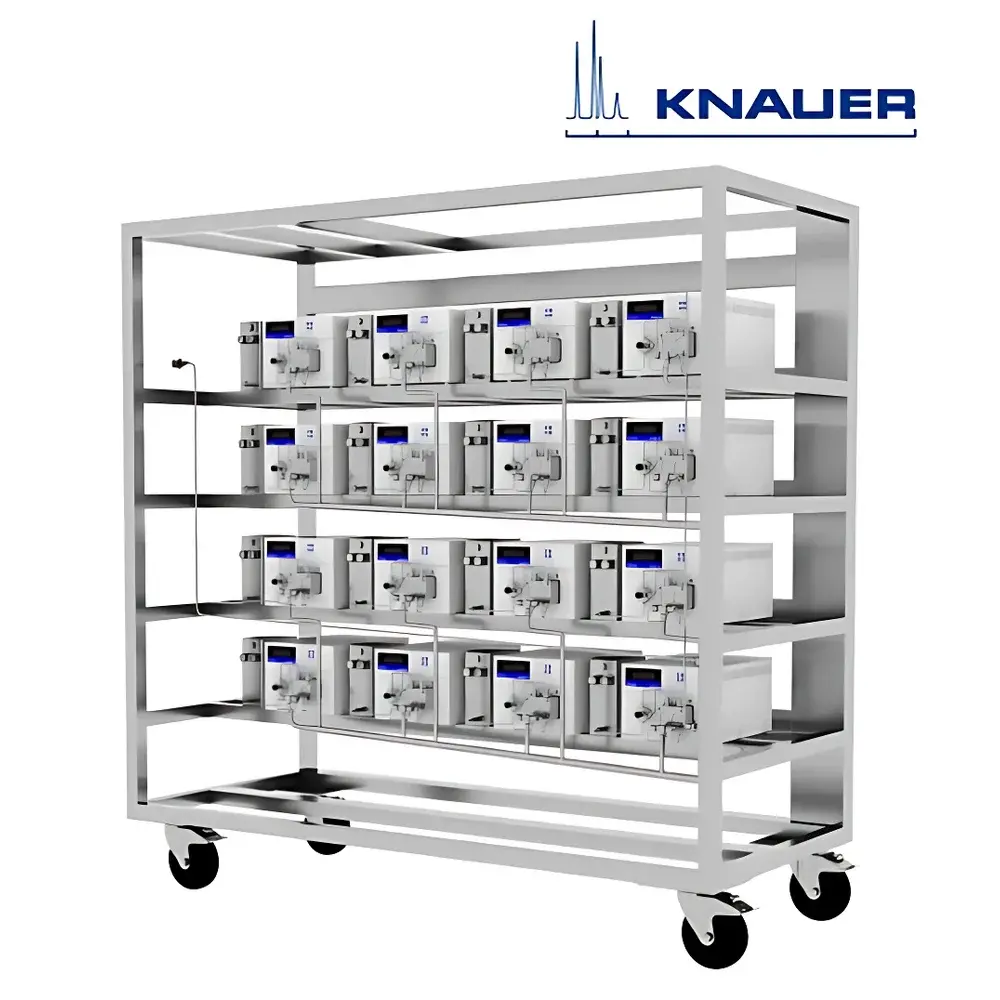
KNAUER IJM Impingement Jet Mixing System – Customized NanoProducers
| Brand | KNAUER |
|---|---|
| Origin | Germany |
| Manufacturer Type | Authorized Distributor |
| Origin Category | Imported |
| Model | Customized NanoProducers |
| Instrument Type | Microfluidic Impingement Jet Homogenizer |
| Dimensions (W×D×H) | Configuration-Dependent |
| Max Number of IJM Mixers | 8 |
| Max Number of Pumps | 16 |
| Max Number of Coriolis Flowmeters | 16 |
| Inlet Connections | 2 × Hygienic Clamp (DIN 11851 / ISO 2852) |
| Outlet Connection | 1 × Hygienic Clamp |
| Max Operating Pressure | 50–70 bar (725–1015 psi) |
| Flow Temperature Range | 4–60 °C |
| Software | KNAUER CDS (Compliant with FDA 21 CFR Part 11 & GAMP5) |
Overview
The KNAUER IJM Impingement Jet Mixing System – Customized NanoProducers is an engineered microfluidic platform designed for the precise, scalable, and reproducible synthesis of lipid nanoparticles (LNPs), particularly for mRNA vaccine formulation and other nucleic acid therapeutics. It operates on the principle of controlled hydrodynamic impingement: two precisely metered fluid streams—typically an ethanolic lipid solution and an aqueous buffer containing mRNA or other active pharmaceutical ingredients (APIs)—are accelerated to high velocities and directed to collide head-on within a geometrically defined mixing chamber. This rapid, turbulent interfacial contact induces spontaneous nanoprecipitation and self-assembly of lipids around the nucleic acid payload, yielding narrow polydispersity index (PDI) LNPs with high encapsulation efficiency. Unlike passive diffusion-based methods, impingement jet mixing enables millisecond-scale mixing kinetics, minimizing uncontrolled aggregation and Ostwald ripening. The system’s architecture supports both lab-scale process development and GMP-ready tech transfer, with full traceability and audit-ready control logic.
Key Features
- Modular, configurable design supporting up to 8 parallel IJM mixers for multi-parameter screening or scale-out production
- Integrated KNAUER 80P high-pressure precision metering pumps (piston-type, ±0.5% flow accuracy) delivering stable, pulseless flow across 0.1–20 mL/min range per channel
- KNAUER Coriolis mass flowmeters (±0.1% mass flow accuracy) enabling real-time density-compensated volumetric control of organic and aqueous phases
- Stainless steel 1.4301 (AISI 304) structural frame with fully welded hygienic tubing paths and DIN 11851 sanitary clamp connections (2 inlets, 1 outlet per mixer)
- Temperature-controlled fluid path (4–60 °C) via integrated Peltier-cooled jacketed manifolds and inline RTD monitoring
- Automated backflush cleaning sequence with programmable solvent selection (e.g., ethanol/water, IPA, buffer) and pressure ramping
- Full system qualification support: Factory Acceptance Test (FAT) conducted at KNAUER Berlin facility; Site Acceptance Test (SAT) executed under client-defined operational protocols
Sample Compatibility & Compliance
The NanoProducers platform accommodates a broad spectrum of LNP-formulating chemistries—including ionizable lipids (e.g., DLin-MC3-DMA, SM-102), phospholipids (DSPC), cholesterol, and PEG-lipids—as well as diverse nucleic acid payloads (mRNA, siRNA, saRNA, CRISPR RNP). All wetted materials comply with USP Class VI and FDA-compliant elastomers (EPDM, FKM) for biopharmaceutical use. The system meets ISO 13485 design control requirements and supports validation documentation packages aligned with ICH Q5A(R2), Q5B, and Q5D. Process parameters—including flow rate ratio, total flow, pressure, temperature, and quench timing—are fully recordable and enforceable under 21 CFR Part 11-compliant electronic signatures and audit trails.
Software & Data Management
Control and data acquisition are managed via KNAUER’s CDS (Control & Data System) software—a validated, role-based interface compliant with GAMP5 lifecycle standards. CDS provides synchronized logging of all analog/digital I/O signals (pressure transducers, flowmeters, thermocouples, valve states), with timestamped metadata embedded in HDF5-format raw data files. Batch records include electronic batch records (EBRs), deviation tracking, and configurable alarm thresholds with SMS/email escalation. All user actions—login, parameter change, start/stop, cleaning cycle initiation—are captured in immutable audit logs with operator ID, timestamp, and before/after values. Export functions support CSV, PDF, and ASAM-ODS formats for integration into LIMS or MES platforms.
Applications
- Preclinical and clinical-stage LNP formulation development for mRNA vaccines and gene therapies
- DoE-driven optimization of particle size (50–150 nm), PDI (90%)
- Process characterization and robustness studies per ICH Q5C and Q8(R2)
- GMP pilot manufacturing (up to 10 L/h per mixer module) with seamless scalability to commercial continuous manufacturing lines
- Comparative evaluation of lipid libraries, buffer compositions, and mixing geometries
- Quench-integrated workflows for kinetic arrest of nanoparticle growth and stabilization of intermediate species
FAQ
What is the minimum and maximum total flow rate per IJM mixer?
Flow capacity is configuration-dependent; typical operating range spans 1–15 mL/min per mixer, scalable via pump selection and nozzle geometry.
Can the system handle viscous lipid solutions (e.g., >20 cP)?
Yes—high-pressure capability (up to 70 bar) and low-shear pump design enable reliable delivery of ethanolic lipid stocks up to 35 cP at 25 °C.
Is remote monitoring and troubleshooting supported?
CDS includes optional OPC UA server integration and TLS-secured web-based HMI for authorized remote access, subject to client network security policies.
How is sterility assurance addressed during operation?
System supports SIP (steam-in-place) compatibility via external steam supply; all wetted surfaces are electropolished (Ra ≤ 0.4 µm) and passivated per ASTM A967.
Does KNAUER provide process validation support?
Yes—KNAUER offers IQ/OQ protocol templates, URS review, and on-site PQ execution support by certified validation engineers trained in ISPE Baseline Guide Vol. 4.



