
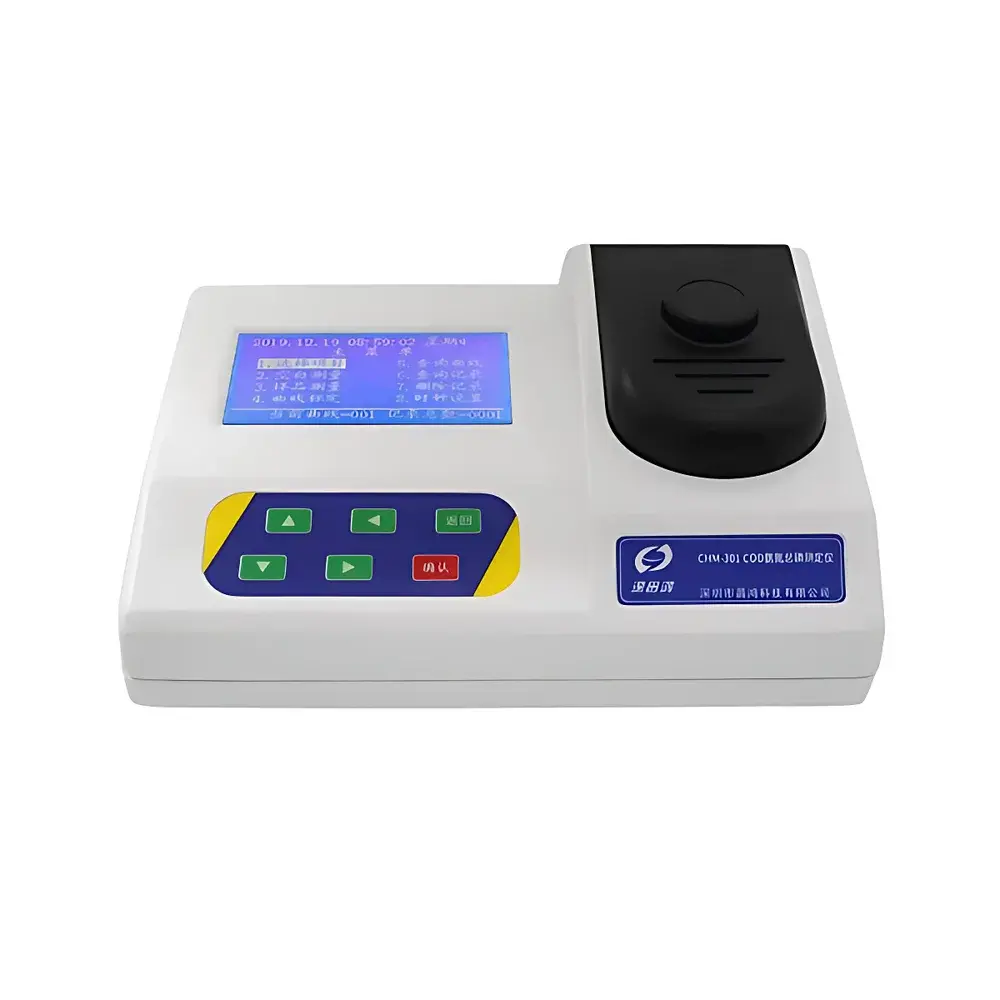
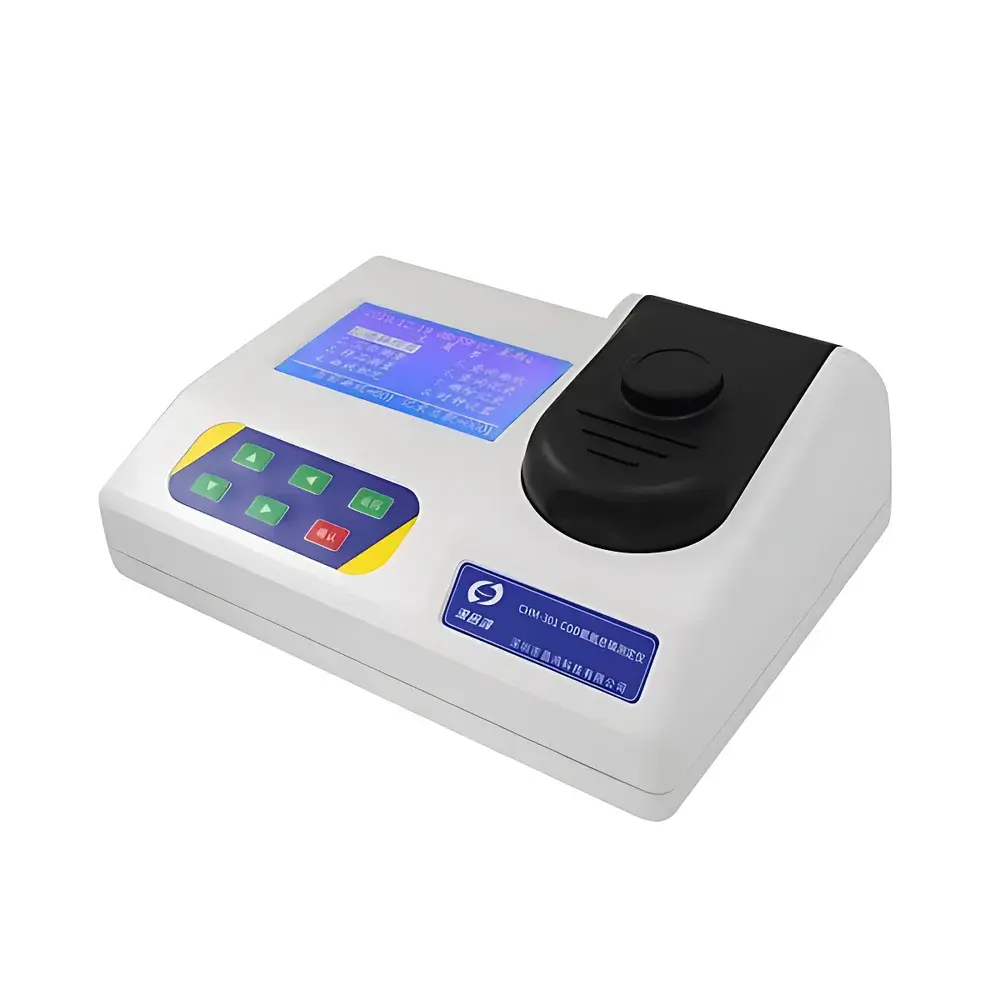
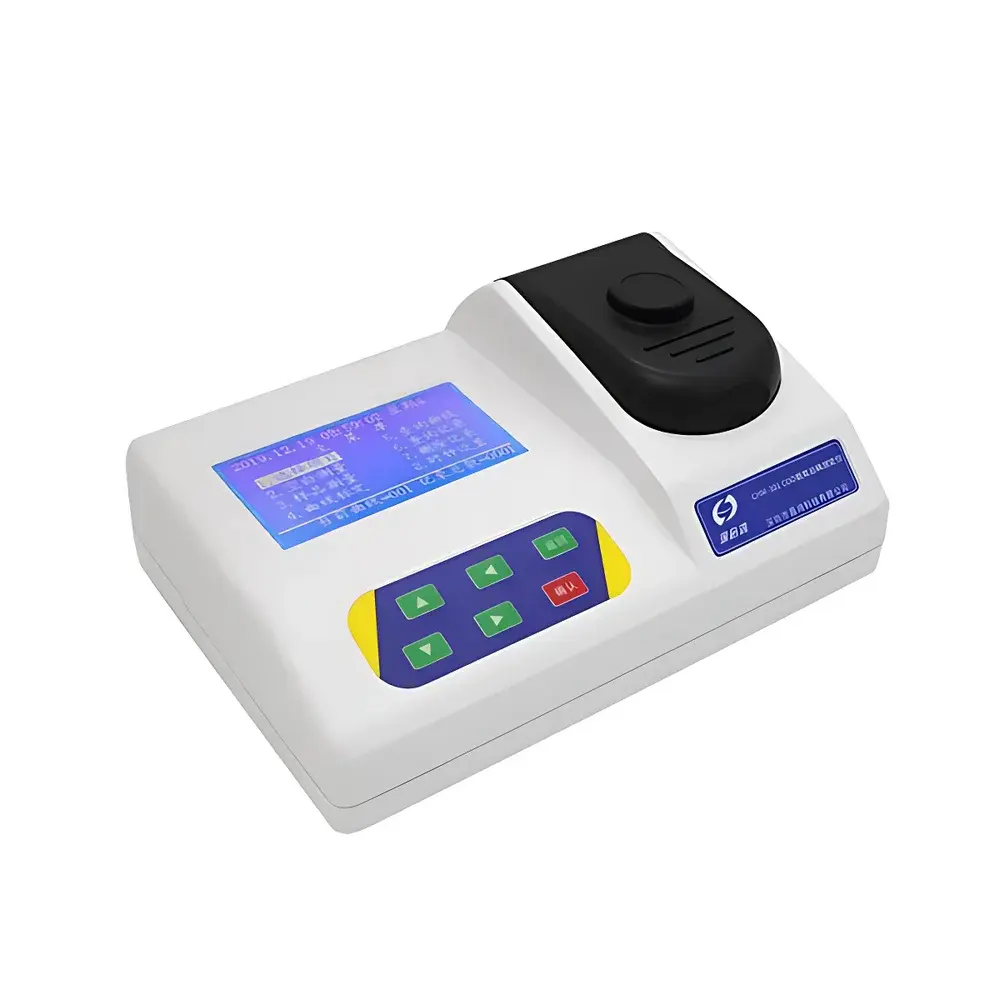
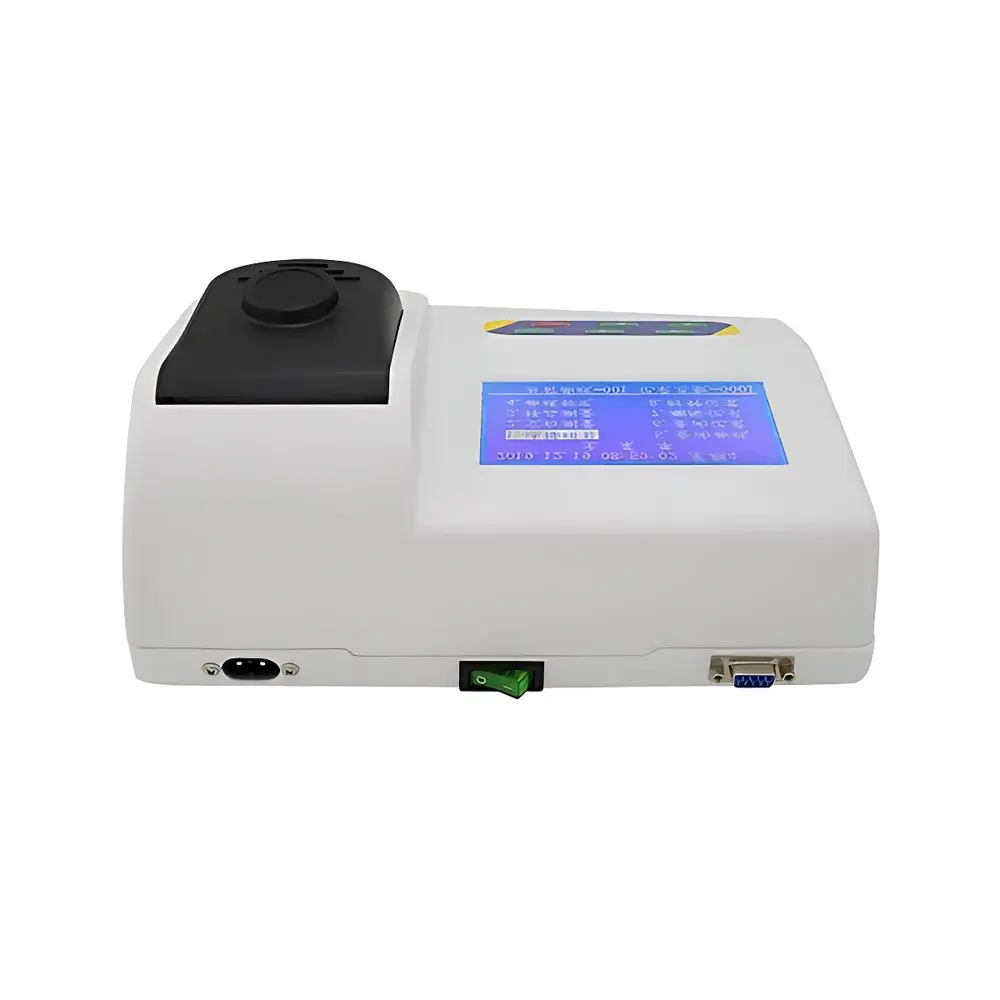
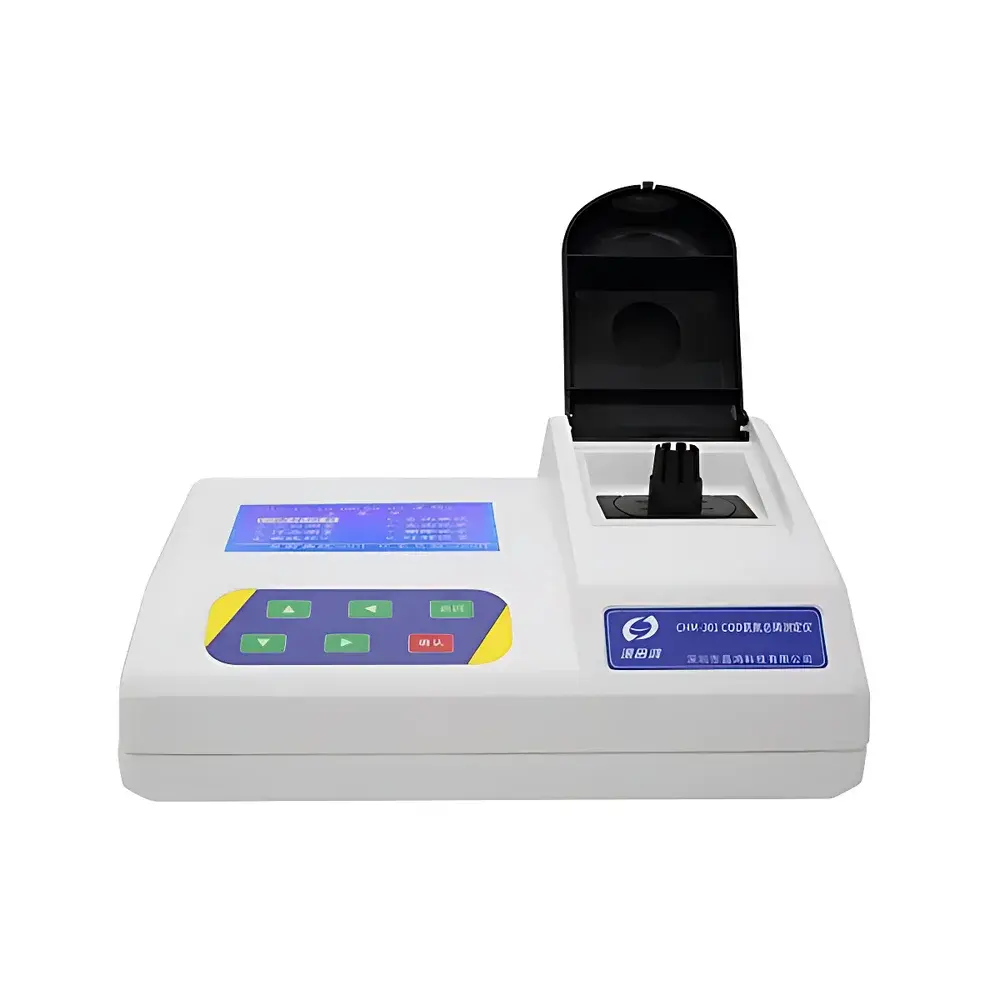
Shenchanghong CHM-301 Benchtop COD, Ammonia-Nitrogen and Total Phosphorus Analyzer
| Brand | Shenchanghong |
|---|---|
| Origin | Guangdong, China |
| Manufacturer Type | OEM Manufacturer |
| Origin Category | Domestic (China) |
| Model | CHM-301 |
| Instrument Type | Laboratory Water Quality Analyzer |
| Measurable Parameters | Chemical Oxygen Demand (COD), Ammonia-Nitrogen (NH₃-N), Total Phosphorus (TP) |
| Optical Stability | Absorbance Drift < 0.002 A within 20 min |
| Repeatability | ≤3% RSD |
| COD Range | 5–2000 mg/L (dilutable) |
| NH₃-N Range | 0.02–25 mg/L |
| TP Range | 0.00–10 mg/L |
| COD Accuracy | ≤±5% |
| NH₃-N Accuracy | ≤±3% or ±0.2 mg/L (whichever is greater) |
| TP Accuracy | ≤±5% or ±0.2 mg/L (whichever is greater) |
| Chloride Interference Tolerance (COD) | ≤2000 mg/L Cl⁻ |
| Dimensions (Analyzer) | 340 × 250 × 130 mm |
| Weight (Analyzer) | 4 kg |
| Power Consumption (Analyzer) | <10 W |
| Digestion Temperature Range | Ambient to 200 °C |
| COD Digestion Temp | 165 °C |
| TP Digestion Temp | 120 °C |
| Temperature Control Accuracy | ±0.5 °C |
| Digestion Time Range | 1–9999 min |
| Standard Batch Capacity | 16 samples (DIS-16B) |
| Display | 3.5″ Color Touchscreen (320×240 px), Bilingual (CN/EN) |
| Power Consumption (Digestor) | <500 W |
| Weight (DIS-16B) | 5.5 kg |
| Dimensions (DIS-16B, w/o shield) | 355 × 260 × 135 mm |
Overview
The Shenchanghong CHM-301 is a benchtop multi-parameter spectrophotometric water quality analyzer engineered for precise, routine quantification of Chemical Oxygen Demand (COD), Ammonia-Nitrogen (NH₃-N), and Total Phosphorus (TP) in laboratory environments. It operates on the principle of colorimetric analysis—where analyte-specific reagents induce chromogenic reactions proportional to concentration—and measures absorbance at optimized wavelengths using a stable LED light source and narrow-band interference filters. Designed for compliance with standard methods including ISO 6060 (COD), ISO 7150-1 (ammonia), and ISO 6878 (total phosphorus), the CHM-301 delivers traceable, reproducible results suitable for environmental monitoring laboratories, municipal wastewater treatment facilities, academic research groups, and regulatory QA/QC departments. Its compact footprint (340 × 250 × 130 mm) and low power draw (<10 W) support integration into space-constrained lab benches without compromising analytical integrity.
Key Features
- Triple-parameter capability: Simultaneous method selection and calibration for COD, NH₃-N, and TP on a single platform—eliminating cross-instrument variability and reducing operational overhead.
- High-stability optical architecture: Equipped with imported long-life (≥100,000 h), high-luminance LEDs and precision narrow-band filters to minimize spectral crosstalk and ambient light interference—ensuring absorbance stability <0.002 A over 20 minutes.
- Bilingual touchscreen interface: 3.5″ color LCD (320×240 resolution) with intuitive Chinese/English menu navigation, real-time parameter display, and on-device data review—reducing training time and operator error.
- User-definable calibration: Supports both factory-loaded standard curves and user-generated calibration functions—enabling method adaptation for matrix-specific corrections or regulatory validation protocols.
- Durable industrial design: Housing fabricated from post-molded ABS with enhanced corrosion resistance—optimized for humid, chemically exposed lab environments.
- Low-power embedded control: 16-bit microcontroller system with optimized firmware for consistent timing, thermal compensation, and error-resilient operation across extended duty cycles.
Sample Compatibility & Compliance
The CHM-301 accepts standard 16 mm round glass or quartz digestion-cuvette tubes (30 supplied), compatible with common EPA, ISO, and GB/T sample preparation workflows. Its measurement ranges meet typical requirements for surface water, effluent, and treated wastewater: COD (5–2000 mg/L, dilutable), NH₃-N (0.02–25 mg/L), and TP (0.00–10 mg/L). The instrument satisfies key performance criteria outlined in ISO/IEC 17025 for testing laboratories—including repeatability ≤3% RSD, accuracy per ISO-defined tolerances, and documented optical drift control. When paired with the DIS-16B (or optional DIS-20B/25B/36B) digestion block—certified to maintain ±0.5 °C temperature uniformity—the full system supports GLP-aligned documentation practices. While not pre-certified to FDA 21 CFR Part 11, audit trails, calibration logs, and user-accessible firmware versioning enable internal validation for GMP-relevant applications.
Software & Data Management
Data acquisition and storage are handled locally via non-volatile memory: up to 1,000 test records—including date/time stamps, sample IDs, measured values, and method identifiers—are retained onboard with timestamped recall. Raw absorbance readings and curve-fit coefficients are accessible for technical review. Export is supported via USB port to CSV-compatible spreadsheets for further statistical analysis or LIMS integration. Firmware updates are performed offline using standard FAT32-formatted USB drives—no cloud dependency or vendor lock-in. All calibration events, digestor temperature profiles, and QC checks generate traceable entries, supporting internal audit readiness and method verification per ISO 17025 Clause 7.7.
Applications
- Environmental monitoring agencies conducting routine compliance testing against national discharge limits (e.g., China’s GB 8978-1996, EU Urban Wastewater Directive).
- Municipal and industrial wastewater treatment plants performing influent/effluent process control and sludge digestion optimization.
- University and government research labs studying nutrient cycling, eutrophication dynamics, or oxidation kinetics in aquatic systems.
- Third-party testing laboratories requiring rapid, cost-effective screening prior to confirmatory ICP-OES or HPLC analysis.
- Educational institutions delivering hands-on training in standard wet-chemistry analytical techniques aligned with APHA Standard Methods (20th/21st ed.).
FAQ
Does the CHM-301 require external PC software for operation?
No—full functionality, including calibration, measurement, data storage, and report generation, is self-contained on the instrument’s embedded system.
Can the CHM-301 be validated for ISO/IEC 17025 accreditation?
Yes—its documented accuracy, repeatability, optical stability, and calibration traceability align with ISO/IEC 17025 Clause 7.2 and 7.7 requirements; users must perform in-house verification per their scope of accreditation.
What digestion protocols does the DIS-16B support out-of-the-box?
Pre-programmed methods include COD (165 °C, 15 min), total phosphorus (120 °C, 30 min), and ammonia distillation-free variants compliant with ISO 7150-1 Annex A.
Is reagent compatibility limited to Shenchanghong-supplied kits?
The CHM-301 accepts any reagent set conforming to the same reaction chemistry and wavelength specifications; however, Shenchanghong kits are pre-validated for accuracy and shelf-life consistency.
How is temperature uniformity verified across the DIS-16B heating block?
Each unit undergoes factory thermal mapping at three load conditions (empty, half-loaded, fully loaded); calibration certificates list max deviation (±0.5 °C) across all 16 positions.







