
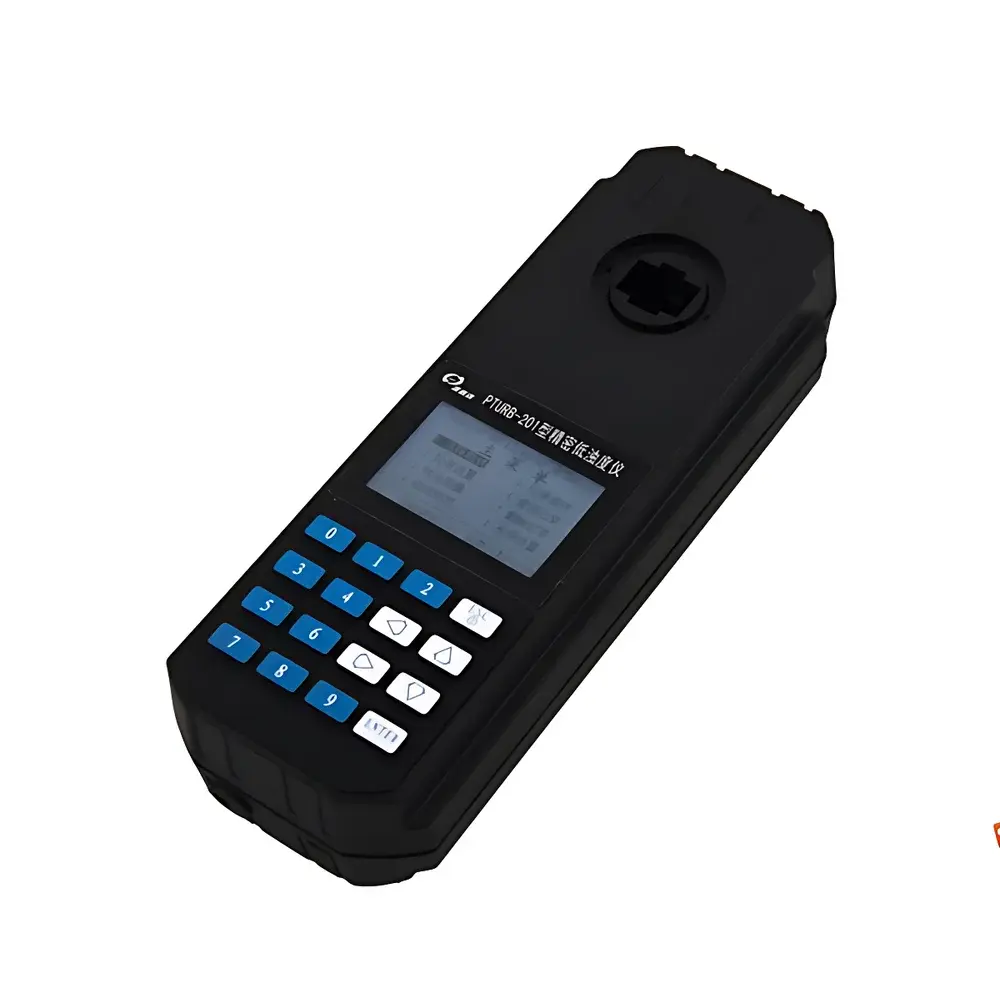
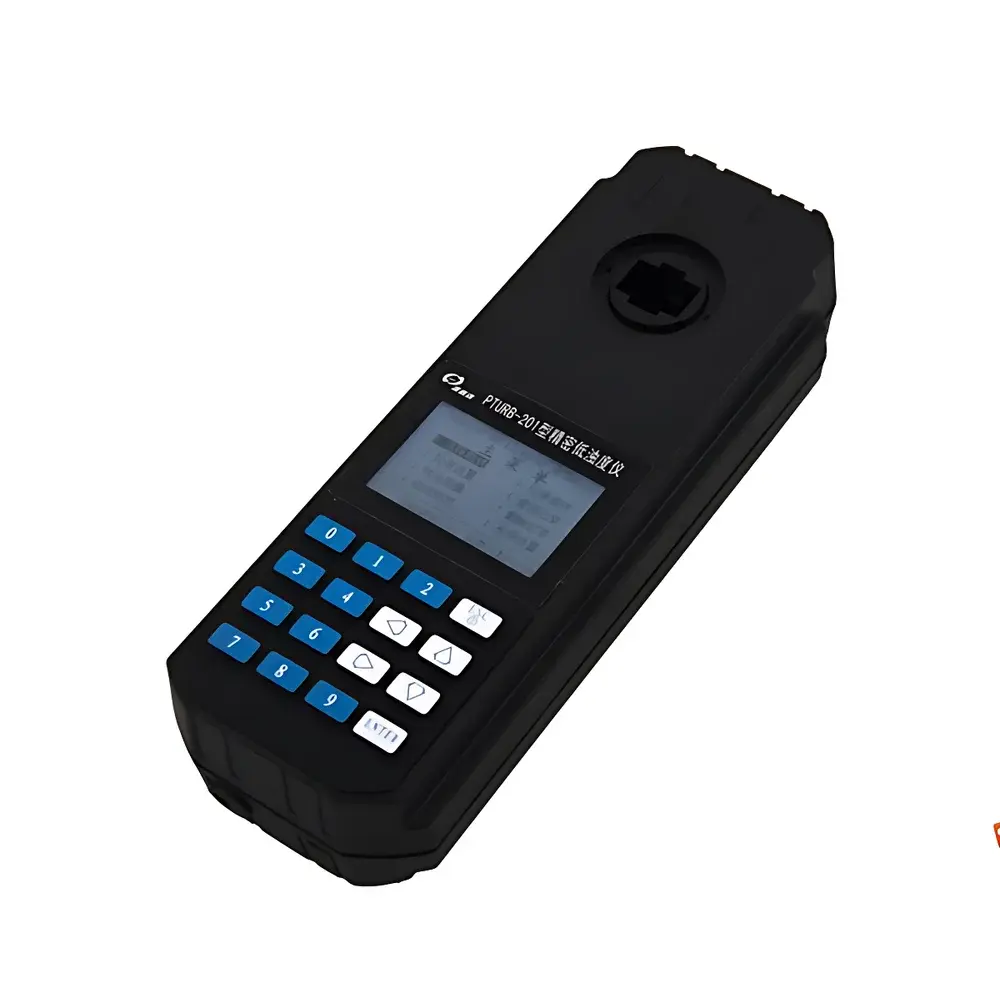
Shenchanghong PTURB-201 Portable Turbidimeter
| Brand | Shenchanghong |
|---|---|
| Origin | Guangdong, China |
| Manufacturer Type | Direct Manufacturer |
| Product Origin | Domestic (China) |
| Model | PTURB-201 |
| Form Factor | Portable |
| Measurement Range | 0–400 NTU |
| Resolution | 0.1 NTU |
| Operating Temperature | 5–40 °C |
| Accuracy | ≤ ±2 % FS |
| Repeatability | ≤ ±2 % FS |
| Drift | < 0.1 NTU/h |
| Display | Backlit LCD with Chinese menu interface |
| Data Storage | 10 calibration curves + 199 measurement records (non-volatile memory) |
| Housing | IP65-rated ABS polymer enclosure |
| Power Supply | AC 220 V ±10 %, 50 Hz |
| Dimensions | 80 × 230 × 55 mm |
| Weight | 1.0 kg |
Overview
The Shenchanghong PTURB-201 Portable Turbidimeter is an ISO 7027-compliant optical instrument engineered for field-deployable and laboratory-grade turbidity measurement in aqueous samples. It operates on the principle of nephelometric detection—measuring the intensity of light scattered at a 90° angle from a collimated near-infrared (NIR) beam—ensuring compliance with international standard methods for turbidity quantification. Designed for high reproducibility under variable environmental conditions, the PTURB-201 integrates a long-life (100,000-hour) high-intensity LED source paired with a precision narrow-band interference filter (center wavelength: 850 nm ±10 nm), minimizing spectral drift and ambient light interference. Its optical architecture delivers stable baseline performance even after extended operation, with thermal drift controlled to <0.1 NTU per hour following a 30-minute warm-up period. The instrument meets core requirements for routine water quality monitoring across regulated and non-regulated environments—including those governed by WHO Guidelines for Drinking-water Quality, EPA Method 180.1, and GB/T 5750.4–2006 (Chinese National Standard for Water Quality Testing).
Key Features
- Nephelometric measurement geometry compliant with ISO 7027 and USEPA Method 180.1
- Stable 850 nm LED light source with integrated thermal compensation and narrow-band optical filtering
- Backlit LCD display with intuitive Chinese-language menu navigation and real-time unit switching (NTU only)
- IP65-rated impact-resistant ABS housing—dust-tight and protected against low-pressure water jets
- Non-volatile memory storing up to 10 user-defined calibration curves and 199 timestamped measurement records
- Low-power 16-bit microcontroller architecture enabling consistent signal processing and minimal thermal noise
- Compact form factor (230 mm × 80 mm × 55 mm) and lightweight design (1.0 kg) optimized for handheld operation and transport
Sample Compatibility & Compliance
The PTURB-201 is validated for use with clear to moderately turbid aqueous solutions, including potable water, process water, pharmaceutical rinse water, beverage formulations, and filtered biological media. It accommodates standard 25 mm round glass cuvettes (included) and supports sample volumes of 10–30 mL. While not designed for highly colored or strongly absorbing matrices (e.g., undiluted fruit juices or wastewater sludge), its 0–400 NTU dynamic range covers >95% of routine municipal and industrial water quality applications. Instrument validation documentation supports GLP-aligned calibration verification protocols. Though not pre-certified for FDA 21 CFR Part 11, its audit-ready data logging structure—including persistent storage without battery backup—facilitates internal compliance with electronic record retention policies under GMP Annex 11 and ISO/IEC 17025.
Software & Data Management
The PTURB-201 operates as a standalone, embedded-system device with no external software dependency. All calibration, measurement, and data recall functions are executed locally via the onboard microcontroller. Calibration is performed using up to three standard reference suspensions (e.g., Formazin or StablCal™), with linear or quadratic curve fitting options stored in non-volatile memory. Each saved measurement includes NTU value, date/time stamp (real-time clock synchronized at power-on), and associated calibration ID. Data export is manual—via visual readout and transcription—making it suitable for facilities requiring air-gapped instrumentation or operating under strict cybersecurity governance. Firmware updates are not supported; hardware revision control is maintained through model-specific serial numbering and factory calibration certificates traceable to NIM (National Institute of Metrology, China).
Applications
- Drinking water treatment: raw intake screening, filtration efficiency verification, and final distribution system monitoring
- Pharmaceutical manufacturing: WFI (Water for Injection) and PW (Purified Water) clarity verification per USP <<788> and EP 2.2.1
- Beverage & brewing QA/QC: post-filtration clarity checks in beer, soft drinks, and bottled water production lines
- Healthcare facilities: sterilization process validation, dialysate water testing, and lab water system surveillance
- Environmental field surveys: surface water and groundwater turbidity profiling in compliance with national monitoring programs
- Academic teaching labs: hands-on instruction in optical sensing principles, calibration methodology, and water quality parameter interrelationships
FAQ
What turbidity standards are compatible with the PTURB-201?
Formazin, StablCal™, AMCO AEPA-1, and custom user-prepared suspensions meeting ISO 7027 spectral criteria.
Is the instrument suitable for continuous online monitoring?
No—it is a portable, batch-mode instrument intended for discrete sampling and spot-checking, not flow-through or immersion probe configurations.
Does the PTURB-201 support USB or Bluetooth data transfer?
No—data output is strictly visual via the LCD screen; no digital communication interfaces are provided.
Can the device be used in outdoor sunlight?
Direct sunlight must be avoided during measurement; the included light-shielding hood mitigates ambient scatter but does not eliminate solar glare interference.
How often does the instrument require recalibration?
Calibration verification is recommended before each measurement session or after every 24 hours of cumulative operation, per ISO/IEC 17025 Clause 7.7.1.




