
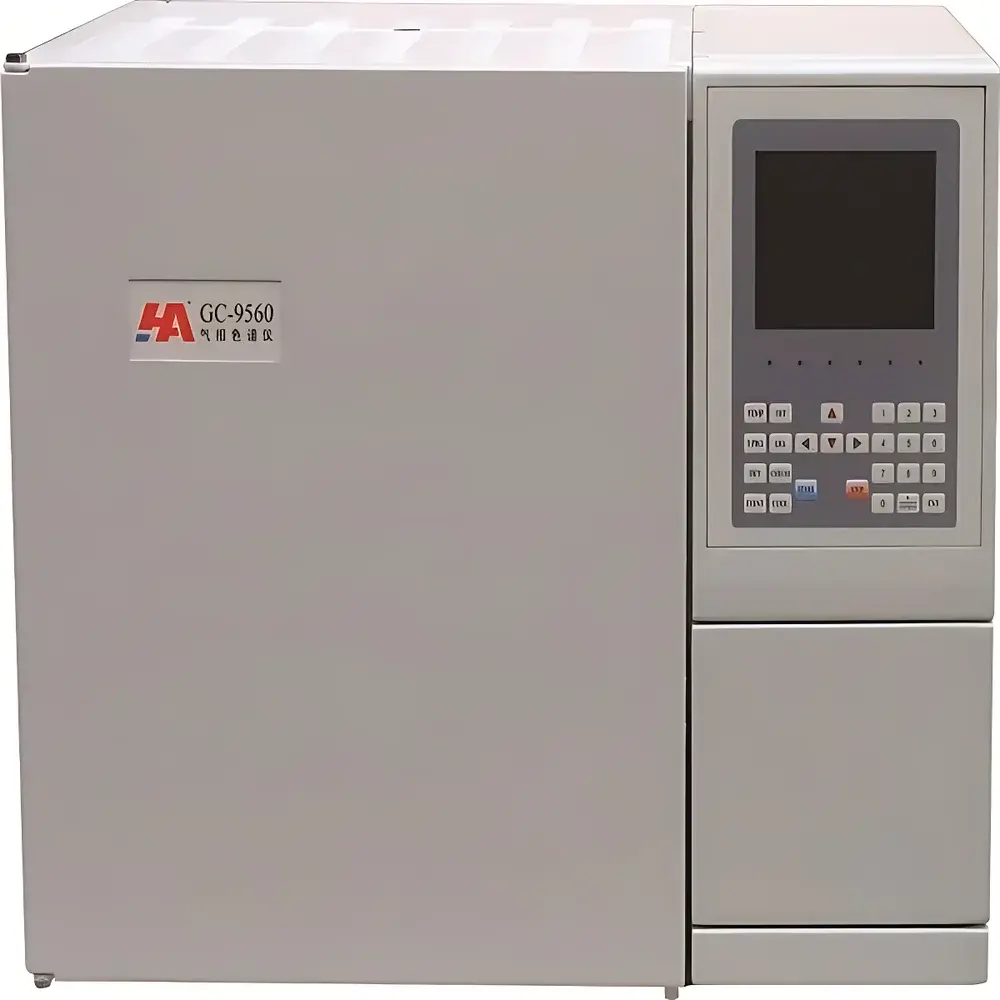
HuaiAi GC-9560-PED Plasma Emission Detector Gas Chromatograph
| Brand | HuaiAi |
|---|---|
| Origin | Shanghai, China |
| Manufacturer Type | Direct Manufacturer |
| Region of Origin | Domestic (China) |
| Model | GC-9560-PED |
| Instrument Type | Laboratory Gas Chromatograph |
| Application Field | Ultra-High-Purity Gas Analysis |
| Temperature Control Range | 8 °C above ambient to 400 °C |
| Oven Ramp Rate | 1–40 °C/min |
| Cooling Rate | 350 °C to 50 °C in ≤7 min |
| Carrier Gas Pressure Control Range | 0–0.4 MPa (8-step programmable) |
| Carrier Gas Flow Control Range | 0–0.4 MPa (8-step programmable) |
| Injector Max Operating Temperature | 400 °C |
| Injector Pressure Setting Range | 0–0.1 MPa |
| Injector Total Flow Setting Range | 0–50 mL/min |
| Detection Limit | Sub-ppb (e.g., 0.5–20 ppb depending on analyte and carrier gas) |
| Temperature Stability | ±0.1 °C |
| Programmable Temperature Program | 8-stage |
| Dimensions | 655 mm (W) × 500 mm (H) × 480 mm (D) |
| Weight | ~48 kg |
| Power Supply | 220 V ±22 V, 50 Hz, ≥2 kW |
Overview
The HuaiAi GC-9560-PED is a dedicated laboratory-scale gas chromatograph engineered for ultra-trace analysis of high-purity and electronic-grade gases. Its core innovation lies in the integrated Plasma Emission Detector (PED), a non-destructive, universal detection technology based on high-frequency, high-intensity electromagnetic field-induced plasma generation. Unlike conventional detectors—such as TCD, FID, or PDHID—the PED operates without electrode contact, eliminating surface contamination, drift, and reactive quenching. As carrier gas (e.g., He or Ar) and eluted analytes pass through a fused-silica plasma cell, they undergo controlled dielectric barrier discharge. This generates a transient, spatially confined plasma state where excited atoms and molecules emit characteristic optical radiation. Wavelength-selective filtering and photomultiplier-based signal transduction convert spectral emissions into quantitative chromatographic peaks. The system achieves sub-ppb detection limits across critical impurities—including H2, O2, N2, CH4, CO, CO2, Ne, Ar—and uniquely resolves the historically challenging O2/Ar pair via proprietary column chemistry and center-cut multidimensional configuration.
Key Features
- Plasma Emission Detector (PED): Universal, electrode-free detection with inherent resistance to poisoning; enables stable, long-term quantification of permanent gases and light hydrocarbons.
- High-Temperature Capability: Oven and injector both rated to 400 °C, supporting robust thermal desorption and high-boiling-point impurity analysis.
- Precision Thermal Management: ±0.1 °C temperature stability over full range; 8-stage programmable ramping (1–40 °C/min); rapid cooling (<7 min from 350 °C to 50 °C) via motorized back-door actuation.
- Advanced Gas Handling Architecture: Dual independent pressure/flow control (0–0.4 MPa, 8-step), low-dead-volume VCR-compatible sampling valves, and integrated purifier modules ensure integrity of ultra-high-purity samples.
- Modular Column System: Multi-oven configuration with center-cutting capability allows sequential or parallel column switching—essential for O2/Ar separation, Ne/He resolution, and multi-component speciation in single-run analysis.
- Comprehensive Compliance Readiness: Hardware and GC-9560V4.0 software support audit trails, user access levels, electronic signatures, and data integrity protocols aligned with FDA 21 CFR Part 11 and GLP/GMP laboratory requirements.
Sample Compatibility & Compliance
The GC-9560-PED is validated for routine analysis of industrial, medical, and electronic specialty gases per internationally recognized standards. It fully supports GB/T 3634.2–2011 (hydrogen purity), GB/T 14599–2008 (oxygen), GB/T 4842–2017 (argon), GB/T 17873–2014 (neon), GB/T 23938–2009 (CO2), and GB/T 16942–2009 through GB/T 21287–2007 (electronic gases). Its O2/Ar separation module meets the selectivity and resolution criteria specified in ISO 8573-5 for compressed air purity class 1 testing. All wetted surfaces are electropolished stainless steel or fused silica; no elastomers contact sample stream. System validation documentation—including IQ/OQ/PQ templates, linearity studies (R² > 0.999), and LOD/LOQ reports—is provided with each installation.
Software & Data Management
GC-9560V4.0 is a Windows-based, instrument-control-and-data-reduction platform with full reverse control capability. It supports method-driven acquisition, real-time baseline correction, peak deconvolution for co-eluting species (e.g., O2 and Ar), and automated calibration curve generation using external standard injections. Raw data files are stored in vendor-neutral .cdf format compliant with ASTM E1947 and EU Annex 11. Audit trail logging records all parameter changes, integration events, and user logins with timestamps and operator IDs. Export options include CSV, PDF analytical reports, and direct LIMS upload via configurable ODBC drivers. Software updates are delivered via secure HTTPS channel with SHA-256 signature verification.
Applications
- Quality assurance of bulk and cylinder gases for semiconductor fabrication (e.g., Ar for sputtering, NH3 for CVD, SF6 for etching).
- Residual impurity profiling in hydrogen fuel cells and electrolyzer feed streams (H2O, O2, CO).
- Verification of neon purity for extreme ultraviolet (EUV) lithography lasers.
- Monitoring trace contaminants (e.g., CO2, CH4) in medical oxygen and nitrogen supplies per ISO 8573-1 Class 0.
- Gas purity certification for cryogenic distillation plants and air separation units (ASUs).
- Research into plasma-assisted catalysis and reaction mechanism studies requiring real-time, multi-species detection.
FAQ
What makes the PED fundamentally different from a helium ionization detector (HID) or pulsed discharge helium ionization detector (PDHID)?
Unlike HID/PDHID—which rely on metastable helium atoms to ionize analytes—the PED generates broadband plasma directly from the carrier-analyte mixture, enabling detection of non-ionizable species (e.g., Ne, He, H2) and eliminating dependency on noble gas purity.
Can the system quantify oxygen and argon simultaneously in a single injection?
Yes. The optional O2/Ar separation module—comprising dual columns, a center-cut valve, and optimized temperature programming—achieves baseline resolution (Rs > 1.5) between O2 and Ar under ISO-compliant conditions.
Is the GC-9560-PED compatible with existing LIMS infrastructure?
Yes. GC-9560V4.0 provides native ODBC connectivity, structured XML export, and configurable REST API endpoints for seamless integration with major LIMS platforms including Thermo Fisher SampleManager, LabWare LIMS, and STARLIMS.
Does the system meet regulatory requirements for pharmaceutical or medical gas release testing?
It satisfies analytical method validation requirements per USP , EP 2.2.43, and ISO 8573-1:2010 for purity class 0–2 gases when operated with documented SOPs, calibrated standards, and full audit trail activation.
What maintenance intervals are recommended for the plasma cell and detector optics?
The fused-silica plasma cell requires cleaning only after ≥500 injections of high-moisture or particulate-laden samples; optical filters should be inspected quarterly and replaced every 18 months under continuous operation. Full PM kits and certified technician service contracts are available globally.




