
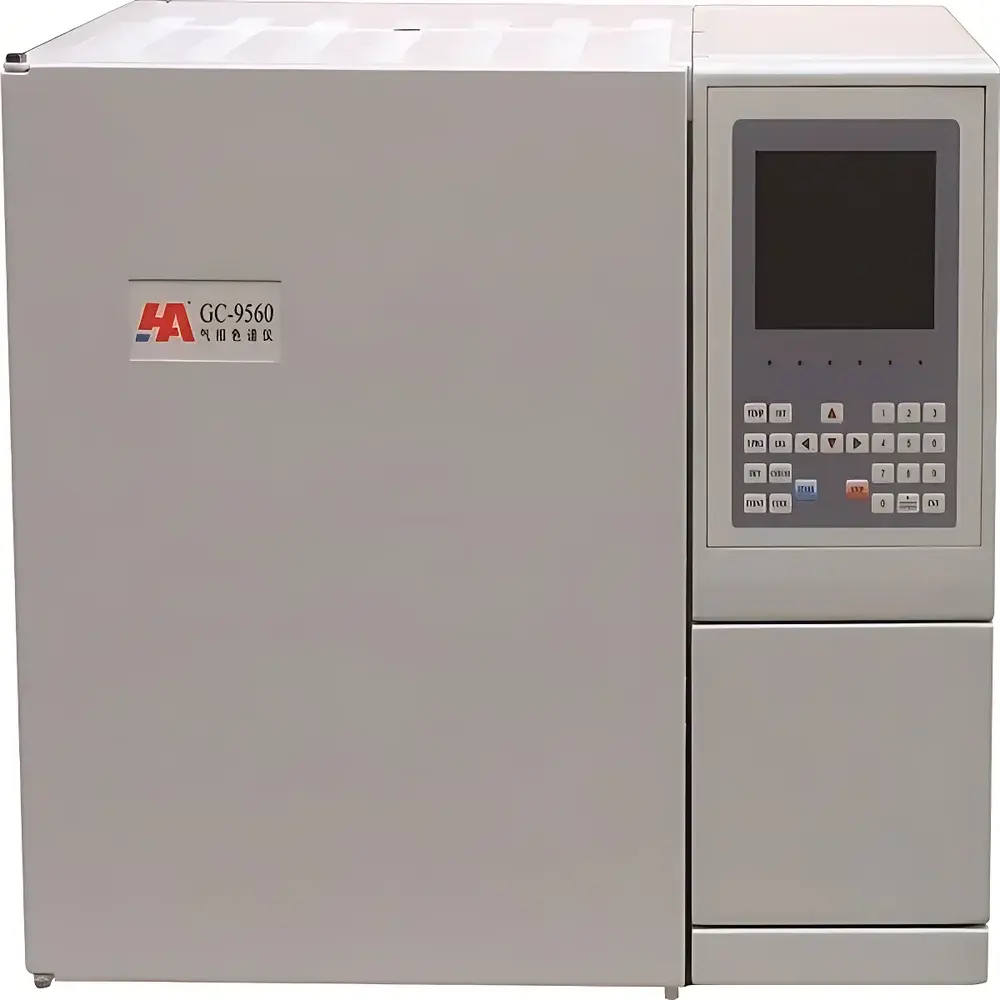
HuaiAi GC-9560-PDD Helium Ionization Gas Chromatograph for Silicon Tetrachloride (SiCl₄) Analysis
| Brand | HuaiAi |
|---|---|
| Origin | Shanghai, China |
| Manufacturer Type | Direct Manufacturer |
| Instrument Category | Domestic Lab-Scale Gas Chromatograph |
| Model | GC-9560-PDD |
| Temperature Control Range | 0–400 °C |
| Ramp Rate | 0–40 °C/min |
| Cool-down Rate | 350 °C → 50 °C (typical) |
| Carrier Gas Flow Range & Control | 0–800 mL/min |
| Carrier Gas Pressure Range & Control | 0–500 psi |
| Injector Maximum Operating Temperature | 400 °C |
| Injector Pressure Setting Range | 0–500 psi |
| Injector Total Flow Setting Range | 0–800 mL/min |
| Detection Principle | Pulsed Discharge Helium Ionization Detection (PDD) |
| Detection Limit for Trace Impurities | ≤5 ppb (v/v) in high-purity SiCl₄ matrix |
| Application Focus | Ultra-high-purity electronic-grade gas analysis (e.g., SiCl₄, SiHCl₃, SiH₂Cl₂, CH₃SiCl₂) |
| Column Configuration | Multi-oven column switching architecture with center-cutting valving |
| Sample Introduction | Backflush-capable, purged valve system with active guard gas routing |
| Pressure Calibration | Integrated automatic inlet pressure correction algorithm for variable-base-gas samples |
| Compliance | Designed to support GLP/GMP-aligned workflows |
Overview
The HuaiAi GC-9560-PDD is a dedicated pulsed discharge helium ionization gas chromatograph engineered for the quantitative and trace-level analysis of impurities in silicon tetrachloride (SiCl₄) and related chlorosilanes used in semiconductor precursor manufacturing. Unlike conventional flame ionization or thermal conductivity detectors, the helium ionization detector (PDD) operates via metastable helium atom-induced ionization—enabling universal, near-equimolar response across permanent gases, hydrocarbons, halocarbons, and inorganic hydrides without chemical quenching or catalytic surface interference. This principle delivers exceptional sensitivity (≤5 ppb v/v), linear dynamic range (>10⁵), and long-term baseline stability—critical for monitoring sub-ppb contaminants such as SiH₂Cl₂, SiHCl₃, CH₃SiCl₂, and metal-containing species (e.g., B, Al, P, As, Ga, Sb, In) in ultra-high-purity SiCl₄ streams. The instrument employs a multi-zone oven architecture with independent temperature control for each column segment, enabling simultaneous separation of light volatiles (He, H₂, O₂, N₂, CO, CH₄) and heavier chlorosilane homologs under optimized retention profiles.
Key Features
- Pulsed discharge helium ionization detection (PDD) with no radioactive source—compliant with IAEA transport regulations and eliminating licensing overhead.
- Center-cutting multi-dimensional GC configuration using precision electro-pneumatic valves with integrated purge gas routing to prevent carryover and cross-contamination between high-concentration matrix and trace analytes.
- Automated inlet pressure correction system that dynamically adjusts sample loop fill volume based on carrier gas composition (e.g., pure He vs. SiCl₄-diluted He), ensuring reproducible mass-on-column across varying base matrices.
- Triple-zone column oven with independent PID control (0–400 °C), ramp rates up to 40 °C/min, and rapid cool-down capability (350 °C → 50 °C in <12 min) to reduce cycle time in high-throughput QC labs.
- Full pneumatic control of carrier gas (0–800 mL/min, 0–500 psi), split/splitless injection, and programmable pressure/flow gradients for method robustness across diverse impurity classes.
- Injector capable of sustained operation at 400 °C with inert deactivation to minimize thermal degradation of reactive chlorosilanes and suppress ghost peaks from adsorption/desorption artifacts.
Sample Compatibility & Compliance
The GC-9560-PDD is validated for direct injection of liquid and vapor-phase SiCl₄ samples with purity ≥99.999% (5N), as well as process gases containing SiHCl₃, SiH₂Cl₂, and CH₃SiCl₂. It meets analytical requirements specified in SEMI F57-0218 (Standard Test Method for Trace Impurities in Electronic Grade Silicon Tetrachloride) and supports conformance testing per ASTM D7607 (Standard Test Method for Trace Contaminants in High-Purity Hydrogen and Helium by Gas Chromatography). System design incorporates hardware-level safeguards for GLP/GMP environments: audit-trail-enabled method storage, electronic signature-capable sequence logs, and user-access-controlled parameter locking. All wetted surfaces utilize SilcoNert®-treated stainless steel or fused silica to prevent catalytic decomposition and metal leaching during analysis of corrosive chlorosilanes.
Software & Data Management
Instrument control and data acquisition are managed via HuaiAi ChromaVision™ GC Workstation v3.2—a Windows-based platform compliant with FDA 21 CFR Part 11 for electronic records and signatures. The software supports method development wizards for multi-step temperature programming, automated peak integration with retention time locking, and customizable reporting templates aligned with ISO/IEC 17025 laboratory accreditation requirements. Raw data files (.chd) are stored with embedded metadata including operator ID, calibration history, column lot number, and environmental chamber logs. Export formats include CSV, PDF, and XML for LIMS integration. Optional cloud-sync module enables remote instrument health monitoring and real-time alerting for pressure deviations, detector voltage drift, or oven temperature excursions beyond ±0.5 °C.
Applications
- Quantification of chlorosilane impurities (SiHCl₃, SiH₂Cl₂, CH₃SiCl₂) in electronic-grade SiCl₄ feedstock prior to fluidized bed reactor (FBR) deposition.
- Monitoring boron, phosphorus, arsenic, gallium, and antimony at ≤0.1–0.5 μg/kg levels in final product batches to ensure compliance with JEDEC JESD22-A107 and SEMI C37 standards.
- Trace oxygen, moisture, and carbon monoxide detection in high-purity carrier gas lines feeding CVD/PVD tools—supporting root-cause analysis of film stoichiometry deviations.
- Stability-indicating assay development for accelerated aging studies of SiCl₄ storage cylinders, tracking hydrolysis byproducts (e.g., HCl, SiO₂ particulates) over time.
- Method transfer between R&D, pilot plant, and full-scale production laboratories using identical column chemistries and retention indexing protocols.
FAQ
What detection technology does the GC-9560-PDD use, and why is it preferred for SiCl₄ analysis?
It uses pulsed discharge helium ionization detection (PDD), which provides uniform response factors for both organic and inorganic impurities without requiring compound-specific calibration—unlike FID or TCD—and avoids radiation safety constraints associated with Ni-63 ECD systems.
Can the system analyze liquid SiCl₄ directly, or is vaporization required?
Liquid SiCl₄ is introduced via heated liquid injection port (up to 400 °C) with precise syringe-driven volume control; optional heated transfer lines and vaporizer modules support fully automated vapor-phase sampling from pressurized cylinders.
How does the automatic inlet pressure correction improve accuracy for varying sample matrices?
It compensates for differences in compressibility and viscosity between pure helium carrier and SiCl₄-rich samples, dynamically adjusting loop fill time and pressure setpoints to maintain constant mass flow—ensuring consistent analyte loading across heterogeneous lot-to-lot compositions.
Is the GC-9560-PDD compatible with regulatory audit requirements such as ISO/IEC 17025 or FDA 21 CFR Part 11?
Yes—hardware timestamps, user authentication, electronic signatures, audit trails, and locked method parameters are natively supported in ChromaVision™ software to satisfy documentation rigor for accredited testing laboratories.
What column configurations are recommended for separating chlorosilane impurities?
A dual-column setup is standard: a 30 m × 0.32 mm ID porous layer open tubular (PLOT) Al₂O₃/KCl column for light gases and a 15 m × 0.53 mm ID DB-1ms column for heavier chlorosilanes—with center-cutting valving to route eluents to optimal detectors.






