
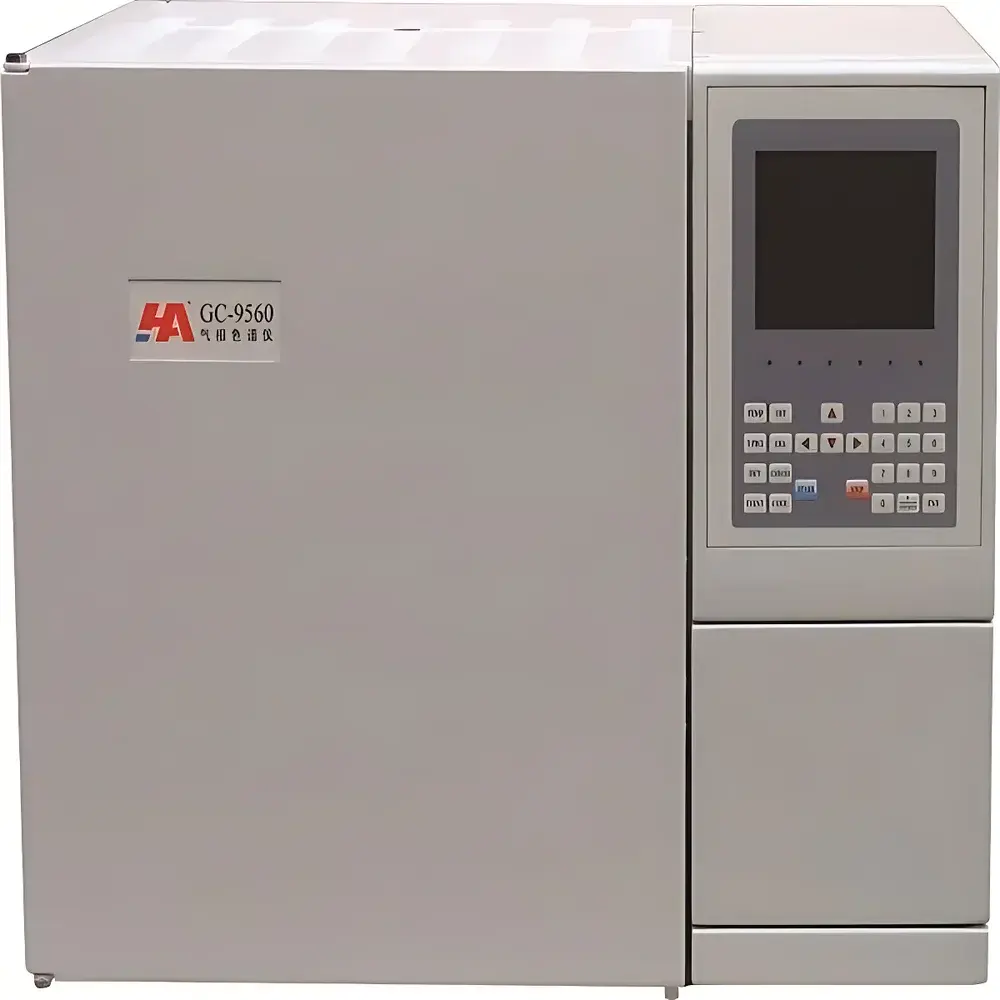
HuaiAi GC-9560-HB Food-Grade CO₂ Analysis Dedicated Gas Chromatograph
| Brand | HuaiAi |
|---|---|
| Origin | Shanghai, China |
| Manufacturer Type | Manufacturer |
| Regional Classification | Domestic |
| Model | GC-9560-HB |
| Instrument Type | Laboratory Gas Chromatograph |
| Application Field | High-Purity Gas Analysis |
| Oven Temperature Range | 8 °C above ambient to 399 °C |
| Ramp Rate | 1–40 °C/min |
| Cooling Rate | ~7 min from 350 °C to 50 °C |
| Carrier Gas Flow Range & Control | 0–500 mL/min |
| Carrier Gas Pressure Range & Control | 0–0.4 MPa |
| Injector Maximum Operating Temperature | 399 °C |
| Injector Pressure Setting Range | 0–0.4 MPa |
| Injector Total Flow Setting Range | 0–500 mL/min |
Overview
The HuaiAi GC-9560-HB is a dedicated laboratory gas chromatograph engineered for precise, regulatory-compliant analysis of food-grade carbon dioxide (CO₂) and associated trace impurities. Designed in accordance with ISO 5923:1984 (Carbon dioxide for fire-extinguishing purposes), GB 10621–2006 (Food Additive Carbon Dioxide), and aligned with international high-purity gas specifications (e.g., Linde, Air Liquide, Matheson), this system delivers robust separation and quantification of critical contaminants—including moisture, hydrocarbons (e.g., benzene), oxygenated organics, chlorinated compounds (e.g., vinyl chloride), sulfur species (total S, H₂S, COS, CS₂), and phosphine (PH₃)—at sub-ppm levels. Its architecture integrates dual detection capability (FID and FPD), programmable multi-valve switching, and cryo-concentration modules to meet the stringent purity requirements defined for food additive CO₂ (98.8–99.8% v/v) and electronic-grade applications.
Key Features
- Dual-detector configuration: Hydrogen Flame Ionization Detector (FID) for hydrocarbon and organic impurity quantification; Flame Photometric Detector (FPD) optimized for sulfur and phosphorus compound detection with selective wavelength filtering (394 nm for S, 526 nm for P).
- Thermally stable oven with precise temperature control (±0.1 °C) across 8 °C above ambient to 399 °C, supporting both isothermal and multi-step programmed temperature ramps (1–40 °C/min).
- High-precision electronic pressure and flow control (EPC/EFC) for carrier gas (N₂ or He), enabling reproducible retention time alignment and method transfer compliance.
- Dual-injector design: Packed-column injector (for PEG-20M φ3×4 m columns) and capillary injector (for FFAP 0.53 mm × 50 m or Porapak Q 0.53 mm × 30 m columns), each independently temperature-controlled up to 399 °C.
- Multi-position six-port switching valves for automated, contamination-free sampling—supporting total sulfur, organic sulfur, and phosphine analysis without manual reconfiguration.
- Integrated cryo-focusing and thermal desorption module for pre-concentration of low-abundance analytes (e.g., PH₃, C₂H₂, CH₃Cl), enhancing detection sensitivity to ≤10 ppb (v/v) for targeted impurities.
Sample Compatibility & Compliance
The GC-9560-HB is validated for direct injection of liquefied or gaseous CO₂ samples, as well as for derivatized or water-absorbed matrices (e.g., oxygenated organics captured in aqueous traps). It supports full compliance with Chinese national standard GB 10621–2006 (mandatory for food-grade CO₂), ISO 5923, JIS K1106, and ASTM D1945 (Standard Test Method for Analysis of Natural Gas by Gas Chromatography). All analytical methods are structured to satisfy GLP documentation requirements, including audit trails for method parameters, calibration history, and raw data integrity per FDA 21 CFR Part 11 guidelines when paired with compliant chromatography data systems (CDS).
Software & Data Management
Controlled via HuaiAi Chromatographic Workstation v3.2 (Windows-based), the system provides real-time instrument monitoring, sequence-driven batch processing, and automated peak integration using tangent skim and valley-to-valley algorithms. Calibration curves are generated using external standardization (linear or quadratic regression), with forced zero-intercept options where appropriate. All quantitative results—including calculated concentrations (Ci = Cs × Ai/As) and mass-based calibrations (Wi = Ws × Ai/As)—are traceable to certified reference standards (e.g., NIST-traceable CO₂/S/PH₃ blends). Audit logs record user actions, method changes, and data exports, ensuring full data integrity for regulatory submissions.
Applications
- Quantitative verification of CO₂ purity (98.8–99.8% v/v) and residual moisture (<0.01% w/w) in beverage carbonation and food packaging gases.
- Trace-level detection of benzene, vinyl chloride, and aldehydes in fermentation-derived CO₂ streams per GB/T 23437–2009.
- Total sulfur and speciated sulfur analysis (H₂S, SO₂, COS, CS₂) in ammonia-scrubbed CO₂ for compliance with ISO 8573-5 (compressed gas purity classes).
- Phosphine (PH₃) screening in lime kiln–derived CO₂ to prevent catalytic poisoning in hydrogenation processes.
- Verification of mineral oil content (<5 mg/kg) via coupled solvent extraction and FID detection following ISO 14812.
- Method development support for emerging contaminants including siloxanes, fluorocarbons, and nitrous oxide in industrial CO₂ recovery loops.
FAQ
What detection limits can be achieved for phosphine (PH₃) using the GC-9560-HB?
With cryo-concentration and FPD detection, the system achieves a method detection limit (MDL) of 5–10 ppb (v/v) for PH₃ in CO₂ matrix, verified per EPA Method 8015M protocols.
Is the instrument compatible with third-party CDS platforms such as Chromeleon or OpenLab?
Yes—the GC-9560-HB supports ASCII and AIA/CDF export formats and is equipped with RS-232 and Ethernet interfaces for integration into enterprise-level LIMS and validated CDS environments.
How is column bleed managed during high-temperature analysis of CO₂ impurities?
The system employs low-bleed fused-silica capillary columns (FFAP, Porapak Q) and includes automatic baseline correction algorithms that subtract thermal drift contributions during extended hold times at 399 °C.
Can the same method be used for both industrial and food-grade CO₂ certification?
Yes—method parameters (oven ramp, detector settings, valve timing) are configurable per application; validation reports include separate uncertainty budgets for each grade per ISO/IEC 17025:2017 requirements.
Does the GC-9560-HB support unattended overnight operation for routine QC batches?
It features auto-shutdown, leak detection diagnostics, and scheduled power-on functionality, enabling 24-hour unattended operation with integrated sample carousel support (optional).
Related Products






