
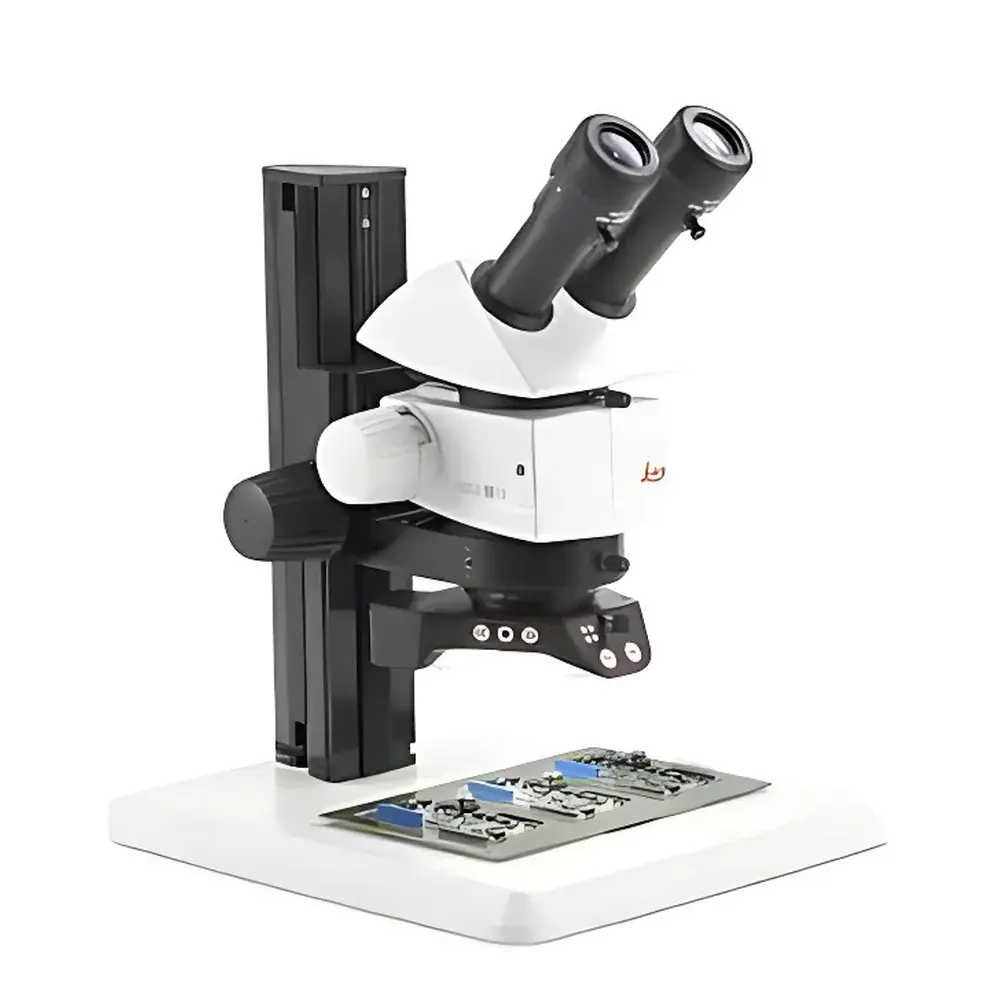
Leica M60 Stereo Microscope
| Brand | Leica |
|---|---|
| Origin | Germany |
| Model | M60 |
| Zoom Ratio | 6.3:1 (continuous and stepwise) |
| Standard Magnification Range | 6.3× – 40× (with 1× objective) |
| Objective | Achromatic 1× (WD = 89.6 mm) |
| Resolution | Up to 450 lp/mm |
| Fixed Zoom Steps | 5 positions with parfocal performance |
| Field Number | 23 mm |
| Mounting Interface | 76 mm standard dovetail |
| Illumination Options | Reflected, transmitted, oblique, ring light, and fiber-optic compatible |
| Compatibility | Manual stage, motorized stage, and transmitted-light stage options available |
| Optical Path | Achromatic, parfocal, and telecentric design optimized for industrial inspection and life science documentation |
Overview
The Leica M60 Stereo Microscope is an entry-level modular stereomicroscope engineered for precision visual inspection, quality control, and routine documentation in industrial manufacturing, electronics assembly, materials science, and biological sample preparation. Based on a robust Greenough optical architecture with achromatic correction, the M60 delivers high-fidelity 3D imaging across its 6.3:1 zoom range. Its telecentric light path ensures minimal perspective distortion and consistent magnification fidelity—critical for measurement traceability and comparative analysis. Designed for operational stability and ergonomic integration, the system supports seamless adaptation to benchtop, inline, or automated inspection workflows without compromising optical integrity or mechanical repeatability.
Key Features
- Parfocal Zoom System: Five fixed zoom positions (6.3×, 10×, 16×, 25×, 40×) maintain focus across magnifications—eliminating refocusing during routine workflow transitions.
- Achromatic 1× Objective: Provides 89.6 mm working distance and 450 lp/mm resolution at maximum magnification, enabling safe manipulation of components under observation while preserving fine structural detail.
- ESD-Safe Construction: Conductive housing and grounded internal pathways ensure electrostatic discharge dissipation within <2 seconds—protecting sensitive electronic assemblies, semiconductor wafers, and microelectromechanical systems (MEMS) from latent damage.
- Ergonomic Integration: Integrated cable management within the focusing column maintains clean workstation layouts; standardized 76 mm dovetail interface allows rapid coupling with Leica’s portfolio of motorized stages, camera adapters, and illumination modules.
- Field-Optimized Optics: 23 mm field number expands usable field-of-view by ~20% versus legacy 20 mm systems—reducing panning frequency during large-sample scanning and improving spatial orientation retention.
Sample Compatibility & Compliance
The M60 accommodates samples up to 120 mm in height and 200 mm in width when used with optional extended-base stages. Its long working distance and flexible illumination compatibility—including incident LED ring lights, transmitted base illuminators, and fiber-optic oblique lighting—support diverse specimen types: PCBs, solder joints, metallurgical cross-sections, botanical specimens, entomological mounts, and histological slides. The optical design complies with ISO 10934-1 (stereomicroscope performance standards) and meets essential requirements for GLP-compliant documentation environments. ESD certification aligns with IEC 61340-5-1 for electrostatic protected areas (EPAs), supporting compliance in electronics manufacturing per IPC-A-610 and J-STD-001.
Software & Data Management
The microscope integrates natively with Leica Application Suite (LAS X) via USB 3.0 or Ethernet. LAS X provides calibrated image capture, annotation tools, measurement overlays (length, angle, area), and batch export in TIFF, JPEG2000, and multi-layered PDF formats. Audit trail functionality records user ID, timestamp, magnification, illumination settings, and stage position—meeting documentation traceability requirements under FDA 21 CFR Part 11 for regulated QC laboratories. Optional Leica DMS1000 digital camera module enables live streaming to networked displays and remote collaboration platforms.
Applications
- Electronics: Solder joint inspection, component placement verification, counterfeit IC detection, and rework process validation.
- Materials Science: Fracture surface analysis, coating uniformity assessment, particle contamination identification, and weld seam evaluation.
- Life Sciences: Dissection support, embryo handling, microinjection setup, and tissue section screening prior to histopathology.
- Forensics & Archaeology: Toolmark comparison, fiber analysis, document examination, and artifact conservation documentation.
- Education & Training: Modular configuration enables progressive pedagogical deployment—from basic stereo observation to structured measurement-based labs.
FAQ
What is the maximum usable magnification with standard eyepieces?
With 10× wide-field eyepieces and the 1× objective, the system achieves 40× total magnification; higher magnifications are possible using optional 1.6× or 2× auxiliary objectives (up to 128×), though resolution remains constrained by the 450 lp/mm optical limit.
Can the M60 be integrated into automated production lines?
Yes—the 76 mm dovetail interface and programmable focus drive (via optional motorized Z-column) enable synchronization with PLC-controlled stages and machine vision triggers for semi-automated inspection routines.
Is the M60 compliant with ISO/IEC 17025 calibration requirements?
While the instrument itself is not certified, its optical path stability, parfocality, and repeatable zoom detents support third-party calibration protocols per ISO/IEC 17025 Annex B. Calibration certificates for magnification accuracy and working distance are available upon request.
Does it support fluorescence observation?
No—the M60 lacks excitation filter turrets and dedicated fluorescence optics; for fluorescence applications, Leica recommends the M205 FA or M165 FC models.
What maintenance intervals are recommended for long-term optical performance?
Annual cleaning of external optics and verification of zoom calibration are advised; internal alignment service is recommended every 3–5 years or after significant mechanical impact, per Leica Service Bulletin LS-M60-03.




