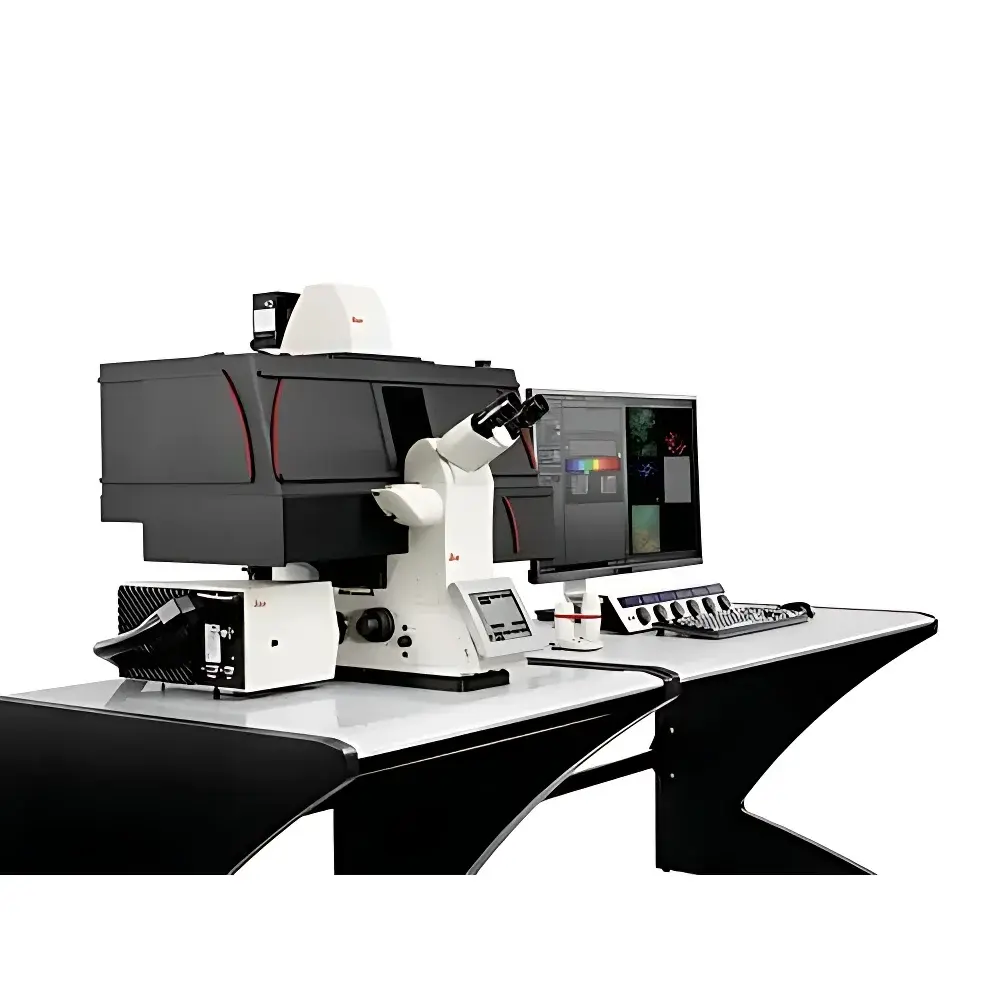
Leica TCS SPE Spectral Confocal Microscope
| Brand | Leica |
|---|---|
| Origin | Germany |
| Model | TCS SPE (Spectral Point-Scanning Confocal System) |
| Laser Lines | 405 nm (optional), 488 nm, 532 nm, 635 nm (solid-state lasers) |
| Detection | High-dynamic-range PMTs |
| Software | Leica LAS AF |
| Compliance | Designed for GLP/GMP-aligned workflows |
| Dimensions | Compact benchtop footprint (< 600 × 500 × 450 mm) |
| Application Focus | Live-cell imaging, fixed-tissue fluorescence microscopy, spectral unmixing, multi-label quantification |
Overview
The Leica TCS SPE is a compact, entry-level spectral point-scanning confocal microscope engineered for precision fluorescence imaging in life science laboratories. Unlike widefield or spinning-disk systems, the TCS SPE employs true point-scanning architecture based on galvanometric mirror steering and pinhole-confined detection—ensuring optical sectioning capability with inherent rejection of out-of-focus light. Its core innovation lies in integrated spectral detection: instead of discrete filter-based channel separation, the system disperses emitted fluorescence across a high-resolution linear PMT array, enabling full-spectrum acquisition per pixel (350–750 nm, 2.5 nm resolution). This spectral fidelity supports robust linear unmixing of fluorophores with overlapping emission profiles—critical for multiplexed labeling in primary neurons, organoids, or tissue sections. The platform is optimized for both live-cell dynamics (e.g., Ca²⁺ flux, mitochondrial membrane potential) and high-fidelity archival imaging of immunolabeled specimens, all while minimizing phototoxicity through low-dose illumination strategies and high quantum-efficiency detection.
Key Features
- True point-scanning confocal architecture with diffraction-limited resolution (lateral ~220 nm at 488 nm, axial ~550 nm)
- Spectral detection engine: 32-channel PMT array with 2.5 nm spectral sampling bandwidth, enabling pixel-wise spectral unmixing without hardware filter changes
- Four integrated solid-state lasers: 488 nm (Ar⁺ replacement), 532 nm (green excitation), 635 nm (far-red), plus optional 405 nm diode for DAPI/Hoechst nuclear counterstaining
- High-dynamic-range hybrid PMTs offering >6-decade signal linearity and sub-picoamp sensitivity—essential for detecting weak signals from sparse endogenous reporters or low-expression transgenes
- Benchtop form factor (W × D × H: 590 × 490 × 440 mm) with vibration-insensitive optical path, suitable for shared core facilities or space-constrained cell culture labs
- FDA 21 CFR Part 11–ready software environment: Leica LAS AF v4.x includes electronic signatures, role-based permissions, and immutable audit trails for regulated research environments
Sample Compatibility & Compliance
The TCS SPE accommodates standard microscopic formats including #1.5 coverslips (0.17 mm), glass-bottom dishes (35 mm, 50 mm), multi-well plates (24-, 48-, 96-well), and upright-compatible tissue slices up to 500 µm thick. Motorized stage options support automated Z-stacks, tile scanning, and time-lapse acquisition with drift correction. All optical components comply with ISO 10934-1 (microscope nomenclature) and IEC 61000-6-3 (EMC emissions). For GxP-regulated applications, the system meets key elements of ALCOA+ data integrity principles when configured with networked storage, timestamped metadata embedding, and validated LAS AF installation protocols.
Software & Data Management
Leica LAS AF serves as the unified acquisition, processing, and analysis platform. It provides real-time spectral unmixing using reference spectra libraries (e.g., Alexa Fluor series, GFP variants, endogenous autofluorescence), batch-processing pipelines for large-scale datasets, and export to open formats (OME-TIFF, HDF5) compatible with Fiji/ImageJ, Imaris, and Python-based analysis frameworks (e.g., scikit-image, napari). Raw spectral cubes (λ-x-y-z-t) are stored with embedded calibration metadata—including laser power logs, PMT gain settings, and objective magnification—ensuring full experimental traceability. Data backup and versioning are supported via integrated network share mapping or Leica’s optional LAS X Archive Server.
Applications
- Live-cell calcium imaging using ratiometric dyes (e.g., Fura-2) or genetically encoded indicators (GCaMP6s), leveraging spectral separation to distinguish cytosolic vs. organelle-localized signals
- Multi-color co-localization studies in fixed tissues—e.g., synaptic marker quantification (Synapsin/PDS95) in mouse hippocampal sections—with unmixing accuracy validated against spectral reference standards
- Autofluorescence removal in aged or lipid-rich samples (e.g., liver, atherosclerotic plaques) by modeling and subtracting NAD(P)H/FAD contributions
- Quantitative assessment of protein expression gradients in 3D spheroids, combining Z-stack reconstruction with voxel-intensity normalization against internal controls
- Teaching laboratories: pre-configured acquisition wizards for common assays (mitochondrial morphology, lysosomal pH, nuclear condensate formation) reduce training time to <30 minutes per user
FAQ
Is the TCS SPE capable of time-lapse imaging of sensitive primary neurons?
Yes—the combination of low-noise PMTs, adjustable dwell time (0.1–10 µs/pixel), and precise laser power modulation (0.01–100% in 0.1% increments) enables acquisition of >100-frame movies at 30-second intervals with minimal photobleaching or morphological artifacts.
Can spectral data be re-analyzed offline after acquisition?
Absolutely. Raw spectral cubes retain full wavelength-resolved intensity information. Users may reapply different unmixing algorithms, adjust reference spectra, or perform deconvolution post-acquisition without re-scanning.
Does the system support objective changers or motorized focus?
Motorized nosepiece (6-position) and Z-drive are available as factory-installed options, enabling automated multi-objective workflows and drift-corrected long-term acquisitions.
What maintenance is required beyond routine cleaning?
No alignment procedures or lamp replacements are needed—the solid-state lasers have >20,000-hour lifetimes, and the sealed optical path eliminates dust-sensitive mirrors or dichroics requiring periodic recalibration.
Is remote operation supported for core facility deployment?
Yes—LAS AF supports secure remote desktop access (via RDP or VNC) with concurrent user session management, allowing centralized instrument scheduling and off-site data review without compromising local acquisition performance.