
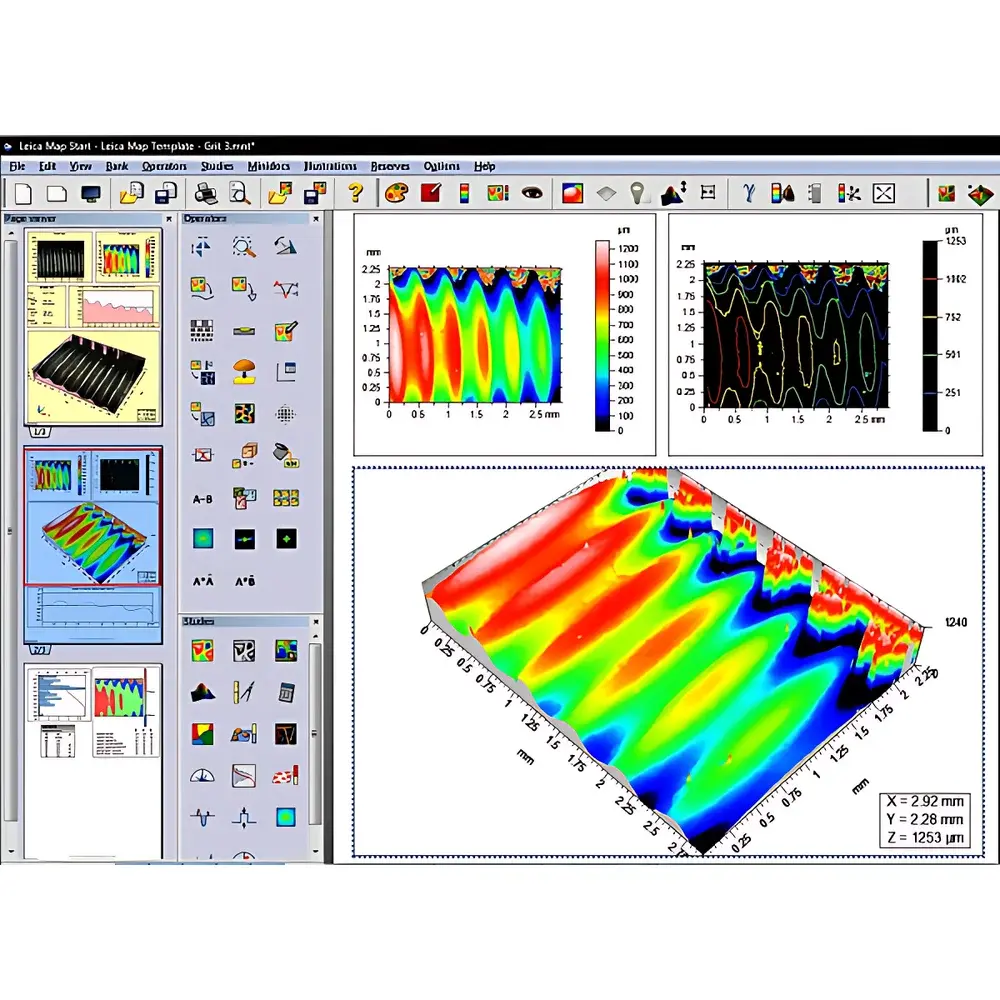
Leica MAP Surface Imaging and Metrology Software
| Brand | Leica |
|---|---|
| Origin | Germany |
| Manufacturer Type | Authorized Distributor |
| Origin Category | Imported |
| Model | Leica MAP |
| Price Range | USD 13,500 – 27,000 |
Overview
Leica MAP is a purpose-built surface imaging and metrology software platform developed by Leica Microsystems for quantitative analysis of surface topography and texture acquired via Leica optical microscopes equipped with LAS (Leica Application Suite) and extended-depth-of-field (EDF) imaging capabilities. Built on a robust computational architecture, Leica MAP implements standardized surface metrology algorithms compliant with ISO 25178 (Geometrical product specifications — Surface texture), ISO 4287 (Profile method), and ISO 11562 (Contact stylus instruments). It supports both static and dynamic surface visualization workflows—enabling users to reconstruct high-fidelity 3D surface models from z-stack or EDF image sequences, extract areal surface parameters (Sa, Sq, Sz, Sdr, etc.), and perform geometric feature analysis including step height, roughness profiling, and volume estimation. Designed for integration into regulated environments, Leica MAP operates within a validated software framework suitable for GLP- and GMP-aligned laboratories engaged in materials science, precision manufacturing QA/QC, and academic surface physics research.
Key Features
- Real-time surface visualization using LAS Montage-based extended depth-of-field (EDF) image synthesis for enhanced detail resolution across complex topographies
- Automated 3D surface reconstruction from calibrated z-stacks or EDF composites with sub-micron vertical resolution
- Comprehensive areal surface parameter calculation per ISO 25178-2, including amplitude (Sa, Sq), spatial (Str, Std), hybrid (Sdr, Vmp), and functional (Sk, Spk, Svk) parameters
- Feature-based metrology tools: step height measurement, profile extraction along arbitrary lines, cross-sectional analysis, and volume computation (e.g., wear volume, coating thickness variation)
- Intuitive desktop publishing interface enabling drag-and-drop layout design for technical reports with embedded interactive 3D views and export-ready vector graphics
- Built-in audit trail functionality supporting 21 CFR Part 11–compliant electronic records when deployed with appropriate system configuration and user access controls
Sample Compatibility & Compliance
Leica MAP natively processes image data generated by Leica DMi8, DM6 M, DVM6, and other LAS-compatible upright/inverted and stereo microscopes. It accepts TIFF, BMP, and proprietary Leica LIF formats with embedded calibration metadata (pixel size, objective magnification, z-step interval). The software supports multi-material surface characterization—including metallic alloys, ceramics, polymers, thin films, and biomedical implants—and accommodates samples ranging from polished wafers (100 µm Sz). All surface parameter calculations adhere strictly to ISO/IEC 17025–recommended uncertainty estimation protocols and are traceable to NIST-traceable reference standards. Validation documentation packages—including IQ/OQ protocols and risk assessments—are available upon request for regulated industrial deployment.
Software & Data Management
Leica MAP employs a modular, license-managed architecture with role-based user permissions (Administrator, Technician, Reviewer). Raw image datasets and processed metrology results are stored in structured project files (.mapx) containing full metadata provenance: acquisition timestamp, instrument ID, operator login, calibration history, and processing log. Export options include PDF/A-1b (for archival compliance), CSV (for statistical process control integration), STL (for additive manufacturing feedback loops), and HTML5-based interactive reports viewable without proprietary software. Data integrity is maintained through SHA-256 hashing of all exported deliverables and optional integration with enterprise document management systems (e.g., Veeva Vault, LabVantage) via RESTful API.
Applications
- Quality assurance of machined and additive-manufactured components in aerospace and automotive supply chains
- Surface finish evaluation of medical device implants per ASTM F2627 and ISO 14289
- Thin-film uniformity assessment in semiconductor packaging and photovoltaic R&D
- Wear and corrosion morphology quantification in tribology studies
- Validation of polishing and etching processes in MEMS fabrication
- Academic research in contact mechanics, wetting behavior, and bio-interface topography
FAQ
Is Leica MAP compatible with non-Leica microscope hardware?
Leica MAP is optimized for and officially supported only on Leica microscopes running LAS X or LAS AF software with calibrated EDF or z-stack acquisition modules. Third-party hardware integration is not validated or guaranteed.
Does Leica MAP support automated batch processing of multiple samples?
Yes—via the optional Leica MAP Batch Module, users can define standardized analysis templates and apply them across folders of image sets with configurable pass/fail thresholds and auto-generated summary dashboards.
Can Leica MAP generate GMP-compliant audit trails?
When installed on a validated Windows OS environment with domain authentication and enabled logging, Leica MAP meets ALCOA+ data integrity principles and supports 21 CFR Part 11 compliance when paired with electronic signature add-ons and procedural controls.
What training and support resources are available?
Leica Microsystems provides instructor-led virtual workshops, on-site implementation services, ISO/IEC 17025-aligned validation support kits, and 24/7 technical assistance through regional application specialists.




