
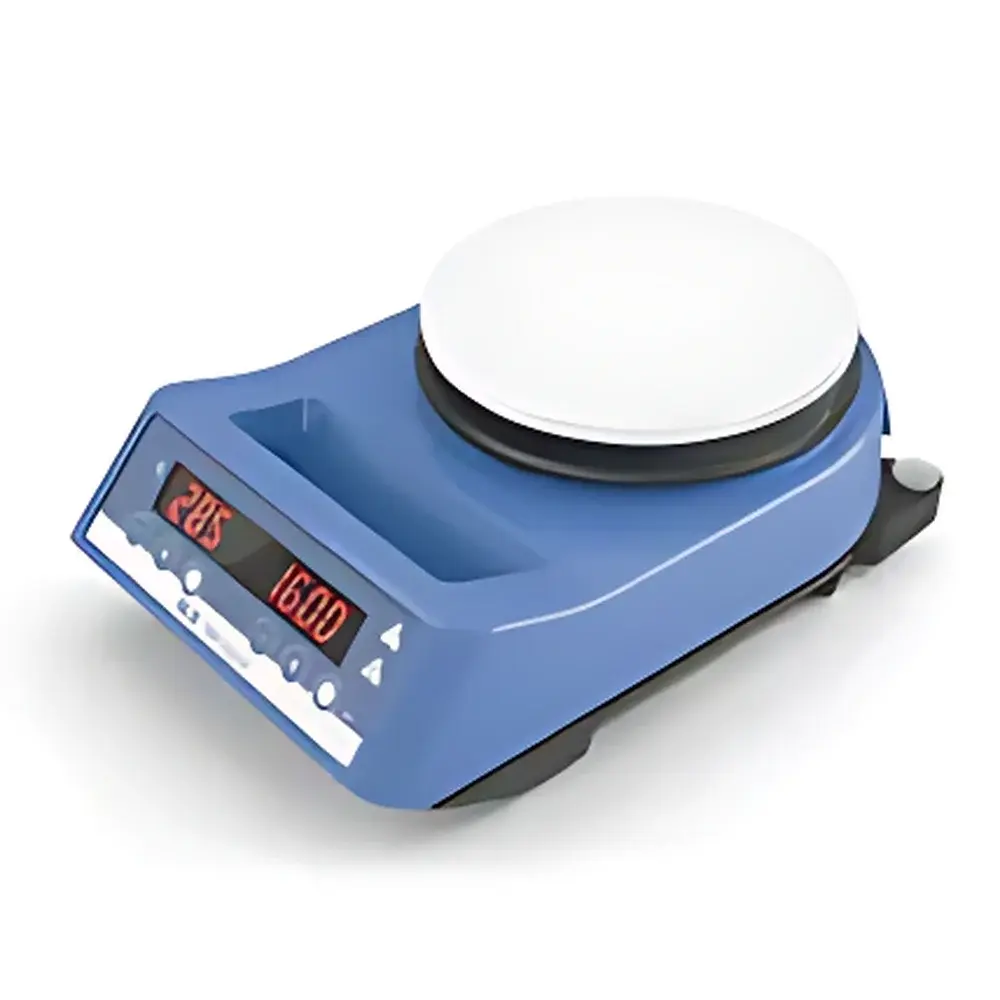
IKA RH digital white Heating Magnetic Stirrer
| Brand | IKA |
|---|---|
| Origin | Germany |
| Model | RH digital white |
| Instrument Type | Magnetic Stirrer |
| Max. Stirring Volume | 15 L |
| Speed Range | 100 – 2000 rpm |
| Heating Temperature Range | 50 – 320 °C |
| Heating Power | 600 W |
| Plate Material | White Ceramic |
| Safety Temperature Limit | 100 – 360 °C |
| Display | Digital LED (Speed & Temp) |
| External Temperature Sensor Interface | ETS-D5 compatible |
| Protection Class | IP21 |
| Dimensions | 160 × 100 × 250 mm |
| Weight | 2.8 kg |
| Power Supply | 230 / 115 / 100 V, 50/60 Hz |
| Input Power | 620 W |
Overview
The IKA RH digital white is a precision-engineered heating magnetic stirrer designed for reliable, reproducible mixing and temperature-controlled sample preparation in academic, industrial, and quality control laboratories. Based on the Couette flow principle, it utilizes a rotating magnetic field to drive PTFE- or glass-coated stir bars within vessels—enabling homogeneous dispersion without mechanical shaft penetration. Its integrated white ceramic heating plate delivers rapid, uniform thermal transfer with high thermal stability, while digital PID control ensures minimal overshoot and consistent setpoint maintenance. Engineered to comply with DIN 12878 for standardized heater-stirrer interface compatibility, the unit supports external temperature monitoring via an ETS-D5–type contact probe, enabling closed-loop feedback control with ±1 K accuracy—critical for applications requiring strict thermal protocol adherence (e.g., dissolution testing, buffer equilibration, or polymer solubilization).
Key Features
- Digital LED display showing real-time speed (100–2000 rpm) and plate/sensor temperature simultaneously
- 600 W high-power ceramic heating element with fast ramp-up: achieves +6 K/min in 1 L water (measured at H15 configuration)
- Adjustable safety temperature limit (100–360 °C) prevents overheating during unattended operation
- Gentle motor start-up sequence minimizes vortex formation and stir bar ejection, especially during low-viscosity startup
- Strong neodymium magnet array ensures stable coupling with stir bars up to 80 mm in length—even at maximum load (15 L H₂O)
- Error code diagnostics (e.g., E1 = overtemperature, E2 = sensor fault) enable rapid troubleshooting without service intervention
- Touch-sensitive control panel with intuitive layout; no mechanical buttons to wear or contaminate
- White enamel-coated steel housing and ceramic top plate resist chemical splashes and facilitate cleaning under GLP-compliant lab hygiene protocols
Sample Compatibility & Compliance
The RH digital white accommodates standard laboratory glassware including beakers (up to 1000 mL), cylindrical vessels, and jacketed reactors (with optional support stands). It is validated for use with aqueous, organic, and mildly corrosive media—provided containers are non-magnetic and thermally stable up to 320 °C. The device conforms to DIN EN 60529 (IP21 ingress protection), ensuring operational safety in typical lab environments with ambient temperatures of 5–40 °C and relative humidity ≤80 %. While not equipped with RS232, USB, or analog outputs, its standalone architecture meets basic ISO/IEC 17025 documentation requirements when used in conjunction with external calibrated thermometers (e.g., traceable NIST-certified Pt100 probes). No FDA 21 CFR Part 11 functionality is embedded; however, manual log entries of setpoints, durations, and observed errors satisfy audit-ready recordkeeping for non-regulated R&D workflows.
Software & Data Management
This is a stand-alone instrument with no onboard data logging, PC connectivity, or software suite. All operational parameters—including speed, heating setpoint, safety limit, and active error states—are displayed locally via dual LED readouts. Users must manually document process conditions using lab notebooks or LIMS-integrated forms. For validation purposes, temperature profiles may be captured externally using a calibrated digital thermometer connected via the ETS-D5 port. The absence of electronic data export aligns with cost-optimized deployment in teaching labs or routine QC where regulatory-grade electronic records are not mandated.
Applications
- Precipitation and crystallization studies requiring controlled thermal ramping and agitation
- Preparation of culture media, buffers, and reagent solutions in microbiology and molecular biology labs
- Solvent-based extractions and homogeneous phase mixing in organic synthesis workflows
- Calibration of viscometers and density meters using thermostatted reference fluids
- Accelerated stability testing of pharmaceutical suspensions under defined thermal–mechanical stress
- General-purpose heating/stirring in undergraduate chemistry laboratories—designed for durability, ease of use, and repeatable pedagogical outcomes
FAQ
Does the RH digital white support external temperature feedback control?
Yes—it features a dedicated ETS-D5–compatible port for connecting a contact temperature sensor immersed directly in the sample, enabling true sample-based temperature regulation with ±1 K accuracy.
What is the maximum recommended vessel diameter for stable stirring at 2000 rpm?
For optimal vortex control and magnetic coupling, use round-bottom or straight-walled containers with internal diameters ≤120 mm when operating above 1500 rpm with 15 L loads.
Can the unit maintain temperature stability during extended overnight runs?
While engineered for continuous operation, the lack of active cooling or adaptive PID tuning means thermal drift may occur beyond 8 hours; periodic verification with an independent thermometer is advised for critical long-duration protocols.
Is the ceramic plate resistant to HF or strong alkali exposure?
No—the white ceramic surface is chemically resistant to common acids and solvents but degrades upon prolonged contact with hydrofluoric acid or >30% NaOH; always use secondary containment for aggressive reagents.
What stir bar length is optimal for 10 L aqueous solutions?
A 60 mm PTFE-coated stir bar provides best torque transmission and centering stability in volumes between 5–12 L; longer bars (>70 mm) increase risk of wobble at speeds >1200 rpm.



