
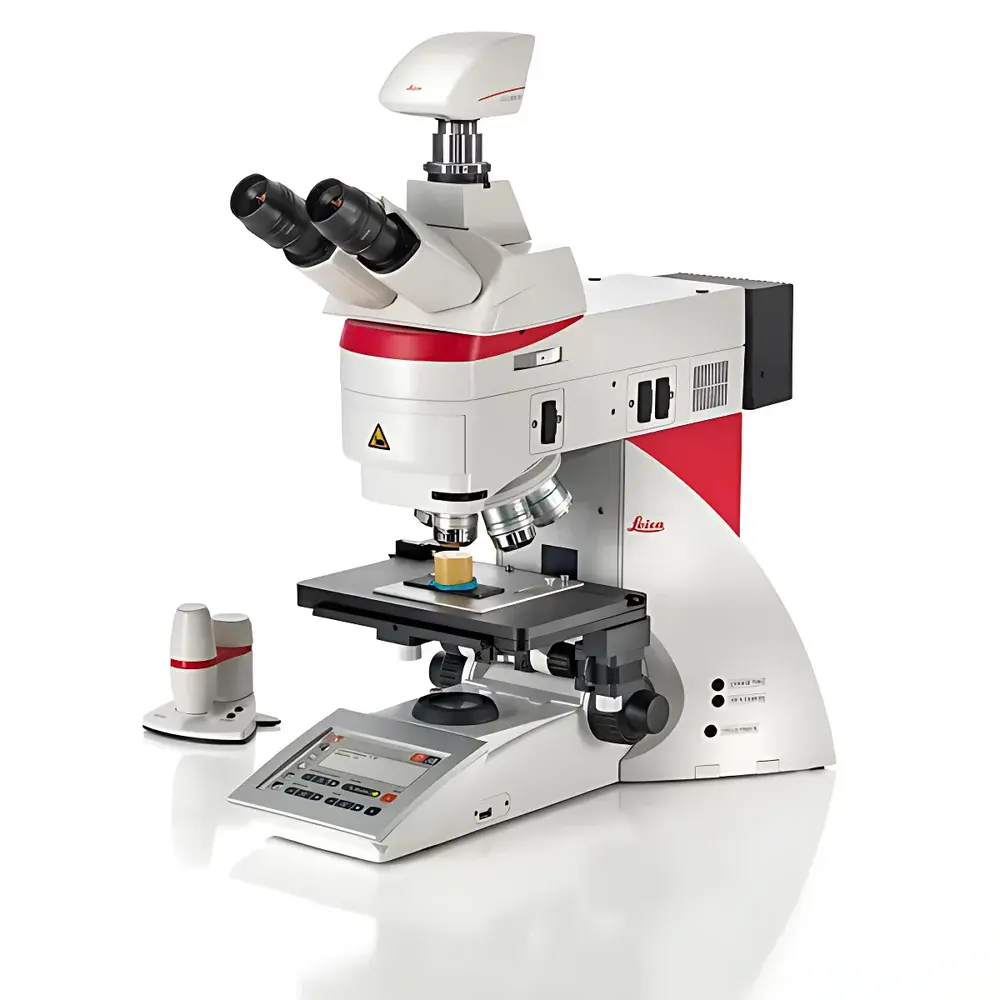
Leica DM6 M Motorized Upright Metallurgical Microscope
| Brand | Leica |
|---|---|
| Origin | Shanghai, China |
| Manufacturer Type | Authorized Distributor |
| Product Origin | Domestic (China) |
| Model | DM6 M |
| Mounting Type | Upright |
| Image Analysis System | Integrated |
| Total Magnification | 1000× |
| Eyepiece | 10× |
| Objective Lenses | 100× |
| Optical Path | Infinity-Corrected Achromatic/Plan-Apochromatic |
| Field of View Diameter | 25 mm |
| Objective Turret | 6-Position Motorized Encoded |
| Focus Mechanism | Motorized Z-Axis with 0.015 µm Step Resolution |
| Illumination | Dual LED (Transmitted & Reflected), Color-Temperature-Stable, Intensity-Programmable |
| Observation Modes | Brightfield, Darkfield (High-Resolution), Polarization, Differential Interference Contrast (DIC) |
| Software Platform | Leica Application Suite X (LAS X), FDA 21 CFR Part 11–Compliant Audit Trail, GLP/GMP-Ready |
| Sample Stage Options | 4×4” or 6×6” Motorized Mechanical Stage |
| Accessories Compatibility | High-Temperature Stage, Fluorescence Module, Cathodoluminescence Adapter, Photometry Unit |
Overview
The Leica DM6 M is a research-grade, motorized upright metallurgical microscope engineered for precision microstructural characterization in materials science laboratories and industrial quality control environments. Built upon Leica Microsystems’ proven optical architecture, the DM6 M employs an infinity-corrected, plan-apochromatic optical path optimized for high numerical aperture (NA) objectives and wide-field (25 mm field number) imaging. Its core measurement principle relies on reflected-light contrast generation—leveraging controlled illumination geometry, polarization state modulation, and interference-based phase contrast—to resolve sub-micron features in opaque, polished, or etched specimens. Unlike conventional manual systems, the DM6 M integrates hardware-level encoding and software-driven automation to ensure full reproducibility: every imaging configuration—including objective lens identity, focus position, illumination intensity, condenser aperture setting, and observation mode—is digitally recorded and recallable with one touch. This eliminates inter-operator variability and supports strict adherence to ASTM E3, ISO 643, USP , and EN 1042 standards for quantitative metallographic analysis.
Key Features
- Motorized 6-position encoded objective turret with automatic parfocal alignment and real-time magnification scaling—enabling seamless switching between 5×, 10×, 20×, 50×, and 100× objectives while preserving focus and updating on-screen scale bars
- Integrated dual-LED illumination system (reflected and transmitted) delivering stable 5700 K color temperature, zero thermal drift, and programmable intensity profiles across all contrast modes
- Precision motorized Z-axis focusing mechanism with 0.015 µm step resolution and closed-loop feedback, supporting automated focus stacking and depth profiling
- Large-format capacitive touchscreen (≥10.1″) mounted directly on the microscope body, providing real-time status visualization and parameter adjustment without external PC dependency
- Modular optical design supporting simultaneous or sequential implementation of brightfield, high-resolution darkfield (HDF), polarization, and DIC—each mode automatically configuring illumination, condenser, and analyzer settings
- Full compatibility with Leica’s LAS X software platform, including compliance-ready audit trail logging, electronic signature support, and multi-user permission management per 21 CFR Part 11 requirements
Sample Compatibility & Compliance
The DM6 M accommodates a broad spectrum of metallurgical and advanced material specimens: polished metallographic sections (steel, aluminum, titanium alloys), sintered ceramics, semiconductor wafers, composite laminates, powder metallurgy compacts, and particulate contaminants. Its 4×4″ or 6×6″ motorized mechanical stage enables full-scan mapping of 200 mm silicon wafers or large-area cross-sections. All optical components meet ISO 10110 surface quality specifications; objective lenses comply with DIN/ISO 8578 for parfocality and lateral chromatic correction. The system conforms to IEC 61000-6-3 (EMC) and IEC 61000-6-2 (immunity) standards. For regulated environments, LAS X software provides full traceability—including timestamped parameter logs, user authentication records, and immutable raw image metadata—required for GLP, GMP, and ISO/IEC 17025 accreditation.
Software & Data Management
Leica Application Suite X (LAS X) serves as the unified control and analysis environment for the DM6 M. It supports automated acquisition workflows (e.g., multi-location tile scanning, focus series, spectral cube capture), quantitative image analysis modules—including ASTM E112-compliant grain size measurement, ISO 4967 inclusion rating, EN 10247 cleanliness classification, and ISO 643 phase fraction quantification—and customizable reporting templates exportable to PDF, Excel, or XML. All image datasets retain embedded EXIF-style metadata: objective NA, magnification, exposure time, illumination intensity, and calibration history. Audit trails are encrypted, tamper-evident, and exportable in CSV format for third-party review. Remote operation via Ethernet or Wi-Fi is supported, enabling integration into centralized laboratory information management systems (LIMS).
Applications
- Quantitative metallography: grain boundary delineation, phase distribution mapping, carbide/nitride precipitation analysis, decarburization depth measurement
- Failure analysis: crack propagation path identification, inclusion morphology classification, weld zone microstructure assessment
- Quality assurance: coating thickness verification (via cross-section), porosity quantification in castings, solder joint integrity evaluation
- Advanced materials R&D: dispersion homogeneity in nanocomposites, grain refinement kinetics in additive manufacturing builds, oxide layer characterization in high-temperature alloys
- Electronics manufacturing: PCB trace inspection, die attach void detection, wafer-level defect localization and classification
FAQ
Does the DM6 M support both reflected and transmitted light observation?
Yes—the system includes integrated LED sources for both epi-illumination (reflected light) and Köhler-transmitted illumination, with independent intensity control and automatic condenser alignment per mode.
Is the microscope compatible with third-party cameras or software?
While optimized for Leica DFC digital cameras and LAS X, the DM6 M provides standard USB 3.0 and GigE Vision interfaces, enabling integration with select third-party imaging hardware and SDK-supported analysis platforms.
Can the system be validated for regulated pharmaceutical or aerospace applications?
Yes—LAS X supports IQ/OQ documentation packages, 21 CFR Part 11 compliance (including electronic signatures and audit trails), and can be configured for GxP-aligned validation protocols upon request.
What is the maximum usable field of view diameter?
The optical path supports a 25 mm field number, enabling full utilization of wide-field eyepieces and high-resolution sensors up to 20 MP without vignetting.
How does the encoded turret ensure measurement traceability?
Each objective lens mount contains a unique RFID tag; the turret encoder logs lens identity, magnification factor, and working distance in real time—automatically populating metadata for every acquired image and ensuring NIST-traceable scale bar generation.



