
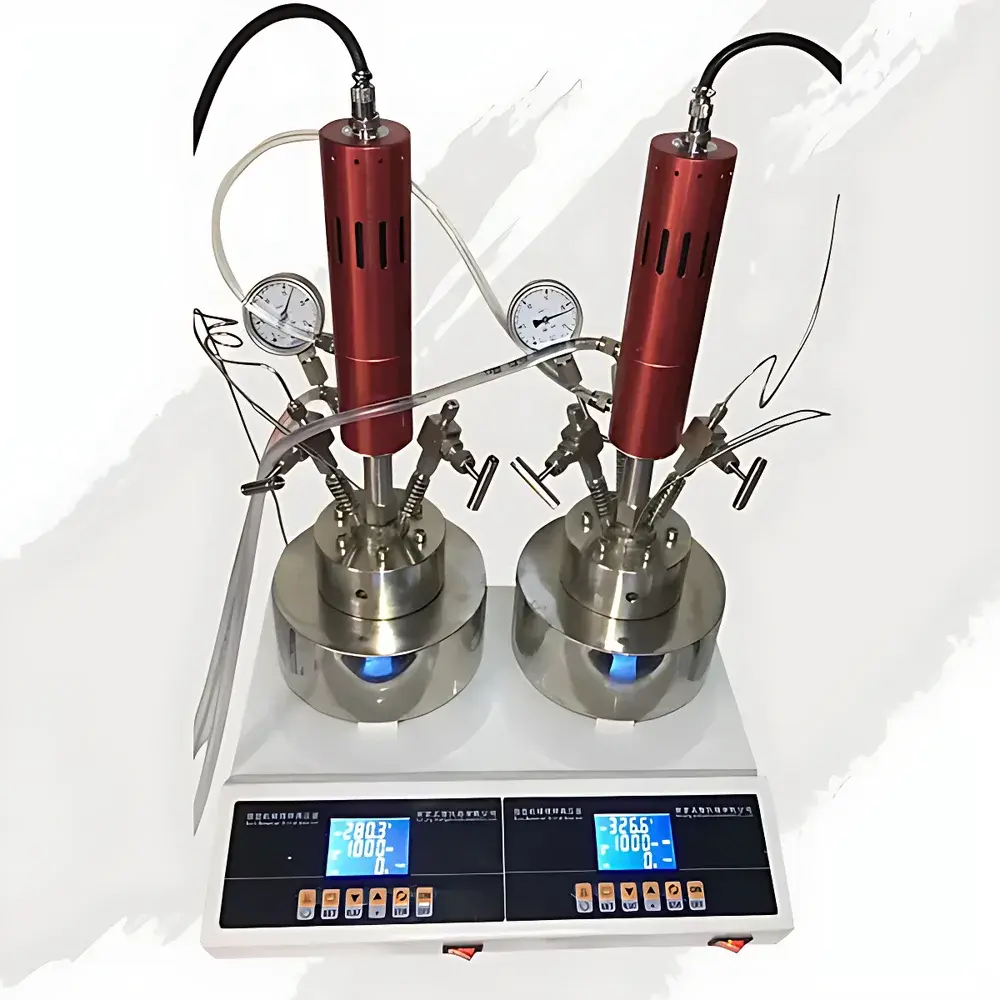
K-PS Parallel Mechanical Stirring High-Pressure Reactor
| Brand | Zhengxin Instrument Factory (ZXYIQI) |
|---|---|
| Origin | Jiangsu, China |
| Manufacturer Type | Authorized Distributor |
| Origin Category | Domestic |
| Model | K-2-PS-100ML |
| Price | USD 5,500 (approx.) |
| Usable Volume | Small-scale (100 mL) |
| Construction Material | Stainless Steel (304/316L standard) |
| Operating Pressure Range | 0–10 MPa (gauge) |
| Vacuum Capability | Up to –0.1 MPa (absolute) |
| Stirring Torque | Up to 40 N·m |
| Stirring Speed | 0–400 rpm |
| Heating Power | 0–2500 W |
| Temperature Range | Ambient to 600 °C |
| Control Accuracy | ±1 °C (PID dual-loop) |
| Safety Features | Burst disc (Hastelloy), overtemperature/overpressure interlock, audible & visual alarm |
| Compliance | Designed per GB/T 25915 (Chinese cleanroom/reactor safety standards), compatible with GLP workflows |
Overview
The K-2-PS Series Parallel Mechanical Stirring High-Pressure Reactor is an engineered platform for controlled, reproducible small-scale synthesis under elevated temperature and pressure conditions. Built upon a monolithic stainless steel (304 or 316L) vessel body precision-machined in one pass on CNC machining centers, the system employs Couette-type mechanical stirring—via a top-mounted, sealed shaft drive—to ensure uniform shear distribution in highly viscous, heterogeneous, or gas-liquid/solid-liquid reaction mixtures. Its design targets laboratory-scale process development in catalysis, polymerization, hydrogenation, supercritical fluid chemistry, and inert-atmosphere synthesis where precise thermal management, robust sealing integrity, and operational repeatability are critical. The reactor operates within a validated pressure envelope of 0–10 MPa (gauge) and temperature range of ambient to 600 °C, supporting both batch and sequential parallel experimentation across 2–8 independent vessels.
Key Features
- Quick-Release Clamping System: Patented cam-lock interlocking structure with six symmetrically distributed torque-controlled studs enables tool-free, repeatable vessel opening/closing—reducing operator fatigue and minimizing exposure time during charging and sampling.
- Dual-Loop PID Temperature Control: Independent heating zone control with embedded thermocouple (K-type, 316L-sheathed, Φ2.0 mm) ensures thermal stability ±1 °C; programmable ramp/soak profiles prevent overshoot and support kinetic studies.
- High-Torque Mechanical Agitation: Brushless DC motor (100 W) coupled to a rigid stainless steel shaft delivers up to 40 N·m torque at 0–400 rpm, enabling homogeneous mixing of pastes, slurries, polymer melts, and high-viscosity reaction media without magnetic coupling limitations.
- Multi-Layer Safety Architecture: Integrated rupture disc (Hastelloy C-276), pressure relief valve, real-time overpressure/overtemperature interlock, and audible-visual alarm system comply with functional safety principles aligned with IEC 61508 SIL 2 concepts for lab-scale pressure equipment.
- Modular Thermal Design: Removable heating module with fully enclosed stainless steel sheath allows rapid thermal cycling and facilitates cleaning/maintenance; power output adjustable from 0–2500 W with dynamic load compensation.
Sample Compatibility & Compliance
The K-2-PS accommodates chemically aggressive systems including strong acids (e.g., HF/HNO₃ mixtures), halogenated solvents, hydrides, and sulfur-containing feedstocks. Standard wetted parts are fabricated from ASTM A240 316L stainless steel; optional liners include PTFE, quartz, PPL, and titanium for enhanced corrosion resistance. All pressure-bearing components conform to GB/T 150.1–2011 (Chinese pressure vessel code) and incorporate traceable material certifications. The system supports GLP-compliant operation through configurable audit trail logging (when paired with optional data acquisition software), aligning with FDA 21 CFR Part 11 requirements for electronic records and signatures in regulated R&D environments.
Software & Data Management
While the base unit features an integrated LCD interface with real-time display of temperature, pressure, stirring speed, and elapsed time, optional USB/RS485 connectivity enables integration with third-party SCADA platforms or custom LabVIEW-based acquisition systems. Data export (CSV/TXT) supports post-run analysis of reaction kinetics, enthalpy profiling, and parameter correlation. Firmware updates preserve backward compatibility and include firmware-level calibration traceability logs—critical for ISO/IEC 17025-accredited laboratories requiring instrument qualification documentation.
Applications
- Catalytic screening (e.g., Fischer–Tropsch, hydrodesulfurization) under syngas or H₂ atmospheres
- Step-growth and chain-growth polymerization (polyesters, polyamides, polyurethanes) with precise stoichiometric control
- Supercritical CO₂-assisted reactions and extractions (T > 31 °C, P > 7.4 MPa)
- Electrochemical precursor synthesis under inert (N₂/Ar) or reducing (H₂) headspace
- High-temperature hydrothermal synthesis of metal oxides, MOFs, and nanomaterials
- Pharmaceutical API route scouting involving exothermic nitration, sulfonation, or halogenation steps
FAQ
What materials are available for the reactor body and internal components?
Standard construction uses ASTM A240 316L stainless steel; optional grades include 304, 310S, 904L, Hastelloy C-276, and Grade 2 titanium. Liners include PTFE, fused quartz, and polyphenylsulfone (PPL).
Can the system operate under vacuum and positive pressure simultaneously?
Yes—the vessel is rated for full vacuum (–0.1 MPa abs) to +10 MPa gauge pressure, with dual-mode pressure transducers calibrated across the entire range.
Is the stirring mechanism suitable for solid-laden suspensions?
Yes—mechanical shaft-driven impellers (Rushton, anchor, or pitched-blade) provide direct torque transmission ideal for abrasive or settling slurries where magnetic coupling would fail.
How is temperature uniformity verified across the reaction volume?
Each unit undergoes thermal mapping per ASTM E2251 using ≥5 calibrated thermocouples; axial/radial gradients remain ≤±2 °C at steady state within the 100 mL active volume.
Does the system support automated reaction sequencing across multiple reactors?
When configured with the optional multi-channel controller (K-PS-MC8), independent PID loops, start/stop triggers, and synchronized data logging enable unattended parallel experimentation with event-driven protocol execution.



