
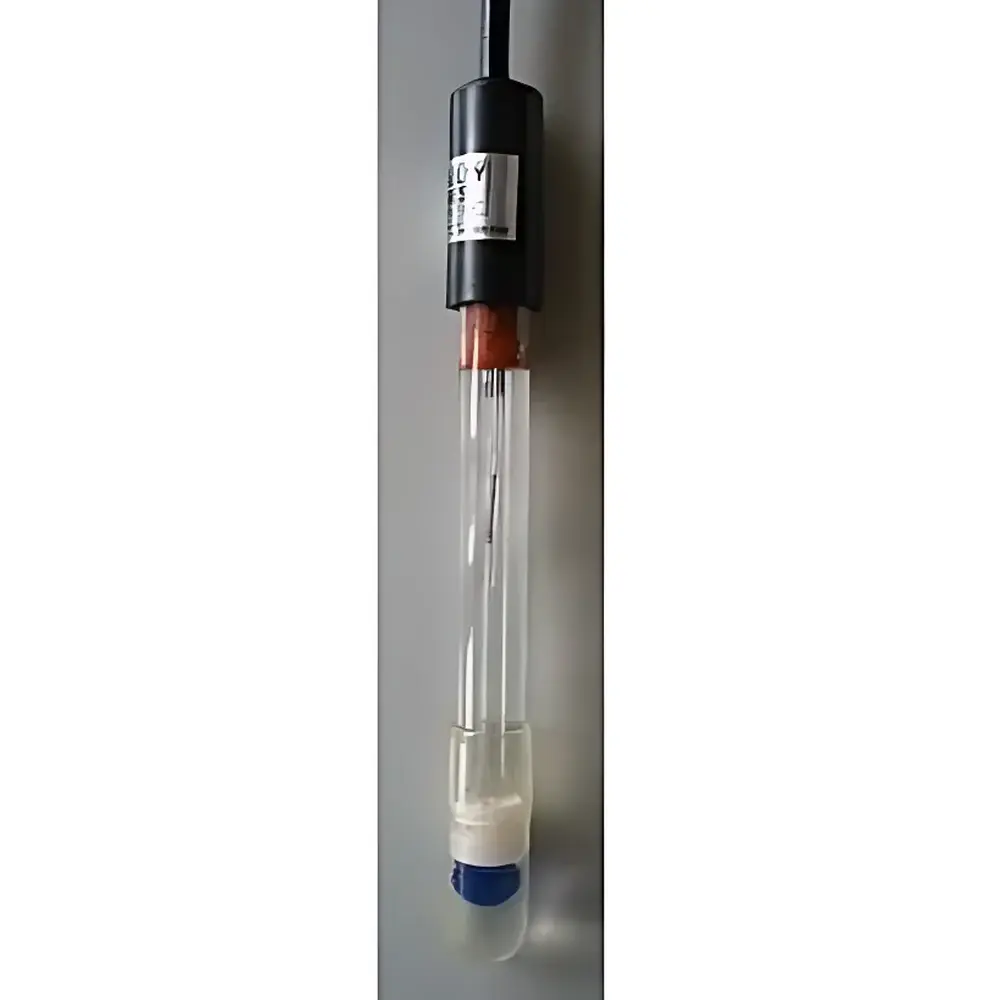
BJC E-1312-EC1-M10ST Industrial pH Electrode
| Origin | USA |
|---|---|
| Manufacturer Type | Authorized Distributor |
| Origin Category | Imported |
| Model | E-1312-EC1-M10ST |
| Instrument Type | Online Water Quality Analyzer |
| Operating Temperature | −5 to 100 °C |
| pH Range | 0.00–14.00 |
| Max Pressure Rating | 30 psig |
| Junction Type | Annular Ceramic Junction |
| Reference System | Ag/AgCl Dual-Salt-Bridge |
| Fill Solution | Non-refillable, Internal-Pressure 3.8 M KCl |
| Sensing Element | HT-3 UV-Resistant Blue Glass Membrane |
Overview
The BJC E-1312-EC1-M10ST is a high-reliability industrial pH electrode engineered for continuous online monitoring in demanding wastewater and process water applications. It operates on the potentiometric principle, measuring the voltage difference between a pH-sensitive glass membrane and a stable Ag/AgCl reference system—converted to pH units via the Nernst equation. Designed specifically for environments with high suspended solids, oils, heavy metals, or organic fouling (e.g., textile dyeing, printed circuit board manufacturing, electroplating, and chemical synthesis), this electrode integrates three core engineering innovations: low-impedance glass technology (<100 MΩ), an annular ceramic junction with enlarged surface area, and an HT-3 ultraviolet-stabilized blue glass membrane. These features collectively minimize signal drift, reduce maintenance frequency, and extend service life under sustained exposure to aggressive UV radiation and particulate-laden media.
Key Features
- Low-impedance glass membrane (typically <100 MΩ) ensures stable signal output and reduced susceptibility to electromagnetic interference in electrically noisy plant environments.
- Annular ceramic junction provides >3× greater electrolyte contact area versus conventional single- or dual-pore junctions—significantly lowering clogging risk in high-turbidity or viscous effluents.
- HT-3 UV-resistant blue glass formulation inhibits photochemical degradation of the internal Ag/AgCl reference element, preventing polarization-induced calibration drift during prolonged outdoor or sunlit installation.
- Dual-salt-bridge reference architecture isolates the inner Ag/AgCl element from sample-side contaminants, enhancing long-term stability in chloride-rich or sulfide-containing streams.
- Non-refillable, internally pressurized 3.8 M KCl electrolyte system maintains consistent junction potential without manual maintenance—ideal for unattended or remote monitoring deployments.
- Rated for continuous operation from −5 °C to 100 °C and up to 30 psig process pressure, supporting integration into hot process lines, cooling towers, and pressurized treatment basins.
Sample Compatibility & Compliance
The E-1312-EC1-M10ST demonstrates robust performance across heterogeneous aqueous matrices, including municipal and industrial wastewater, rinse waters from metal finishing operations, alkaline etchants, acidic pickling baths, and biologically active fermentation broths. Its annular junction resists fouling by fibers, colloids, and precipitated hydroxides common in textile and pulp/paper effluents. While not certified to specific ISO or ASTM standards as a standalone sensor, the electrode meets functional requirements aligned with ASTM D1293 (Standard Test Method for pH of Water) and EPA Method 150.1 when integrated into validated online analyzers. Its design supports compliance with GLP and GMP data integrity expectations when paired with systems offering audit-trail-capable software (e.g., FDA 21 CFR Part 11-compliant controllers).
Software & Data Management
As a sensor-level component, the E-1312-EC1-M10ST outputs a millivolt signal compatible with all standard pH transmitters adhering to NAMUR NE43 or IEC 60770 analog protocols (e.g., 4–20 mA with HART, Modbus RTU/TCP). When connected to programmable logic controllers (PLCs) or SCADA systems, it enables real-time trending, automated alarm thresholds (e.g., pH 9.0 for discharge compliance), and scheduled calibration logging. For regulated environments, pairing with transmitter firmware that supports electronic signature, user-access controls, and immutable calibration history satisfies key elements of data governance frameworks under ISO/IEC 17025 and EU Annex 11.
Applications
- Continuous pH monitoring in industrial pretreatment systems prior to municipal sewer discharge.
- In-line control of neutralization reactors in electroplating and PCB etching lines.
- Effluent compliance verification at outfall points per local environmental permits (e.g., NPDES).
- Process optimization in high-temperature cleaning and descaling operations (e.g., boiler blowdown, CIP cycles).
- Integration into packaged wastewater treatment skids requiring rugged, low-maintenance sensing.
FAQ
Is the E-1312-EC1-M10ST suitable for sterilizable bioreactor applications?
No—this model is not rated for autoclaving or SIP (steam-in-place); for fermenter use, BJC offers the EASYFERM series with steam-tolerant construction and sterile-thread fittings.
Can the electrode be cleaned with acid or base solutions?
Yes—routine cleaning with dilute HCl (0.1 M) or NaOH (0.1 M) is recommended for inorganic scale or organic film removal; avoid prolonged immersion or oxidizing agents like bleach.
Does the non-refillable design compromise long-term accuracy?
No—the internal-pressure 3.8 M KCl system maintains stable junction potential for ≥12 months in typical wastewater service; lifetime is primarily limited by glass membrane aging, not electrolyte depletion.
What transmitter compatibility should be verified prior to installation?
Confirm the transmitter supports asymmetric pH input ranges (−2 to +16 pH) and provides adjustable mV offset compensation to accommodate the electrode’s inherent asymmetry potential.
Is calibration traceable to NIST standards?
Calibration is performed using NIST-traceable buffer solutions (e.g., pH 4.01, 7.00, 10.01 at 25 °C); the electrode itself carries no NIST certificate, but measurement uncertainty can be documented per ISO/IEC 17025 procedures.







