
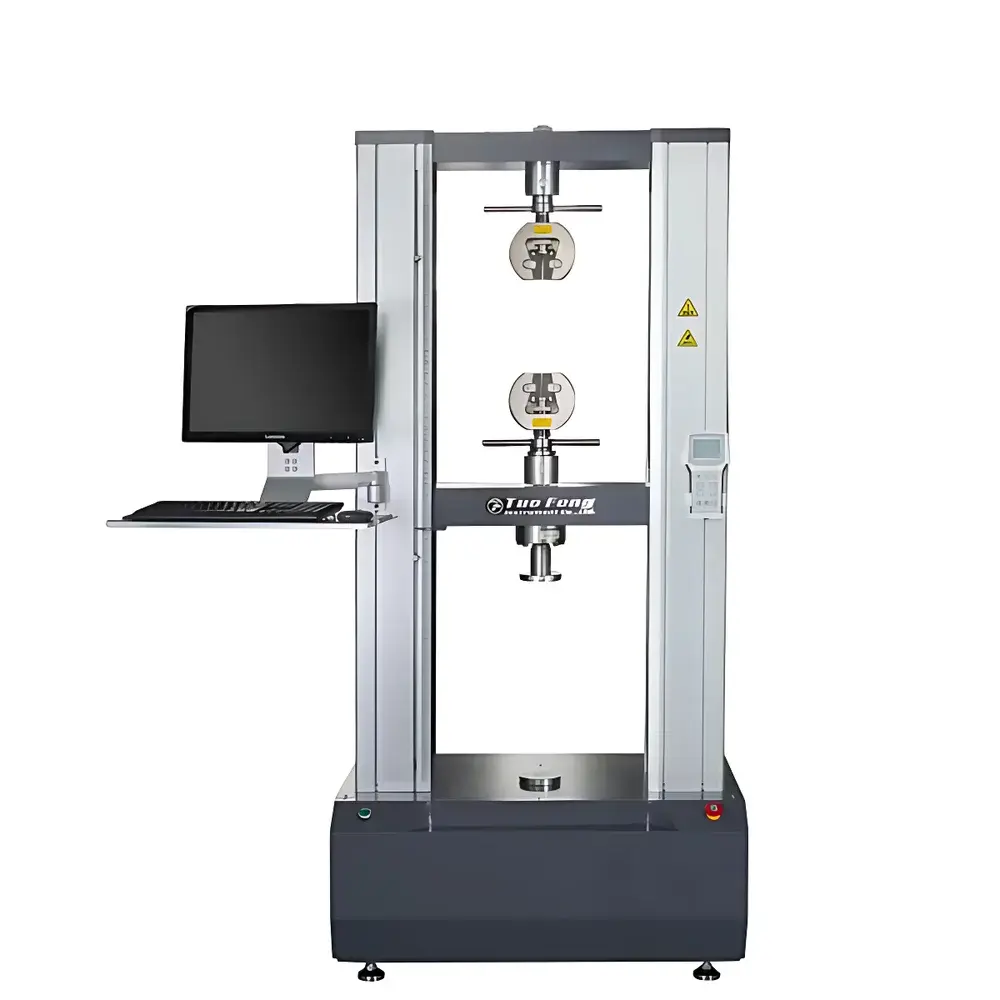
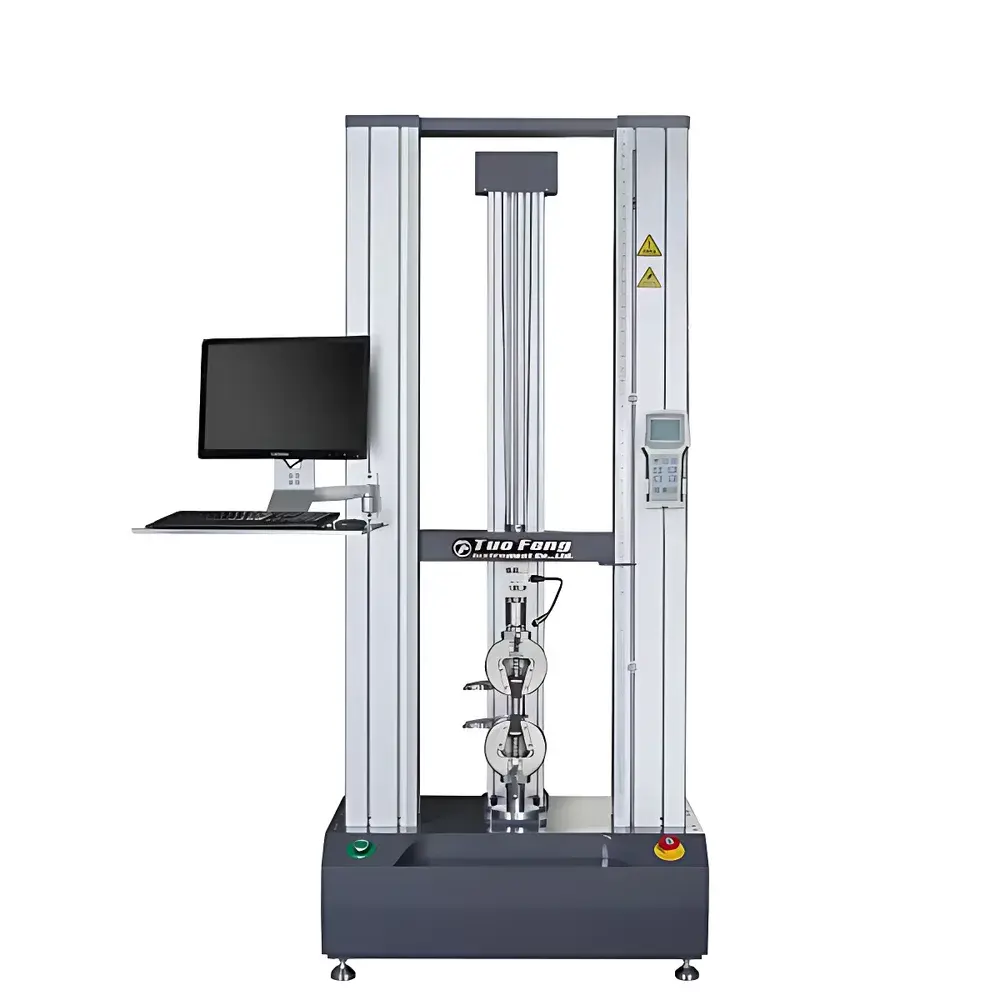
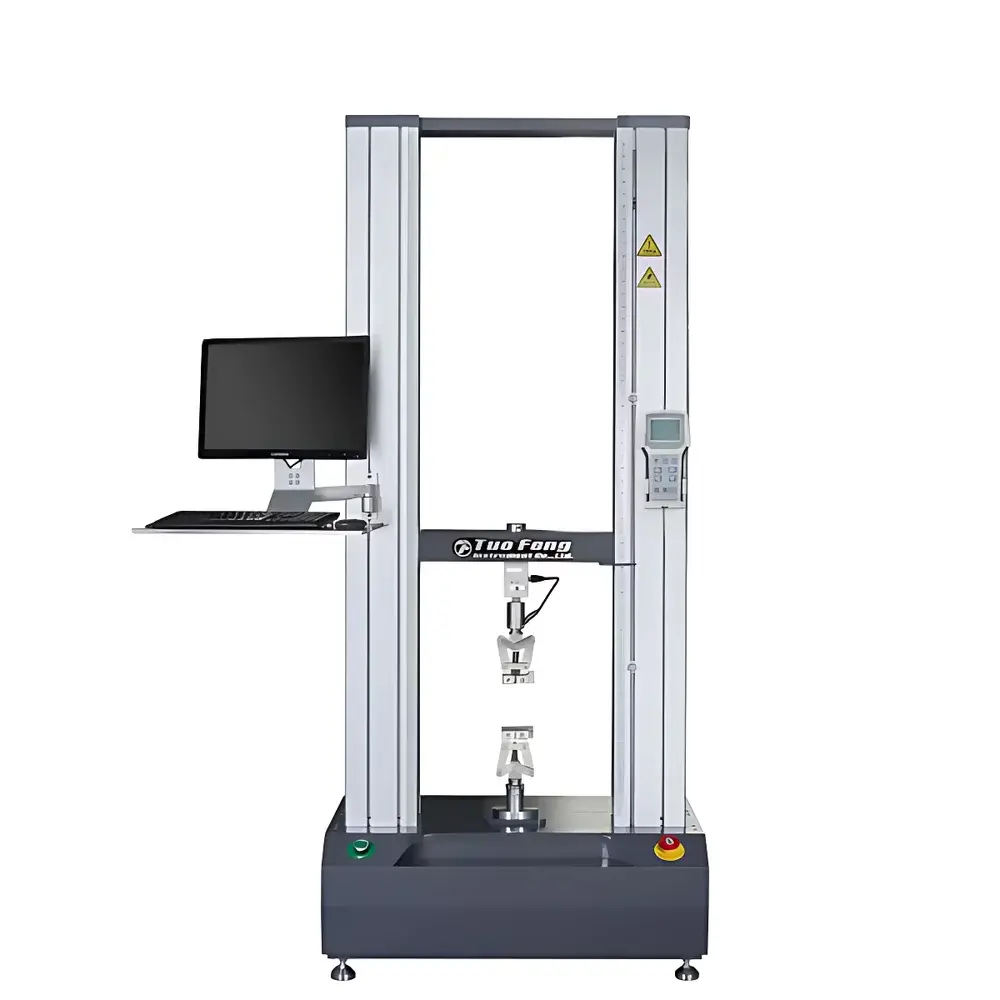
Tuofeng TFW-156 Cable-Specific Electronic Universal Testing Machine
| Brand | Tuofeng |
|---|---|
| Model | TFW-156 |
| Type | Electronic Universal Testing Machine |
| Origin | Shanghai, China |
| Manufacturer | Tuofeng Instrument Co., Ltd. |
| Load Capacity | 150 kN (configurable up to 200 kN) |
| Accuracy Class | 0.5 |
| Force Range | 0.2–100% of full scale |
| Force Measurement Accuracy | ±0.005% of reading |
| Resolution | 1 part in ±500,000 full-scale codes (single-range, no auto-ranging) |
| Drive System | Imported servo motor with precision worm-gear reducer |
| Lead Screw | High-accuracy preloaded ball screw |
| Effective Test Width | 600 mm (customizable) |
| Max Stroke | 800 mm (extendable) |
| Speed Range | 0.001–500 mm/min (infinitely variable) |
| Displacement Measurement | Optical encoder, accuracy ±0.005% of reading |
| Strain Measurement | Optional extensometer or large-deformation sensor, accuracy ±0.005% of reading |
| Safety Protection | Dual electronic limit switches, emergency stop, overload protection (>110% FS), automatic return on test completion |
| Control Mode | Position, load, displacement, and time control |
| Compliance | GB/T 16491–2008, JJG 475–2008, ASTM E4, ASTM E8, ISO 6892-1, ISO 7500-1, DIN 51221, JIS Z2241, BS EN ISO 6892-1 |
Overview
The Tuofeng TFW-156 Cable-Specific Electronic Universal Testing Machine is a high-precision, microprocessor-controlled mechanical testing system engineered for rigorous tensile, compression, bending, shear, tear, peel, and puncture evaluation of metallic, polymeric, composite, and elastomeric materials—with particular design emphasis on wire-and-cable applications. Built upon a robust dual-column frame architecture and driven by a closed-loop servo-controlled actuation system, the TFW-156 operates on the fundamental principle of force-displacement transduction via calibrated load cells and high-resolution optical encoders. Its mechanical architecture—featuring preloaded ball screws, low-backlash gear reduction, and rigid crosshead guidance—ensures minimal compliance and high axial stiffness, critical for accurate modulus determination and low-force/high-strain measurements common in insulated conductor, armored cable, and fiber-optic jacket testing. The system meets international metrological requirements for static force measurement (ISO 7500-1 Class 0.5) and is validated per national verification规程 JJG 475–2008 and manufacturing standard GB/T 16491–2008.
Key Features
- Class 0.5 force measurement accuracy with ±0.005% reading uncertainty across the full dynamic range (0.2–100% FS)
- True single-range resolution of 1:500,000 without hardware ranging—eliminating step-change errors during low-to-high load transitions
- Motorized dual-speed crosshead control (fast jog + precise positioning) with programmable return-to-start functionality
- Integrated triple-level safety architecture: hardware-based emergency stop, software-enforced electronic limits, and mechanical overload cutoff at 110% FS
- Modular fixture interface supporting standardized grips (pneumatic, wedge, vise), custom cable anchoring fixtures, and environmental chamber integration
- Real-time synchronization of force, displacement, and strain channels at ≥1 kHz sampling rate for high-fidelity curve capture
Sample Compatibility & Compliance
The TFW-156 accommodates specimens from fine-diameter copper conductors (≥0.1 mm) to multi-core armored cables (≤80 mm OD) using adjustable-width test beds (standard 600 mm, extendable upon request). Its modular grip system supports ASTM D3043 (flexural testing of reinforced plastics), ASTM D882 (tensile properties of thin plastic sheeting), IEC 60811-501 (tensile testing of cable insulation), and EN 50396 (mechanical testing of railway cable sheaths). All force and displacement calibrations are traceable to NIM (National Institute of Metrology, China) standards and fully compliant with GLP audit requirements—including full electronic audit trail, user access control, and data integrity safeguards aligned with FDA 21 CFR Part 11 principles.
Software & Data Management
Powered by Tuofeng’s proprietary WinTest Pro v4.x software suite, the system delivers ISO/IEC 17025-aligned test automation. The application supports multi-language UI (English, Simplified/Traditional Chinese), customizable unit systems (N/kN/lbf, mm/inch, MPa/psi), and real-time display of up to four synchronized plots: load–time, load–displacement, stress–strain, and extension–time. Automated parameter extraction includes ultimate tensile strength (UTS), yield point (0.2% offset), Young’s modulus, elongation at break, tear strength (ASTM D624), peel adhesion (ASTM D903), and load retention at constant strain (creep hold). Raw data is stored in encrypted .tdms format with embedded metadata (operator ID, calibration certificate ID, environmental conditions). Export options include CSV, PDF reports (with digital signature), and XML for LIMS integration. Software updates are provided free of charge for the instrument’s operational lifetime.
Applications
- Tensile characterization of stranded copper/aluminum conductors and annealed vs. hard-drawn wire
- Insulation jacket adhesion testing (conductor–insulation bond strength under peel and shear loads)
- Sheath crush resistance and impact deformation analysis per IEC 60502 and UL 1581
- Armored cable tensile load capacity and armor wire slippage evaluation
- Thermoplastic vs. thermoset polymer jacket elongation and recovery behavior
- Quality control of extruded profiles, braided shields, and filler tapes in cable assembly lines
FAQ
Does the TFW-156 support ASTM D3043-compliant three-point flexural testing for cable trays and conduits?
Yes—the system includes optional flexural test fixtures with standardized support span and loading nose geometry, fully compliant with ASTM D3043 Annex A1.
Can the software generate 21 CFR Part 11-compliant electronic records for pharmaceutical-grade cable validation?
Yes—WinTest Pro implements role-based access control, biometric or token-based login, immutable audit logs, and digital signature workflows meeting FDA requirements for regulated environments.
Is thermal chamber integration available for elevated-temperature tensile testing of PVC and XLPE insulation?
Yes—Tuofeng offers ISO 17025-accredited environmental chamber interfaces (−70°C to +300°C) with integrated temperature feedback loops and synchronized data logging.
What is the maximum specimen length accommodated for full-cable tensile testing (e.g., 10 m lengths)?
The base configuration supports 800 mm stroke; extended travel columns (up to 2500 mm) and auxiliary floor-mounted anchors are available as factory-configured options.
How frequently must force calibration be performed to maintain 0.5-class certification?
Per GB/T 16491–2008, initial verification is required before first use, followed by annual recalibration traceable to national standards—with intermediate verification recommended every 3 months in high-throughput QC labs.



