
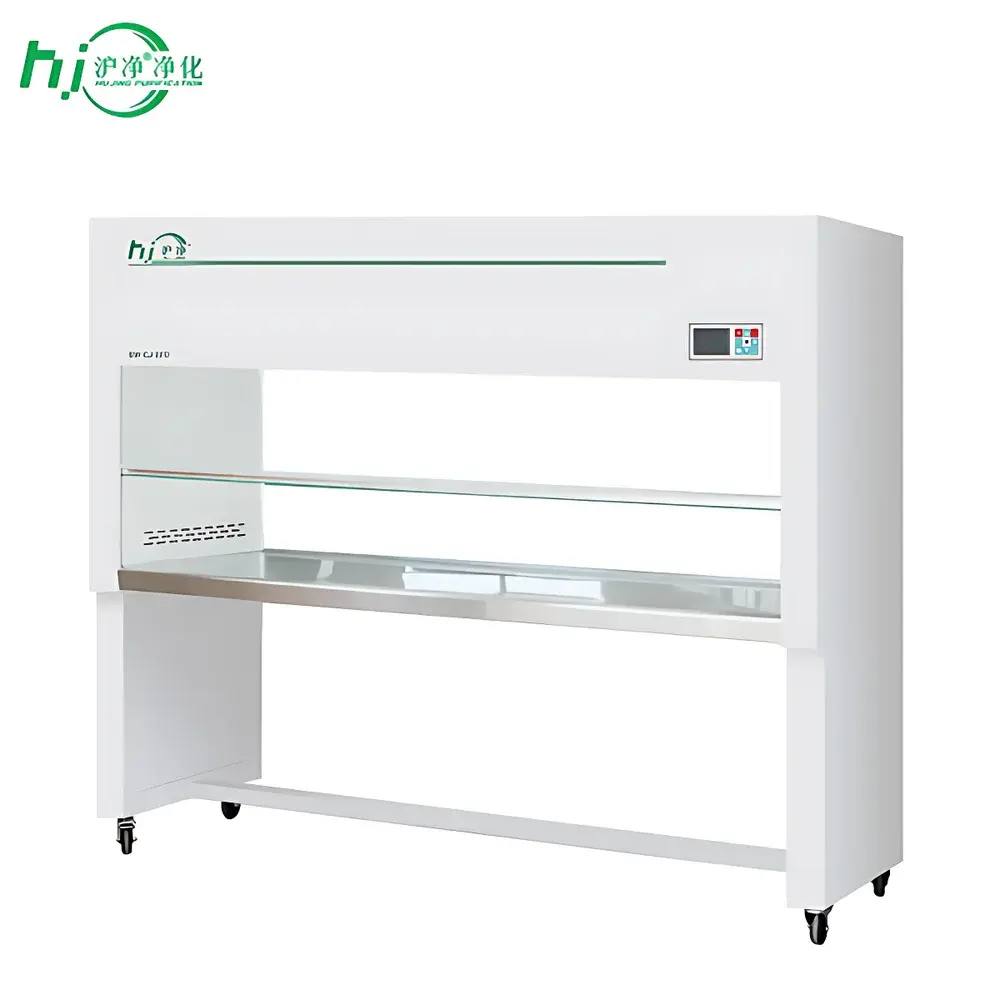
HJ SWCJ3FD Stainless Steel Three-Person Vertical Flow Clean Bench
| Brand | HJ Purification |
|---|---|
| Origin | Shanghai, China |
| Manufacturer Type | Direct Manufacturer |
| Region | Domestic (China) |
| Model | SWCJ3FD |
| Price Range | USD 1,400–2,800 |
| Instrument Category | Vertical Flow Clean Bench |
| Cleanliness Class | ISO Class 5 (equivalent to Federal Standard 209E Class 100 @ ≥0.5 µm) |
| Noise Level | ≤62 dB(A) |
| User Capacity | Three operators, single-sided configuration |
| Airflow Pattern | Vertical downward laminar flow |
| Work Surface Material | SUS304 brushed stainless steel |
| Cabinet Material | Cold-rolled steel with electrostatic powder coating |
| Pre-filter | Washable aluminum mesh |
| HEPA Filter | 1785 × 555 × 50 mm, single unit, ≥99.995% @ 0.3 µm |
| Average Face Velocity | 0.25–0.45 m/s |
| Illumination | ≥300 lux (20 W fluorescent lamp) |
| UV Lamp | 36 W, timer-controlled with safety interlock |
| Power Supply | AC 220 V / 50 Hz |
| Max. Power Consumption | 700 W |
| Net Weight | 200 kg |
| Working Area Dimensions (W×D×H) | 1800 × 650 × 580 mm |
| Overall Dimensions (W×D×H) | 1960 × 690 × 1600 mm |
| Vibration | ≤5 µm peak-to-peak (X/Y/Z axes) |
| Microbial Recovery | ≤0.5 CFU/plate·hour (90 mm Petri dish) |
Overview
The HJ SWCJ3FD Stainless Steel Three-Person Vertical Flow Clean Bench is an ISO Class 5-certified laminar flow workstation engineered for consistent personnel protection and product sterility in non-aseptic but particle-sensitive laboratory operations. Unlike biological safety cabinets, this clean bench provides unidirectional vertical laminar airflow—generated by a centrifugal blower and conditioned through a pre-filter and a certified HEPA filter (≥99.995% efficiency at 0.3 µm)—to maintain a contamination-free work environment for non-hazardous samples. The vertical downflow design establishes a continuous, low-turbulence air curtain across the entire working area, minimizing cross-contamination between operators and preventing ambient particulates from re-entering the workspace. Its structural integrity derives from a fully welded cold-rolled steel chassis with electrostatic powder coating, paired with a corrosion-resistant SUS304 brushed stainless steel work surface compliant with ISO 14644-1 and aligned with the performance criteria of Federal Standard 209E Class 100 (≥0.5 µm). Designed for shared use, the SWCJ3FD accommodates three technicians operating simultaneously along a single front access plane—making it suitable for high-throughput preparation tasks in pharmaceutical QC labs, electronics assembly staging, plant tissue culture rooms, and academic teaching laboratories.
Key Features
- Vertically oriented laminar airflow system with adjustable face velocity (0.25–0.45 m/s), ensuring uniform particle removal and stable aerodynamic containment
- Three-operator single-face configuration with ergonomic height and depth dimensions (working area: 1800 × 650 × 580 mm) optimized for collaborative sample handling without spatial interference
- Integrated safety interlock between UV germicidal lamp (36 W) and fluorescent lighting (20 W), preventing accidental UV exposure during operation
- Digital LCD control panel with programmable UV timer, fan speed monitoring, and real-time status indicators for operational transparency
- Vertical quasi-closed work surface geometry that enhances downward air curtain integrity, reducing lateral ingress of room air and improving localized cleanliness retention
- Dual-stage filtration architecture: washable aluminum pre-filter extends service life of the main HEPA filter (1785 × 555 × 50 mm); both filters are accessible for scheduled maintenance without disassembly
Sample Compatibility & Compliance
The SWCJ3FD is intended for applications involving non-pathogenic, non-toxic materials where environmental particulate control—not operator or environmental protection—is the primary objective. It complies with ISO 14644-1:2015 (Class 5), meets the airborne particle concentration requirements of Federal Standard 209E Class 100 (≥0.5 µm), and satisfies illumination (≥300 lux) and noise (≤62 dB[A]) specifications outlined in ISO 14644-4. While not certified for biosafety (i.e., it lacks negative pressure containment and does not meet NSF/ANSI 49 requirements), its validated microbial recovery rate (≤0.5 CFU/plate·hour using 90 mm settle plates) supports routine environmental monitoring under GLP-aligned workflows. The unit’s construction materials conform to RoHS directives, and electrical components comply with IEC 61010-1 for laboratory equipment safety.
Software & Data Management
The SWCJ3FD operates via embedded microcontroller logic with no external software dependency. All operational parameters—including UV exposure duration, fan activation state, and fault diagnostics—are managed through the front-panel LCD interface. No data logging, network connectivity, or electronic audit trail functionality is provided, consistent with its classification as a Class I passive environmental control device. For laboratories requiring 21 CFR Part 11 compliance or electronic recordkeeping, integration with external environmental monitoring systems (e.g., Vaisala, DeltaTrak) is supported via analog voltage outputs (optional) or manual logbook documentation per SOP-defined intervals.
Applications
- Preparation of sterile media, buffers, and reagents in pharmaceutical and biotechnology quality control laboratories
- Handling of sensitive optical components, semiconductor wafers, and precision instrumentation where sub-5 µm particulate exclusion is critical
- Plant tissue culture transfer and micropropagation under controlled particulate conditions
- Electronics prototyping and PCB assembly in R&D environments requiring low-static, low-particulate workspaces
- Academic teaching labs conducting microbiology demonstrations, cell culture fundamentals, and analytical sample prep where biosafety level 1 (BSL-1) containment suffices
FAQ
Is the SWCJ3FD suitable for handling infectious agents or hazardous chemicals?
No. This unit provides only product protection—not personnel or environmental protection—and must not be used with biohazards, volatile solvents, or toxic compounds.
What is the recommended maintenance schedule for the HEPA filter?
HEPA filter replacement is typically required every 12–24 months depending on ambient air quality and usage frequency; pre-filter cleaning should occur biweekly.
Can the unit be installed in a room without HVAC supply air?
Yes, but ambient air quality must meet ISO Class 8 (or better) to avoid premature pre-filter saturation and ensure stable laminar flow performance.
Does the SWCJ3FD include certification documentation for ISO Class 5 compliance?
Factory-installed units are supplied with a Certificate of Conformance and a commissioning report including as-built airflow velocity mapping and particle count verification per ISO 14644-1 Annex B.
Is the stainless steel work surface resistant to common laboratory disinfectants?
Yes—SUS304 grade stainless steel withstands routine exposure to 70% ethanol, isopropyl alcohol, and diluted sodium hypochlorite solutions when wiped promptly and dried.



