
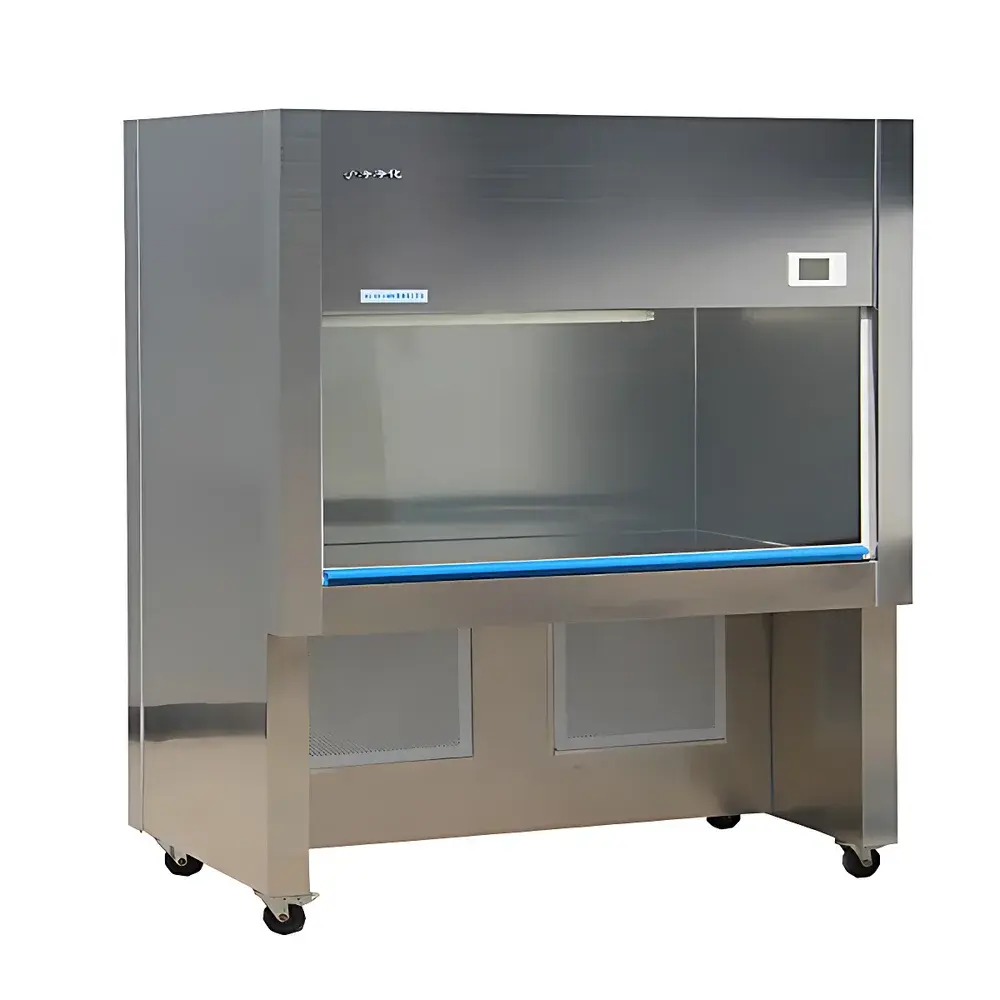
HJ HS-1300U Horizontal Laminar Flow Clean Bench for Dual Operators
| Brand | HJ Purification |
|---|---|
| Origin | Shanghai, China |
| Manufacturer Type | Direct Manufacturer |
| Country of Origin | China |
| Model | HS-1300U |
| Instrument Category | Horizontal Flow Clean Bench |
| Cleanliness Class | ISO Class 5 (equivalent to Federal Standard 209E Class 100 @ ≥0.5 µm) |
| Noise Level | ≤62 dB(A) |
| Operator Capacity | Dual-user, single-face configuration |
| Airflow Pattern | Horizontal laminar flow |
| Pre-filter Material | Anodized aluminum |
| HEPA Filter Specification | 1135 × 600 × 38 mm, unpleated, ultra-thin no-separator type (single unit) |
| Average Air Velocity | 0.25–0.45 m/s (dual-speed adjustable) |
| Vibration Amplitude (peak-to-peak) | ≤5 µm (X/Y/Z axes) |
| Illuminance | ≥300 lx |
| Power Supply | AC 220 V, 50 Hz |
| Max. Power Consumption | 800 W |
| Net Weight | 150 kg |
| Work Area Dimensions (W×D×H) | 1140 × 560 × 580 mm |
| Overall Dimensions (W×D×H) | 1295 × 765 × 1765 mm |
| Fluorescent Lamp | 30 W × 1 |
| UV Lamp | 30 W × 1 |
| Microbial Recovery | ≤0.5 CFU/plate·hour (Φ90 mm settle plate) |
Overview
The HJ HS-1300U Horizontal Laminar Flow Clean Bench is an ISO Class 5-certified containment system engineered for aseptic manipulation of non-hazardous samples in microbiology, cell culture, pharmaceutical quality control, and precision electronics assembly. Unlike vertical-flow hoods, this bench employs a horizontal laminar airflow architecture—air is drawn through a pre-filter, conditioned by a high-efficiency particulate air (HEPA) filter meeting EN 1822-1:2019 H14 performance criteria, then directed uniformly across the work surface at controlled velocity (0.25–0.45 m/s) toward the operator-facing sash. This unidirectional airflow minimizes turbulence-induced particle resuspension and ensures consistent particle removal from the active work zone. The system complies with Federal Standard 209E Class 100 (≥0.5 µm), validated per ISO 14644-1:2015 Annex B protocols using discrete particle counters and microbial settle plate assays (≤0.5 CFU/plate·hour, Φ90 mm). Structural integrity is maintained via a rigid steel frame with aluminum alloy side panels and tempered glass side shields, supporting long-term stability under continuous operation.
Key Features
- Ultra-thin, no-separator HEPA filter (1135 × 600 × 38 mm, H14 grade) reduces static pressure drop and enables compact plenum design—maximizing usable work depth without compromising filtration efficiency or service life.
- Dual-speed electronically commutated (EC) blower system with real-time feedback loop maintains constant face velocity across variable filter loading conditions; user-selectable low/high modes ensure adaptability to procedural requirements.
- Integrated LCD control panel provides intuitive status monitoring—including fan speed, UV lamp activation timer, and filter life estimation based on cumulative runtime and differential pressure trends.
- Anodized aluminum pre-filter is washable and reusable, extending maintenance intervals and reducing consumable cost over lifecycle.
- Non-porous, seamless aluminum-plastic composite work surface resists chemical corrosion and facilitates decontamination; surface flatness tolerance ±0.2 mm/m ensures compatibility with automated pipetting systems.
- UV germicidal irradiation (30 W, 254 nm) and fluorescent lighting (30 W, 5000 K CCT) are independently switchable and interlocked to prevent simultaneous UV exposure during operation.
Sample Compatibility & Compliance
The HS-1300U is intended exclusively for non-toxic, non-volatile, non-aerosol-generating procedures. It is not suitable for handling biohazards requiring biosafety level (BSL-2 or higher) containment, nor for volatile organic compounds (VOCs) or radionuclides. Its design aligns with ISO 14644-1:2015 (cleanroom classification), ISO 14644-3:2019 (testing methods), and ASTM E2952-14 (standard guide for clean bench performance verification). For regulated environments, the unit supports GLP-compliant documentation through optional audit-trail-capable controllers (available as upgrade), and its construction materials meet UL 61010-1:2012 safety requirements for laboratory equipment. Routine certification per ISO 14644-3 Annex D is recommended every six months or after filter replacement.
Software & Data Management
While the base HS-1300U operates via embedded microcontroller without external software dependency, optional firmware upgrades enable RS-485 Modbus RTU communication for integration into centralized facility monitoring systems (e.g., LabVantage, Siemens Desigo CC). Logged parameters—including cumulative fan runtime, UV exposure duration, and differential pressure across the HEPA filter—can be exported via USB-C interface for traceability in GMP or ISO 17025-accredited labs. All operational events are timestamped and stored in non-volatile memory for minimum 12-month retention, satisfying basic FDA 21 CFR Part 11 record-keeping prerequisites when paired with validated electronic signature modules.
Applications
- Aseptic transfer of bacterial and fungal cultures in clinical microbiology laboratories.
- Preparation of media plates and reagent aliquots under sterility-critical conditions.
- Handling of primary mammalian cells and stem cell lines prior to incubation.
- Assembly and inspection of optical components, semiconductor wafers, and MEMS devices where sub-micron particulate control is essential.
- Pharmaceutical QC testing—including dissolution sample preparation and visual inspection of parenteral vials—per USP environmental requirements for low-risk compounding.
FAQ
Is the HS-1300U certified to ISO Class 5?
Yes—the unit achieves and maintains ISO Class 5 (formerly Fed Std 209E Class 100) performance at ≥0.5 µm when operated within specified velocity and maintenance parameters, verified via ISO 14644-3-compliant particle counting.
Can it be used for handling hazardous biological agents?
No. This is a clean bench, not a biosafety cabinet. It provides product protection only—not personnel or environmental protection—and must not be used for BSL-2 or higher agents.
What is the recommended HEPA filter replacement interval?
Under typical lab use (8 hrs/day, 5 days/week), replacement is advised every 18–24 months or when differential pressure exceeds 250 Pa—whichever occurs first.
Does the unit support third-party calibration services?
Yes. All critical performance parameters (air velocity, particle count, illumination, noise) are verifiable using NIST-traceable instruments; HJ provides calibration certificates upon request for accredited service providers.
Is electrical safety certification included?
The HS-1300U carries CE marking per EU Directive 2014/30/EU (EMC) and 2014/35/EU (LVD), and conforms to GB 4793.1-2019 (China’s equivalent to IEC 61010-1).



