
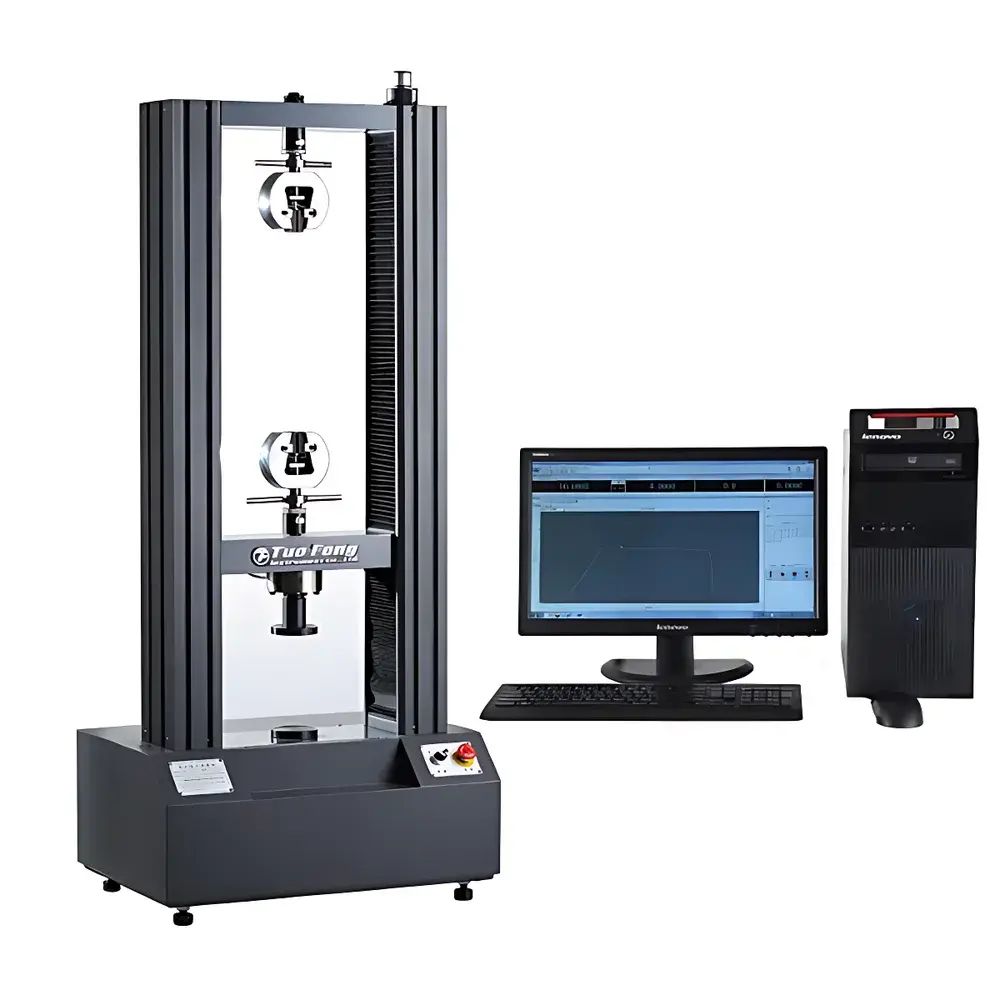
Tuofeng TFW-250 Microcomputer-Controlled Electronic Universal Testing Machine
| Brand | Tuofeng |
|---|---|
| Model | TFW-250 |
| Maximum Test Load | 250 kN |
| Accuracy Class | 0.5 |
| Effective Force Measurement Range | 0.2–100% of Full Scale |
| Force Measurement Accuracy | ±0.005% of Reading |
| Force Resolution | 1/500,000 Full Scale (Fixed, No Range Switching) |
| Drive System | Imported Servo Motor with Precision Worm Gear Reducer |
| Lead Screw | High-Accuracy Ball Screw |
| Effective Test Width | 600 mm (Customizable) |
| Tensile Stroke | 800 mm (Customizable) |
| Test Speed Range | 0.001–500 mm/min (Infinitely Variable) |
| Displacement Measurement | Optical Encoder |
| Displacement Accuracy | ±0.005% of Reading |
| Strain Measurement | Optional Extensometer or Large-Deformation Sensor |
| Strain Accuracy | ±0.005% of Reading |
| Safety Protection | Electronic Limit Switches, Emergency Stop Button, Overload Protection (10% above max load) |
| Crosshead Adjustment | Dual-Speed Motorized Control (Fast/Slow), Manual Point-to-Point Jog |
| Return Function | Automatic or Manual Return to Initial Position at Maximum Speed |
| Fixture Customization | Application-Specific Clamping Solutions Available |
| Power Supply | 220 V AC, 3.0 kW |
| Dimensions (W×D×H) | 1100 × 900 × 2600 mm |
| Approx. Weight | 1500 kg |
| Compliance | GB/T 16491–2008, JJG 475–2008, ASTM E4, ASTM E8, ISO 6892-1, ISO 7500-1, DIN 51221, JIS Z2241, BS EN 10002-1 |
Overview
The Tuofeng TFW-250 is a high-precision microcomputer-controlled electronic universal testing machine engineered for static mechanical property evaluation of metallic, polymeric, composite, and ceramic materials under uniaxial loading conditions. Based on the fundamental principles of force transduction via strain-gauge load cells and displacement measurement via optical encoders, the system delivers traceable, repeatable, and metrologically validated data in accordance with international standards for materials characterization. Its modular architecture supports tensile, compression, flexural, shear, tear, peel, and puncture testing modes—enabling comprehensive mechanical profiling across R&D, quality control, and regulatory compliance workflows. Designed for integration into ISO/IEC 17025-accredited laboratories and GMP-compliant manufacturing environments, the TFW-250 meets stringent requirements for measurement uncertainty, system linearity, and long-term stability.
Key Features
- 0.5-class accuracy certified per GB/T 16491–2008 and ISO 7500-1:2018, ensuring traceability to national metrological standards
- Force resolution of 1 part in 500,000 full scale—maintained continuously across the entire 0.2–100% measurement range without auto-ranging or hardware switching
- Imported servo motor coupled with precision worm gear reducer and ground ball screw assembly for smooth, low-backlash motion control and minimal thermal drift
- Dual-speed crosshead drive (fast positioning + fine adjustment) with jog capability and programmable return-to-start functionality
- Integrated safety architecture including electronic limit switches, emergency stop circuitry, and automatic overload cutoff at 110% of rated capacity
- Modular fixture interface compatible with standardized wedge-action, pneumatic, hydraulic, and custom-designed grips for diverse specimen geometries and surface conditions
- Real-time dual-channel data acquisition at ≥1 kHz sampling rate, supporting synchronized force, displacement, and optional strain inputs
Sample Compatibility & Compliance
The TFW-250 accommodates specimens ranging from thin films (<0.1 mm thickness) to structural steel sections (up to 100 mm width), with customizable test widths (600 mm standard) and extended stroke configurations. It supports standardized test methods per ASTM E8/E8M (tensile metals), ASTM D638/D695 (plastics), ISO 6892-1 (metallic materials), ISO 527 (polymer tensile), ISO 178 (flexural), ISO 14890 (optical fiber strength), and GB/T 228.1 (Chinese metallic tensile standard). All calibration and verification procedures comply with JJG 475–2008 (China National Verification Regulation for Electronic UTM) and are fully documented for GLP/GMP audit readiness. The system satisfies FDA 21 CFR Part 11 requirements for electronic records and signatures when configured with audit-trail-enabled software.
Software & Data Management
The Windows-based TFW TestSuite software provides multi-mode closed-loop control—including constant-rate-of-load, constant-rate-of-displacement, constant-strain-rate, load-hold, displacement-hold, and cyclic protocols. Users may switch between Simplified Chinese, Traditional Chinese, and English interfaces without reinstallation. Units for force (N, kN, lbf), displacement (mm, in), stress (MPa, psi), and strain (%) are freely convertible within the same session. Real-time plotting supports simultaneous display of up to four parameter combinations: Load–Time, Load–Displacement, Stress–Strain, Displacement–Time, and Load–Extension. Post-test analysis includes automatic calculation of yield strength (0.2% offset), ultimate tensile strength, fracture elongation, Young’s modulus, compressive strength, flexural modulus, tear strength, peel adhesion, and bond strength—based on user-input cross-sectional area and gauge length. Data export conforms to ASTM E1434 and ISO/IEC 17025 reporting templates, with native CSV, PDF, and XML output formats. All test files include embedded metadata (operator ID, timestamp, environmental conditions, calibration status) and support version-controlled archiving.
Applications
This system serves as a primary mechanical testing platform in aerospace component validation (e.g., fastener shear, composite laminate compression), automotive material qualification (seat belt webbing tensile, battery module crush resistance), medical device mechanical verification (catheter burst pressure, suture tensile strength), construction material certification (rebar yield testing, concrete prism compression), and advanced packaging integrity assessment (peel strength of laminated pouches, seal strength of blister packs). It is routinely deployed in third-party certification labs (e.g., SGS, TÜV, BV) for ISO 9001 and IATF 16949 process audits, as well as in university materials science departments for graduate-level deformation mechanics instruction.
FAQ
What standards does the TFW-250 comply with for calibration and verification?
It conforms to GB/T 16491–2008, JJG 475–2008, ISO 7500-1:2018, and ASTM E4, with factory calibration certificates traceable to NIM (National Institute of Metrology, China).
Can the system perform cyclic or fatigue testing?
The base configuration supports quasi-static loading only; high-cycle fatigue capability requires optional add-on modules including servo-hydraulic actuation and dedicated waveform generation firmware.
Is remote operation and data monitoring supported?
Yes—via Ethernet-connected PC with secure HTTPS-based web interface for real-time status viewing, test queue management, and historical report retrieval.
How is software validation handled for regulated industries?
TFW TestSuite includes IQ/OQ documentation packages, electronic signature workflows, and configurable audit trails meeting FDA 21 CFR Part 11 and EU Annex 11 requirements.
What maintenance intervals are recommended?
Load cell recalibration every 12 months; ball screw lubrication every 6 months; encoder alignment check every 24 months—per the manufacturer’s Preventive Maintenance Schedule (PMS-250 Rev. 3).



