
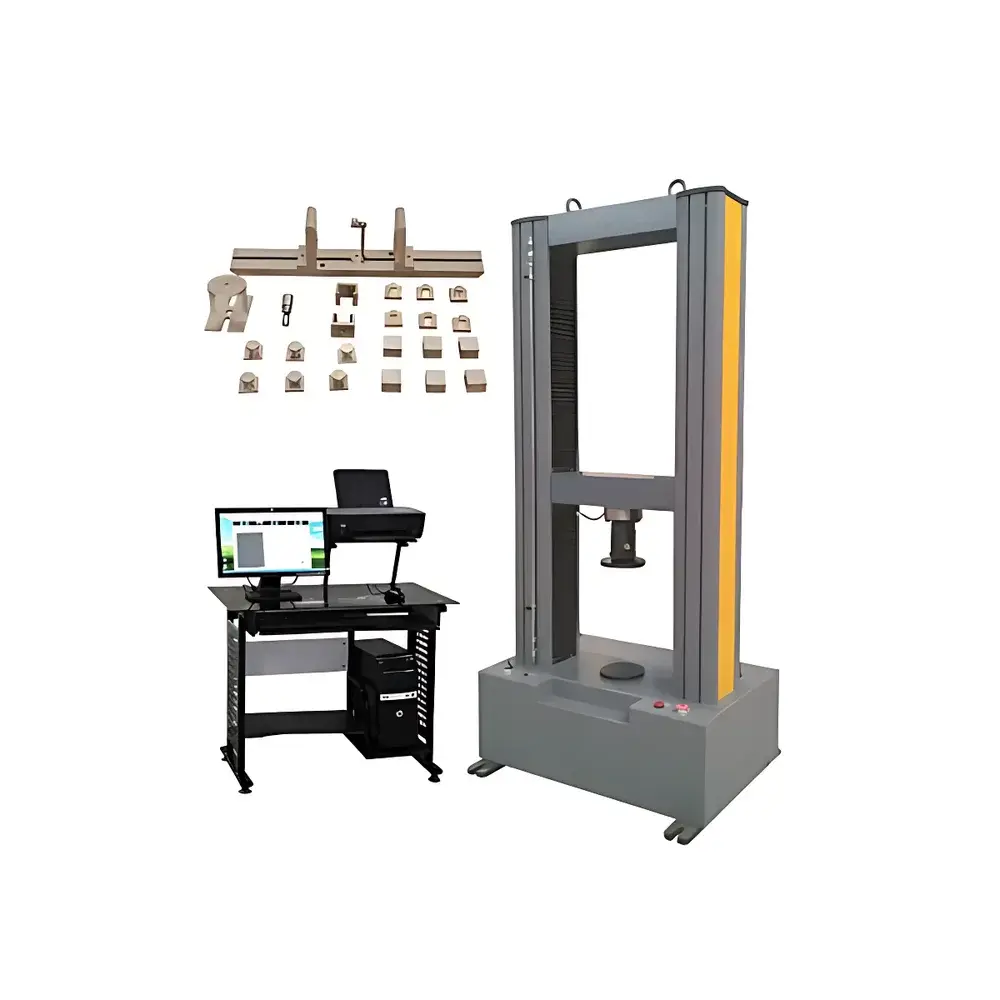
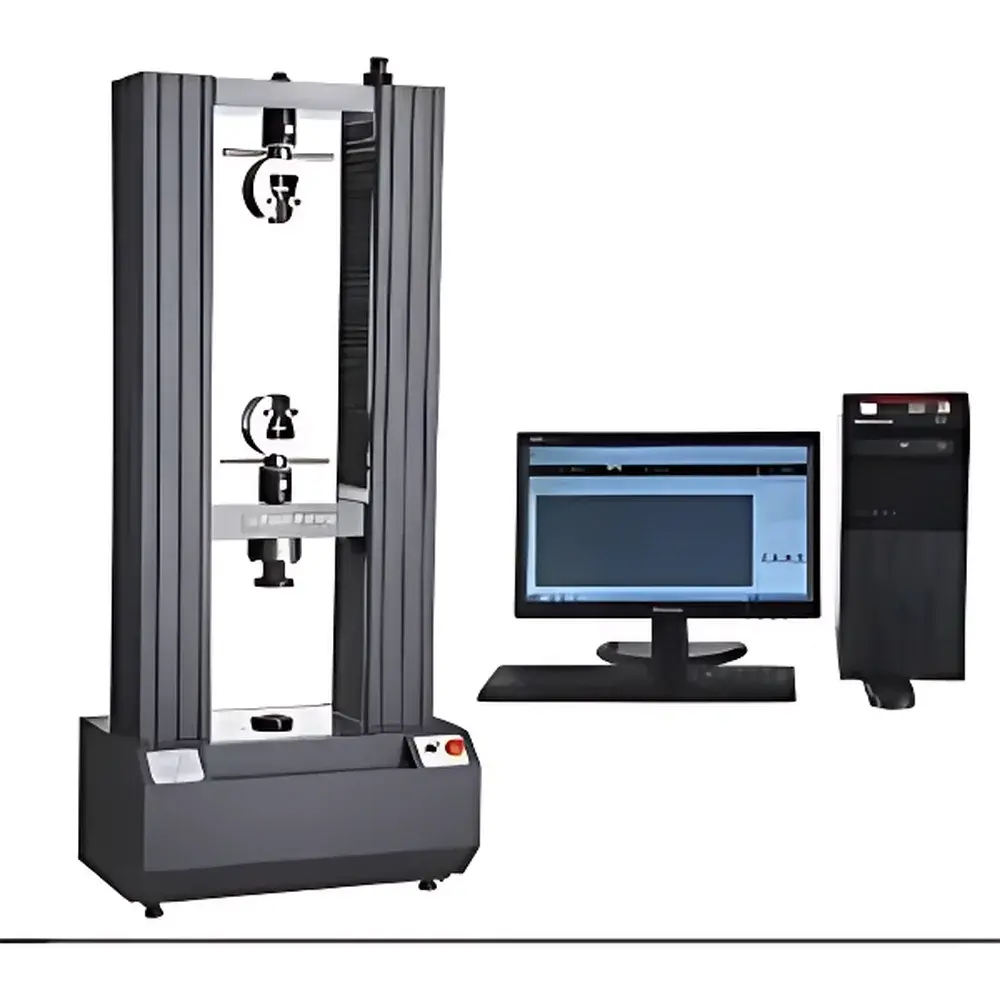
TOFENG MC-20 Universal Testing Machine for Wood and Engineered Panels
| Brand | TOFENG |
|---|---|
| Model | MC-20 |
| Type | Electromechanical Tensile & Compression Testing Machine |
| Max Test Load | 20 kN |
| Force Measurement Range | 0.4–100% of Full Scale |
| Force Accuracy | ±0.5% of reading |
| Crosshead Travel | 800 mm |
| Displacement Resolution | 1/500,000 mm |
| Test Speed Range | 0.01–500 mm/min (infinitely variable) |
| Test Width | 400 mm |
| Dimensions (W×D×H) | 780 × 560 × 1780 mm |
| Weight | 350 kg |
Overview
The TOFENG MC-20 Universal Testing Machine is an electromechanical static testing system engineered specifically for the mechanical characterization of wood-based composite panels—including plywood, particleboard, medium-density fiberboard (MDF), oriented strand board (OSB), and laminated veneer lumber (LVL). It operates on the principle of controlled uniaxial loading under displacement- or load-controlled modes, complying with standardized test protocols defined in ISO 16978, ASTM D1037, EN 310, EN 319, EN 317, and GB/T 17657. The machine integrates a high-rigidity dual-column frame, precision ball-screw-driven crosshead actuation, and a calibrated load cell to deliver repeatable, traceable force and displacement data across its full 20 kN capacity range. Designed for laboratory and quality control environments, the MC-20 supports both tensile and compressive testing configurations without mechanical reconfiguration—enabling efficient evaluation of modulus of elasticity (MOE), modulus of rupture (MOR), internal bond strength, surface bonding strength, screw withdrawal resistance, and edge hardness per industry-standard specimen geometries.
Key Features
- Electromechanical drive system with brushless servo motor and precision recirculating ball screw, ensuring smooth, low-noise operation and long-term mechanical stability.
- Full-scale force measurement from 0.4% to 100% FS with ±0.5% accuracy (per ISO 7500-1 Class 0.5), validated using certified dead-weight standards.
- High-resolution displacement sensing with 1/500,000 mm resolution, enabling precise determination of strain at yield, proportional limit, and failure points.
- Infinitely variable test speed control from 0.01 to 500 mm/min, programmable in discrete steps or continuous ramps to match ASTM D695, ISO 604, or EN 822 requirements.
- Dual-mode control architecture supporting both load-controlled and displacement-controlled testing sequences, with real-time PID feedback for consistent ramp rates.
- Integrated hardware safety limits—including programmable upper/lower displacement stops, emergency stop circuitry, and automatic overload cutoff—to protect both operator and specimen integrity.
- Multi-sensor calibration support: up to four independent load cells can be registered and selected via software, facilitating seamless transition between low-force (e.g., surface bonding) and high-force (e.g., bending) test configurations.
Sample Compatibility & Compliance
The MC-20 accommodates standard panel specimens per ISO 16978 (150 × 50 mm for MOR/MOE), EN 310 (100 × 25 mm for bending), EN 319 (50 × 50 mm for internal bond), and ASTM D1037 (25 × 25 mm for nail/screw withdrawal). Its 400 mm test width and 800 mm vertical travel allow full-height testing of thick LVL sections and multi-layer composites. All force and displacement outputs are traceable to national metrological standards. The system meets essential safety requirements per CE Machinery Directive 2006/42/EC and electromagnetic compatibility (EMC) compliance per EN 61326-1. Routine verification follows ISO/IEC 17025 guidelines for testing laboratories, with documented calibration certificates available for each load cell and encoder channel.
Software & Data Management
The MC-20 is operated via TOFENG’s proprietary Windows-based testing software, featuring fully localized Chinese menu navigation and bilingual (English/Chinese) report generation. The interface provides real-time graphical display of stress–strain, load–displacement, and time–force curves with adjustable scaling and overlay capability. Automated parameter extraction includes peak load, yield point, secant modulus, fracture energy (area under curve), and statistical summaries across test batches. Raw data export is supported in CSV, Excel (.xlsx), and XML formats. Audit trail functionality logs all user actions, method changes, calibration events, and result modifications—satisfying documentation requirements for GLP, ISO 9001, and internal QA/QC procedures. Software validation packages—including IQ/OQ documentation—are available upon request for regulated manufacturing environments.
Applications
- Mechanical performance certification of structural and non-structural wood composites for building code compliance (e.g., ICC-ES, APA PRG-320).
- Quality assurance during production of decorative laminates, HDF core boards, and fire-retardant treated panels.
- R&D evaluation of adhesive formulations, fiber orientation effects, and moisture-induced property degradation.
- Third-party conformity assessment for CE marking, CARB ATCM, and EPA TSCA Title VI compliance programs.
- Educational use in materials science and forestry engineering curricula for hands-on mechanical property instruction.
FAQ
What standards does the MC-20 support out-of-the-box?
The system includes preloaded test methods aligned with ISO 16978, EN 310, EN 319, ASTM D1037, and GB/T 17657. Custom method templates can be configured for other standards.
Can the MC-20 perform cyclic or fatigue testing?
No—the MC-20 is designed exclusively for quasi-static monotonic testing. For dynamic or fatigue applications, TOFENG recommends the MF-Series electrodynamic systems.
Is the software compliant with FDA 21 CFR Part 11?
The base software does not include electronic signature or role-based access controls required for Part 11; however, a validated 21 CFR Part 11 add-on module is available for pharmaceutical-grade wood-derived excipient testing.
What maintenance intervals are recommended?
Load cell recalibration every 12 months or after 10,000 cycles; ball screw lubrication every 6 months; annual mechanical inspection of guide rails and alignment tolerances per ISO 7500-1 Annex B.
Does the MC-20 require external air or hydraulic supply?
No—it is fully self-contained, requiring only a stable 220 V AC / 50 Hz power source and standard grounding.



