
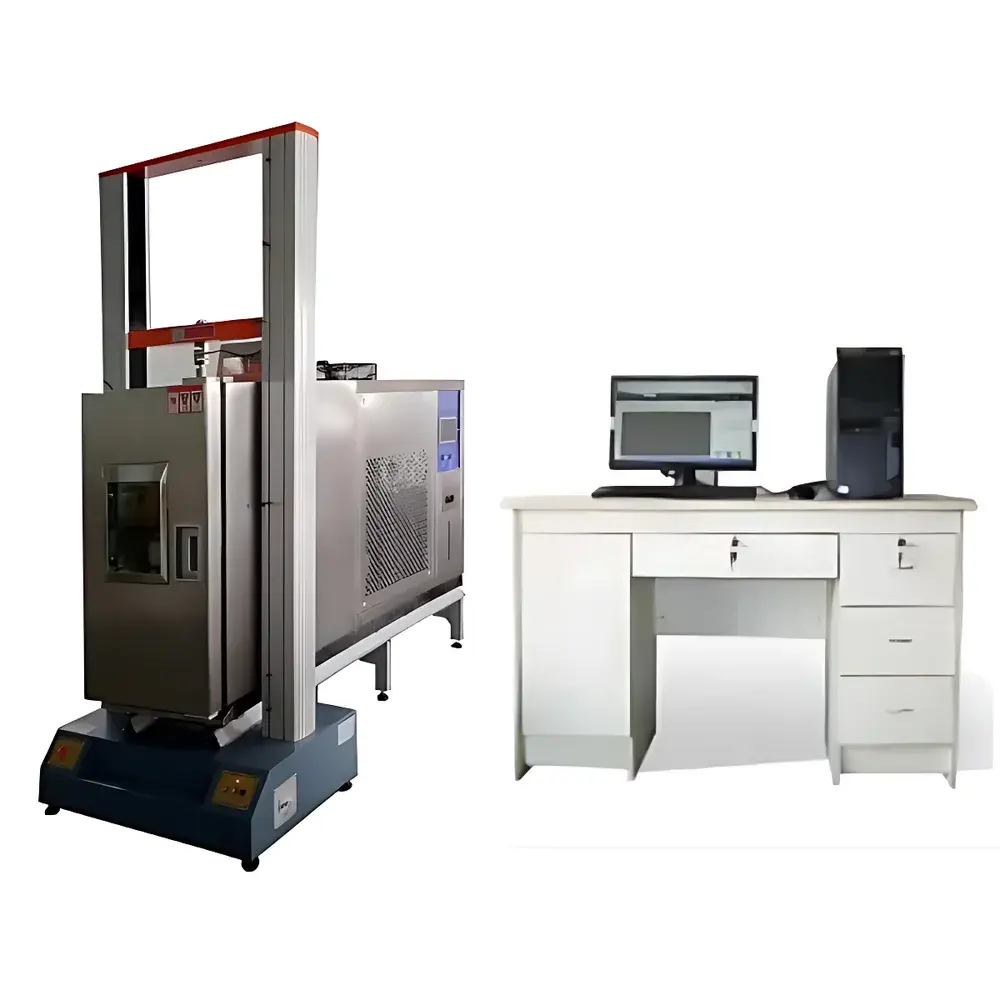
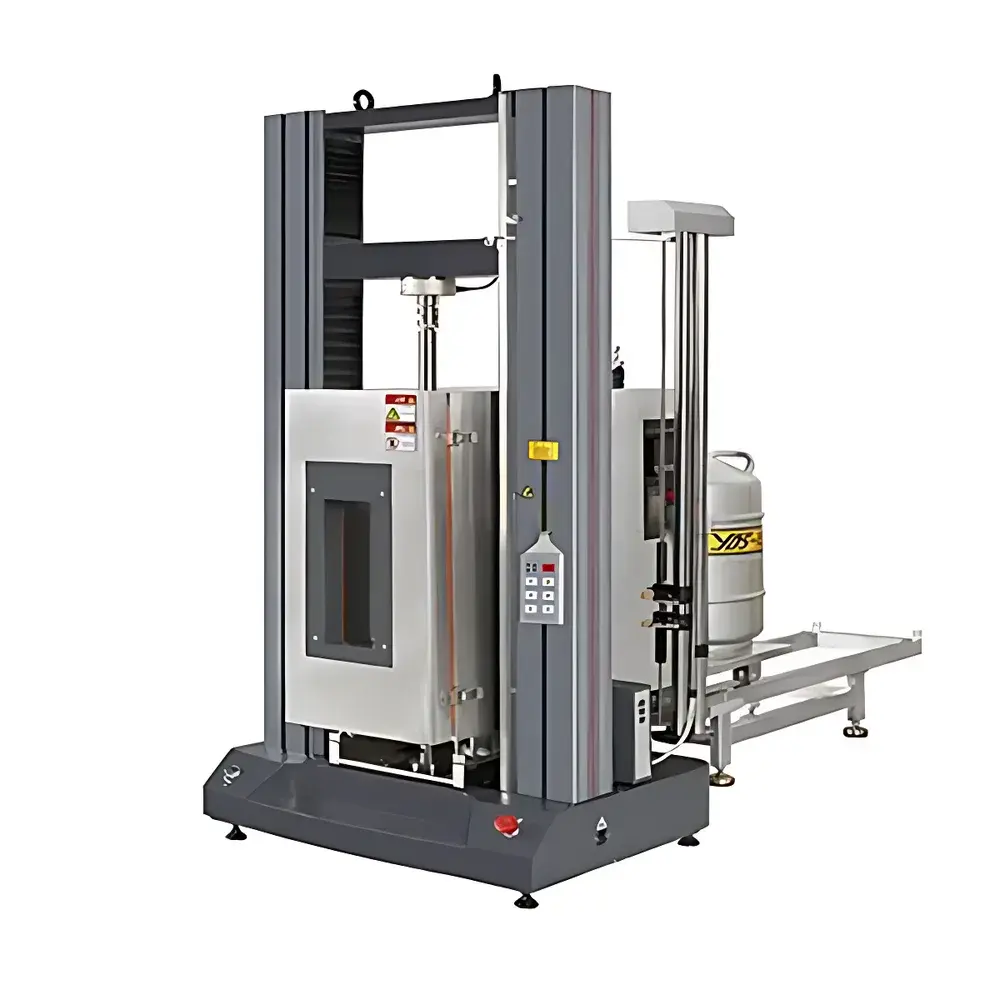
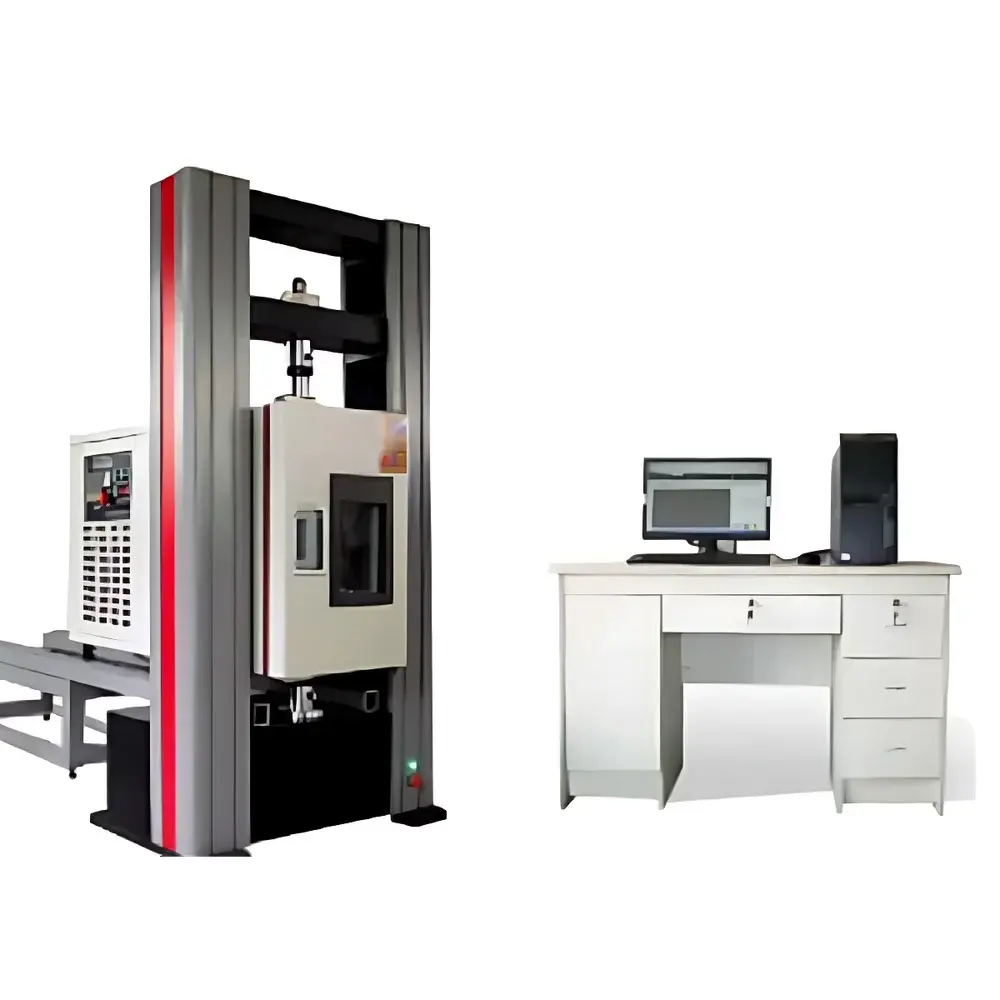
Tuofeng TFW-306 High-Low Temperature Electronic Universal Testing Machine
| Brand | Tuofeng |
|---|---|
| Origin | Shanghai, China |
| Manufacturer Type | Direct Manufacturer |
| Model | TFW-306 |
| Instrument Type | Electromechanical Universal Testing Machine |
| Load Capacity Range | 0.02 N to 300 kN |
| Load Accuracy | ±0.5% |
| Temperature Chamber Range | −40 °C to +100 °C |
| Temperature Uniformity | ±2 °C over 100 mm axial zone |
| Heating Rate | ≤30 min to reach +100 °C from ambient |
| Chamber Internal Dimensions | 360 × 300 × 500 mm (W × D × H) |
| Column Spacing | 840 mm |
| Crosshead Travel | 1000 mm |
| Power Supply | AC 220 V / 50 Hz ±10%, 750 W (main unit) |
| Weight | ~380 kg |
| Compliance | GB/T 228.1, ISO 6892-1, ASTM E8/E21, ASTM D638/D790/D1708, JIS Z2241, DIN 50125 |
Overview
The Tuofeng TFW-306 High-Low Temperature Electronic Universal Testing Machine is an electromechanical materials testing system engineered for precision mechanical characterization under controlled thermal environments. It integrates a high-stiffness dual-column load frame with a programmable environmental chamber capable of stable operation from −40 °C to +100 °C. The system operates on the principle of servo-controlled displacement and force feedback, utilizing a precision ball-screw-driven crosshead and high-resolution load cell technology to deliver traceable, repeatable mechanical data across tension, compression, bending, peel, tear, and shear modes. Designed for compliance with international standard test methods—including ISO 6892-1 (tensile testing of metallic materials), ASTM E8/E21 (metallic tensile and elevated-temperature testing), ASTM D638 (plastics tensile properties), and GB/T 228.1—the TFW-306 supports both ambient and thermally conditioned evaluation of structural integrity, ductility, yield behavior, and modulus evolution as a function of temperature.
Key Features
- Full-range load capacity from 0.02 N to 300 kN, selectable via interchangeable load cells calibrated to Class 0.5 accuracy per ISO 7500-1
- Force measurement resolution of 1 part in 500,000 of full scale, maintained continuously without range switching
- Integrated high-uniformity environmental chamber with programmable ramp/soak profiles, ±2 °C axial temperature tolerance over 100 mm test zone
- Chamber features 316 stainless steel interior, ceramic fiber insulation, dual-zone PID control, and platinum RTD sensing at top/bottom furnace ports
- Modular sample access: dual 50 mm-diameter apertures with retractable thermal shielding blocks to minimize heat leakage during in-situ loading
- Rigid 380 kg base frame with 840 mm column spacing and 1000 mm vertical travel accommodates large specimens and multi-axis fixtures
- Real-time synchronization between mechanical actuation and thermal conditioning, enabling true isothermal or thermomechanical loading protocols
Sample Compatibility & Compliance
The TFW-306 accommodates metallic alloys (e.g., aluminum, titanium, stainless steels), polymers (thermoplastics, elastomers, composites), ceramics, adhesives, thin films, and fiber-reinforced laminates. Specimen geometries include dog-bone tensile bars, cylindrical compression samples, three/four-point bend fixtures, peel tabs, and trouser-tear configurations—all compatible with chamber-integrated grips and extensometry. The system meets essential regulatory and quality framework requirements: it supports audit-ready data capture aligned with GLP and GMP practices; its software architecture permits configuration for FDA 21 CFR Part 11-compliant user access control, electronic signatures, and immutable audit trails; and hardware calibration certificates are traceable to national metrology institutes (NIM, NIST-equivalent). All mechanical outputs comply with uncertainty budgets defined in ISO/IEC 17025-accredited laboratories.
Software & Data Management
The Windows-based testing software provides real-time acquisition of force, displacement, strain (via optional extensometers), and chamber temperature at up to 1 kHz sampling rate. It auto-calculates standard mechanical parameters—including ultimate tensile strength (UTS), yield strength (Rp0.2), Young’s modulus, elongation at break, compressive yield stress, flexural modulus, and peel/adhesion energy—according to user-selected standards. Curve overlays support comparative analysis across temperature points; derivative functions enable strain-rate sensitivity assessment. Raw data exports to CSV, Excel, and XML formats; report templates are customizable and support bilingual (English/Chinese) generation. Software modules include batch test sequencing, pass/fail tolerance banding, statistical process control (SPC) charting, and integration with LIMS via ODBC drivers.
Applications
This system serves advanced materials development and quality assurance workflows in aerospace component validation (e.g., thermal cycling of fasteners and sealants), automotive polymer qualification (low-temperature impact resistance of PP blends), medical device polymer certification (ISO 10993-12 compliant mechanical aging), battery electrode binder performance under thermal stress, and R&D of high-entropy alloys requiring cryogenic ductility mapping. Universities and national institutes utilize it for fundamental studies on thermoelastic coupling, time–temperature superposition modeling, and constitutive model parameterization for finite element simulation.
FAQ
What temperature stability is guaranteed during active mechanical loading?
Temperature uniformity remains within ±2 °C over a 100 mm axial zone during static and dynamic loading, verified per ASTM E2202 Annex A3.
Can the system perform strain-controlled cyclic tests inside the chamber?
Yes—closed-loop strain control is supported using clip-on or non-contact extensometers rated for operation within the full −40 °C to +100 °C range.
Is third-party calibration documentation included?
Each delivered system includes factory calibration certificates for load cell, displacement transducer, and chamber temperature sensors, traceable to CNAS-accredited reference standards.
How is thermal drift compensated during long-duration creep tests?
The controller applies real-time thermal offset correction using dual RTD feedback and pre-characterized thermal expansion coefficients of the load train.
Does the software support automated compliance with ISO 527 or ASTM D790?
Yes—test method wizards embed all procedural logic, acceptance criteria, and calculation routines required by these standards, including specimen dimensional verification and modulus determination algorithms.
Related Products



