
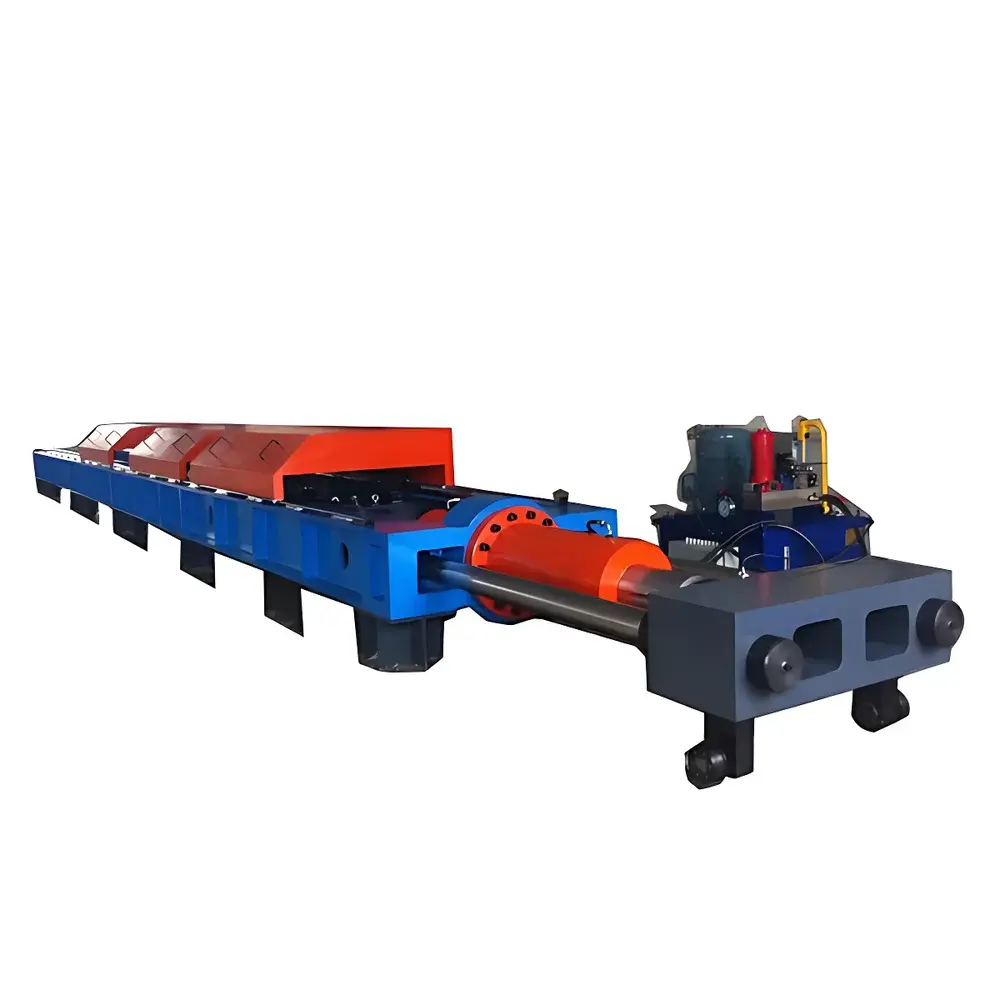
TOFENG WAL-1000 Microcomputer-Controlled Horizontal Tensile Testing Machine
| Brand | TOFENG |
|---|---|
| Model | WAL-1000 |
| Type | Electromechanical Horizontal Tensile Testing Machine |
| Max Test Load | 1000 kN |
| Load Measurement Range | 0.2–100% FS |
| Load Accuracy | ±0.5% |
| Adjustable Test Span | 2–25 m (excluding piston stroke) |
| Piston Stroke | 1000 mm (customizable) |
| Crosshead Speed | 0–200 mm/min |
| Displacement Resolution | 0.0001 mm |
| Load Cell | High-Precision Dual-Range Compression/Tension Load Sensor |
| Position Sensing | Optical Encoder |
| Control System | Digital Servo Controller with Force, Displacement, and Strain Closed-Loop Feedback |
| Compliance | ASTM E4, ASTM E8/E8M, ISO 6892-1, GB/T 228.1, EN 10002-1 |
Overview
The TOFENG WAL-1000 Microcomputer-Controlled Horizontal Tensile Testing Machine is a heavy-duty, frame-based electromechanical system engineered for high-capacity static tensile evaluation of structural and safety-critical components. Designed specifically for horizontal loading configuration, it eliminates gravitational interference during elongation measurement and enables stable, repeatable force application across extended test spans—critical for evaluating long, flexible, or high-inertia specimens such as wire ropes, marine anchor chains, lifting slings, safety harnesses, high-strength bolts, shackles, and turnbuckles. The machine employs a single-rod, double-acting servo hydraulic cylinder to deliver precisely regulated axial load, while a calibrated dual-range load cell ensures traceable force measurement per ISO/IEC 17025–accredited calibration protocols. Real-time displacement is captured via high-resolution optical encoders synchronized with the crosshead motion, supporting sub-micron positional fidelity over strokes up to 1000 mm. All control logic—including ramp-hold-step profiles, load-rate modulation, and break-point detection—is executed by an embedded digital servo amplifier capable of simultaneous force, displacement, and strain closed-loop regulation.
Key Features
- Robust welded steel frame architecture with reinforced anchoring base, rated for sustained 1000 kN operational load and validated for fatigue life exceeding 10⁵ cycles at 80% FS
- Hydraulic crosshead positioning system with mechanical pin-locking mechanism enabling rapid, repeatable adjustment of test span between 2 m and 25 m in discrete increments
- Dual-channel digital servo controller supporting ASTM E4-compliant load calibration verification and real-time PID parameter tuning without hardware intervention
- Integrated safety interlock network including emergency stop circuitry, light-curtain protected test zone, full-enclosure polycarbonate guard, and automatic load-unload sequence upon specimen rupture
- Modular fixture interface compliant with ISO 26203-2 mechanical coupling standards, supporting quick-swap configurations for wedge-grip, swivel-eye, clevis, and threaded-end attachments
- Onboard data acquisition at 1 kHz sampling rate with 24-bit analog-to-digital conversion, ensuring high-fidelity capture of transient failure events and plastic deformation onset
Sample Compatibility & Compliance
The WAL-1000 accommodates specimens with diameters ranging from 3 mm to 120 mm and lengths up to 25 meters—ideal for full-scale qualification testing of offshore mooring systems, elevator suspension ropes, and wind turbine guy wires. It meets mechanical and procedural requirements defined in ASTM A931 (steel strand), ISO 17081 (chain testing), EN 12195-2 (lashing equipment), and MIL-STD-1344 (aerospace fastener validation). All firmware and software modules are designed to support audit-ready operation under GLP and GMP environments, including electronic signature capability, user-access-level management, and 21 CFR Part 11–compliant audit trails for raw data, calibration logs, and test method versions.
Software & Data Management
The TOFENG TMS-Link™ software suite provides ISO 17025-aligned test method templates for tensile strength, yield point, elongation at break, reduction in area, and modulus of elasticity calculations. It supports automated generation of compliance reports conforming to ASTM E2382 and ISO 7500-1 reporting formats, with embedded metadata tagging for specimen ID, operator, environmental conditions (temperature/humidity), and calibration certificate traceability. Raw binary data (.tdms) and processed results (.xlsx, .pdf) are stored in hierarchical project folders with SHA-256 hash verification. Optional integration with LIMS platforms via RESTful API enables seamless transfer of pass/fail status, statistical process control (SPC) metrics, and nonconformance records.
Applications
- Qualification and periodic retesting of marine-grade anchor chains per DNV-OS-E301 and ABS Steel Vessel Rules
- Mechanical validation of personal protective equipment (PPE) including fall arrest lanyards and energy-absorbing connectors per EN 361 and ANSI Z359.1
- Structural integrity assessment of prestressed concrete tendons and post-tensioning systems in bridge and building infrastructure
- R&D characterization of advanced composite cables, aramid fiber ropes, and high-modulus polyethylene (HMPE) synthetic slings
- Factory acceptance testing (FAT) of large-diameter bolts and stud anchors used in oil & gas flange connections and wind turbine foundations
FAQ
What is the maximum allowable test length for specimens requiring full-span elongation measurement?
The effective test span—defined as the distance between active grips—is adjustable from 2 m to 25 m using the hydraulic crosshead translation system and mechanical pin-locking grid; this excludes the 1000 mm piston stroke, which contributes additional extension capacity.
Does the system support strain-controlled testing modes required for ISO 6892-1 Annex G?
Yes—the digital servo controller implements true closed-loop strain control using extensometer input signals (compatible with clip-on and video-based extensometers), enabling precise execution of strain rate protocols specified in ISO 6892-1:2019 Annex G for metallic materials.
Can test data be exported in formats compatible with third-party statistical analysis tools?
All acquired data are exportable in ASCII-delimited (.csv), MATLAB (.mat), and NI TDMS formats; metadata headers include SI unit annotations, timestamp synchronization, and sensor calibration coefficients for metrological traceability.
Is remote diagnostics and firmware update supported over secure network connection?
Yes—TMS-Link™ includes TLS 1.2–secured remote maintenance mode allowing authorized service engineers to perform real-time system health checks, log review, and signed firmware updates without local physical access.
How is load cell calibration traceability maintained throughout the instrument lifecycle?
Each load cell is supplied with a UKAS-accredited calibration certificate (ISO/IEC 17025) valid for 12 months; the software enforces mandatory recalibration prompts and blocks test execution if the certificate expiry date has passed or if verification load checks deviate beyond ±0.25% FS tolerance.



