
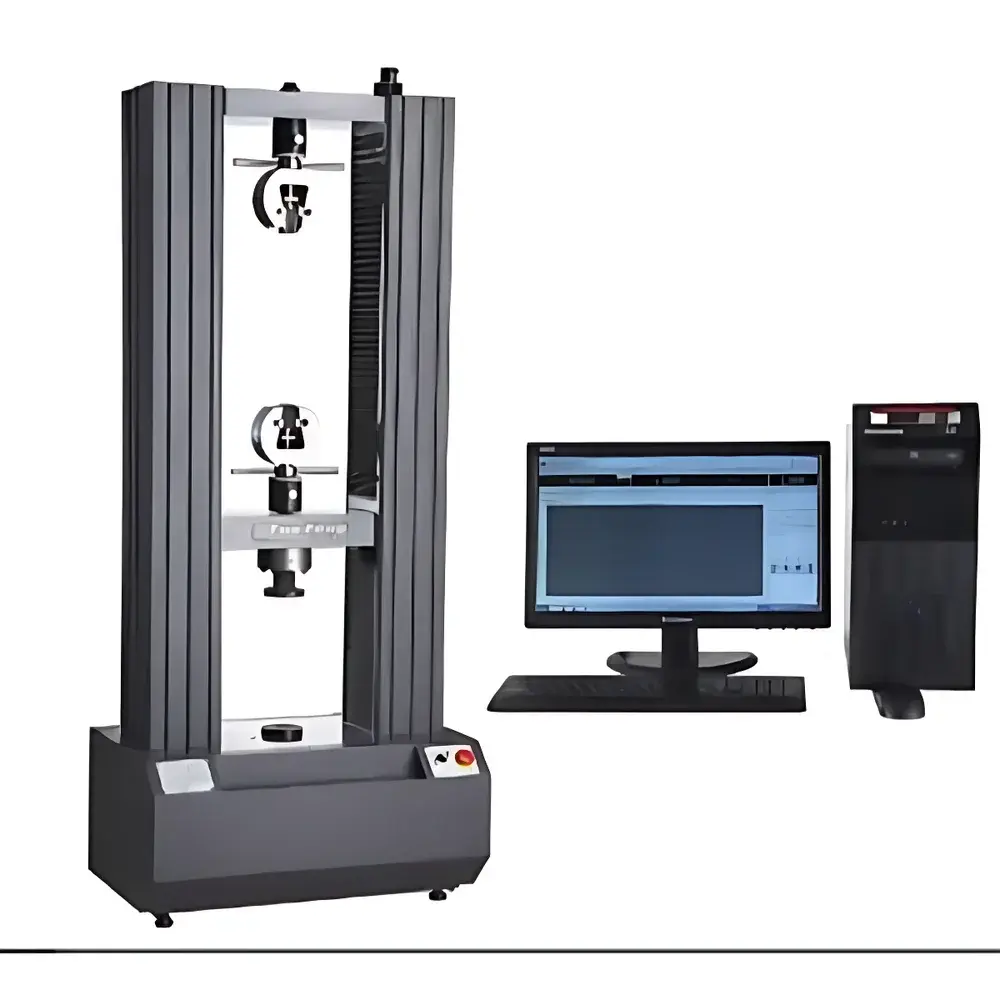
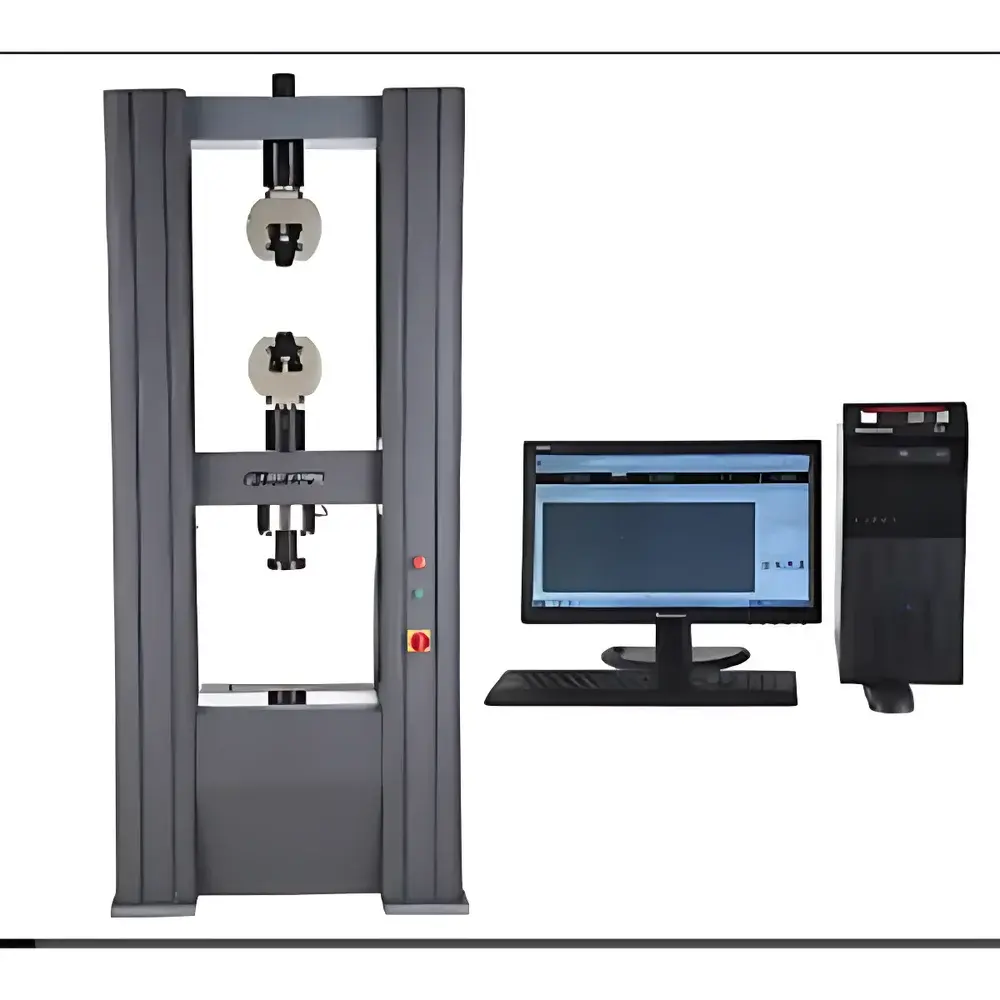
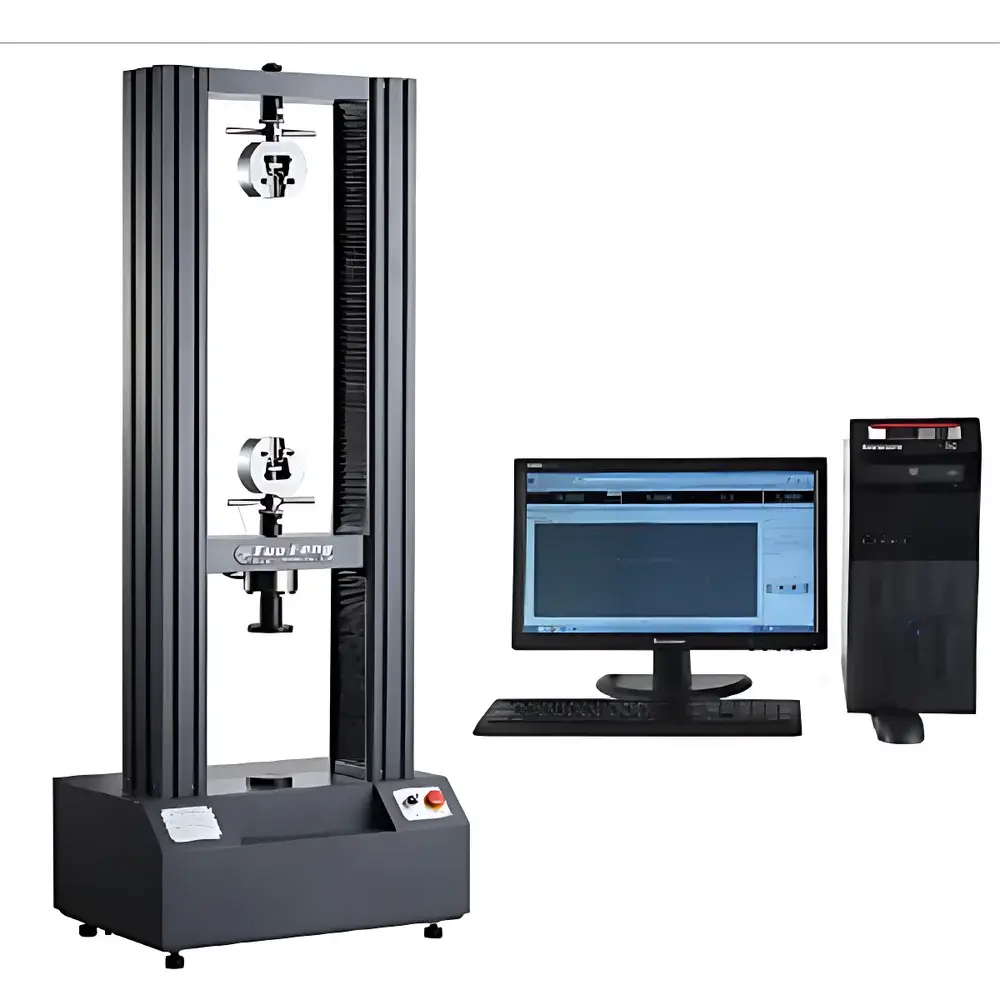
Tuofeng TFW-291 Advanced Microcomputer-Controlled Universal Testing Machine
| Brand | Tuofeng |
|---|---|
| Origin | Shanghai, China |
| Manufacturer Type | Direct Manufacturer |
| Instrument Type | Electromechanical Universal Testing Machine |
| Maximum Load Capacity | 300 kN |
| Load Accuracy | ±0.5% |
| Load Cell Resolution | 1 part in 500,000 full scale (fixed resolution, no range switching) |
| Test Speed Range | 0.001–500 mm/min (infinitely variable) |
| Effective Test Width | 600 mm (customizable) |
| Vertical Travel | 800 mm (extendable) |
| Displacement Measurement Accuracy | ±0.005% of reading |
| Strain Measurement | Optional extensometer or large-deformation sensor (±0.005% accuracy) |
| Control System | Imported servo motor + precision worm-gear reducer + preloaded ball screw |
| Safety Protection | Electronic limit switches, emergency stop button, overload protection (110% of rated capacity) |
| Software Compliance | Supports ASTM E4, ASTM E8/E21, ISO 6892-1, ISO 7500-1, GB/T 16491-2008, JJG 475-2008 |
Overview
The Tuofeng TFW-291 Advanced Microcomputer-Controlled Universal Testing Machine is a high-precision electromechanical system engineered for static mechanical property characterization of metallic, polymeric, ceramic, composite, and elastomeric materials. It operates on the principle of controlled axial force application via a closed-loop servo-driven actuation system, enabling precise displacement- or load-controlled testing across tension, compression, bending, shear, peel, tear, and puncture configurations. Designed to meet international metrological and structural integrity requirements, the machine delivers traceable, repeatable, and reproducible results under standardized test protocols. Its rigid four-column frame, high-stiffness crosshead assembly, and thermally stable load cell architecture minimize parasitic deformation and thermal drift—critical for long-duration creep or hold tests and high-resolution modulus determination.
Key Features
- 300 kN maximum load capacity with ±0.5% load accuracy and 1:500,000 internal resolution—ensuring high fidelity across the full dynamic range (0.2%–100% of full scale)
- Imported high-torque servo motor coupled with a backlash-free worm-gear reduction and preloaded recirculating ball screw for smooth, low-noise, and wear-resistant motion control
- Dual-speed automatic crosshead positioning (fast/slow modes) with programmable return-to-start functionality and point-to-point jog control for rapid specimen setup
- Integrated multi-level safety architecture: electronic travel limits, hardware-based emergency stop circuitry, real-time overload cutoff (triggered at 110% of rated load), and mechanical overload buffer
- Modular fixture interface compatible with standardized wedge-action grips, compression platens, bend fixtures, peel jigs, and custom tooling per ASTM D638, ISO 527, ASTM D790, ISO 178, ASTM D1876, and ISO 8510-2
- Thermally compensated load cell and optical encoder-based displacement measurement system—both calibrated per ISO 7500-1 Class 0.5 requirements
Sample Compatibility & Compliance
The TFW-291 accommodates specimens ranging from thin films (≥0.05 mm thickness) to structural steel coupons (up to 100 mm wide × 30 mm thick), with customizable test width (standard 600 mm, extendable upon request) and vertical clearance (800 mm standard, expandable). It supports both standard and non-standard geometries—including dog-bone, dumbbell, rectangular, cylindrical, and irregular profiles—via interchangeable gripping systems. The system complies with national and international regulatory frameworks: GB/T 16491–2008 (Chinese standard for electronic UTM design), JJG 475–2008 (verification regulation for electromechanical UTMs), ISO 7500-1:2018 (static calibration of force-proving instruments), and ASTM E4–2022 (practice for verification of force-measuring instruments). All calibration certificates are NIST-traceable, and the machine supports GLP/GMP-compliant audit trails when paired with optional 21 CFR Part 11–enabled software modules.
Software & Data Management
The Windows-based TFW-TestSuite software provides fully configurable test sequencing, real-time data acquisition at up to 1 kHz sampling rate, and multi-parameter synchronization (load, displacement, strain, time). Users may select from load-controlled, displacement-controlled, or strain-controlled test modes—including ramp-hold, cyclic loading, and stepwise stress relaxation. The interface supports multilingual operation (English, Simplified/Traditional Chinese), unit conversion across SI, imperial, and metric systems, and simultaneous display of up to four independent curves: load–time, load–displacement, stress–strain, and displacement–time. Post-test analysis includes automatic calculation of tensile strength, yield strength (0.2% offset), Young’s modulus, elongation at break, compressive strength, flexural modulus, peel adhesion, and tear resistance. Data export conforms to CSV, XML, and PDF formats; batch reporting supports statistical summary (mean, min, max, SD) and curve overlay comparison. Software updates are provided free of charge for the lifetime of the instrument.
Applications
The TFW-291 serves as a primary mechanical characterization platform in R&D laboratories, quality assurance departments, and third-party certification bodies. Typical use cases include: validation of aerospace aluminum alloys per AMS 2355; tensile evaluation of automotive thermoplastics (PP, PA66, PBT) per ISO 527-2; compression testing of concrete cores and cementitious composites per ASTM C39; peel strength assessment of medical device laminates per ISO 8510-2; flexural performance of carbon fiber-reinforced polymer (CFRP) panels per ASTM D7264; and mechanical screening of battery electrode coatings during roll-to-roll manufacturing. It is routinely deployed in accredited testing facilities supporting ISO/IEC 17025 audits and FDA-regulated material qualification dossiers.
FAQ
What standards does the TFW-291 support out-of-the-box?
The system includes preconfigured test methods for ASTM E8/E21 (metals), ASTM D638/D790 (plastics), ISO 6892-1 (tensile testing), ISO 178 (flexural testing), GB/T 228.1 (Chinese metallic materials standard), and ISO 7500-1 (calibration compliance). Custom method development is supported via scriptable test templates.
Can the machine perform cyclic fatigue testing?
While the base configuration is optimized for quasi-static testing, optional high-cycle fatigue modules—including hydraulic/pneumatic actuators, enhanced thermal management, and dedicated waveform generators—are available for low-frequency (≤5 Hz) sinusoidal, triangular, or block-loading protocols.
Is remote monitoring or network integration possible?
Yes—the TFW-TestSuite supports TCP/IP communication, OPC UA server integration, and SCADA-compatible data streaming. Lab-wide deployment with centralized database logging and role-based user access control is achievable with enterprise licensing.
What maintenance intervals are recommended?
Annual recalibration of the load cell and displacement encoder is advised. Ball screw lubrication and drive belt inspection should occur every 6 months under continuous operation; all service procedures follow ISO 13374 condition monitoring guidelines.
Does the system support automated specimen identification?
Via optional RFID-enabled grip adapters and barcode-scanned sample labels, the software can auto-populate test parameters, assign batch IDs, and enforce pre-defined pass/fail criteria against stored specification limits.



