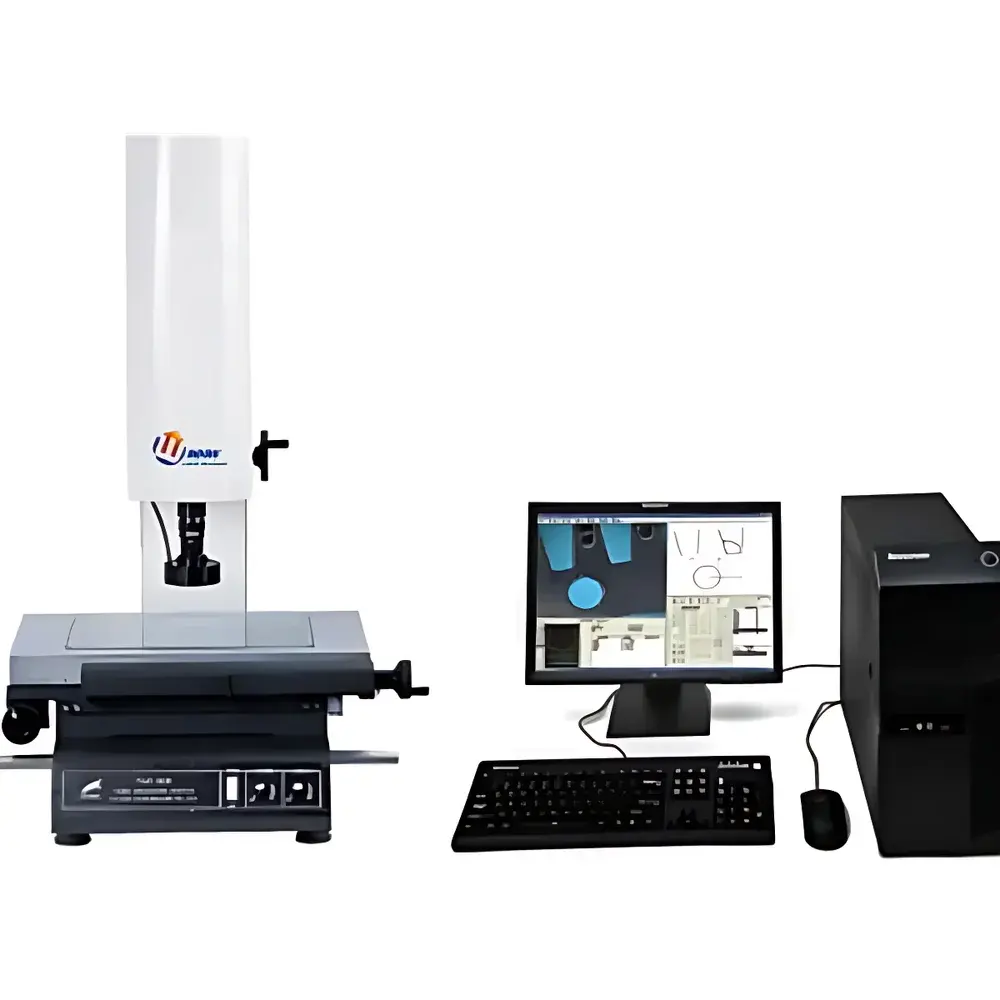
YANRUN YR-T5030 Economical Vision Measuring Machine
| Brand | YANRUN |
|---|---|
| Origin | Shanghai, China |
| Manufacturer Type | Direct Manufacturer |
| Country of Origin | China |
| Model | YR-T5030 |
| Price | USD 1 (Base Unit Reference Only) |
| Table Load Capacity | ≥450 kg |
| Table Dimensions (L×W×H) | 1250 × 900 × 780 mm |
| Metal Stage Size | 706 × 466 mm |
| Glass Stage Size | 550 × 350 mm |
| X-Y Travel Range | 500 × 300 mm |
| Z-Axis Vertical Travel | 200 mm |
| Working Distance | 92 mm |
| Digital Readout Resolution (X/Y/Z) | 0.0005 mm |
| Positioning Accuracy (X/Y) | ≤(3 + L/200) μm |
| Camera | Color 1/3" CCD |
| Zoom Objective Magnification | 0.7×–4.5× |
| Total Video Magnification | 30×–230× |
| Field of View (Object Side) | 7.0–1.1 mm |
| Illumination | Dual LED (Top Surface & Bottom Transmission), Adjustable Brightness |
| Power Supply | AC 180–260 V, 50 Hz |
| Standard Software | Automated 2D Metrology Suite with Edge Detection, Deburring Algorithm, Geometric Feature Recognition (Points, Lines, Circles, Circle-to-Circle Distance, Part Alignment) |
Overview
The YANRUN YR-T5030 Economical Vision Measuring Machine is a high-value, entry-tier coordinate measuring system engineered for precision 2D geometric metrology in quality control laboratories, contract manufacturing facilities, and R&D workshops. It operates on the principle of optical magnification and digital image analysis—capturing high-contrast silhouette or surface-reflected images via a calibrated telecentric optical path, then computing dimensional coordinates through sub-pixel edge detection algorithms. Designed to meet ISO 10360-7 (Acceptance and Reverification Tests for Coordinate Measuring Systems with Optical Distance Sensors) foundational requirements, the YR-T5030 delivers traceable, repeatable measurements across metal, plastic, ceramic, and PCB components without physical contact. Its rigid granite base and thermally stable mechanical architecture minimize drift during extended measurement cycles, while the dual-LED illumination system ensures consistent contrast under varying ambient conditions—critical for compliance with ASTM E2927-22 (Standard Practice for Calibration of Optical Measurement Systems).
Key Features
- High-resolution 1/3″ color CCD imaging sensor with real-time analog-to-digital conversion for noise-resilient edge acquisition
- Motorized zoom objective (0.7×–4.5×) enabling seamless switching between wide-field overview and high-magnification detail inspection
- Full-range video magnification from 30× to 230×, supporting both macro-level alignment and micro-feature verification (e.g., solder paste deposit width, micro-hole positioning)
- Integrated dual-LED lighting: top coaxial and bottom transmission modules with independent brightness control—optimized for translucent, reflective, and opaque samples
- 0.5 µm digital encoder resolution on all three axes (X/Y/Z), paired with linear scale feedback for enhanced positional fidelity
- Robust mechanical construction featuring a 450 kg load-rated granite base platform (1250 × 900 × 780 mm), ensuring vibration damping and long-term stability
- Compliance-ready design: supports audit trails, user access levels, and calibration log retention—aligned with GLP/GMP documentation expectations
Sample Compatibility & Compliance
The YR-T5030 accommodates flat, planar, and low-relief components up to 200 mm in height and 450 kg in mass. Typical use cases include stamped metal parts, injection-molded housings, printed circuit boards, gaskets, and precision machined fixtures. Its non-contact methodology eliminates part deformation risk and avoids tool wear associated with tactile probes. The system meets fundamental performance criteria outlined in ISO 14253-1 (Geometrical Product Specifications — Inspection by Measurement of Workpieces and Measuring Equipment) and supports traceability to national metrology institutes when used with certified reference artifacts (e.g., NIST-traceable step gauges or grid plates). While not inherently FDA 21 CFR Part 11 compliant out-of-the-box, its software architecture permits configuration for electronic signature and audit trail functionality per internal validation protocols.
Software & Data Management
The standard 2D metrology software provides automated feature recognition—including point, line, circle, arc, slot, and distance measurements—with programmable measurement sequences and batch reporting. Edge detection employs adaptive thresholding and Gaussian smoothing to suppress noise-induced false triggers; deburring logic filters spurious pixel clusters at feature boundaries. All measurement data is exportable in CSV, DXF, and PDF formats. Raw image capture, coordinate logs, and operator metadata are timestamped and stored locally with optional network backup. The interface supports multi-language UI (English default) and configurable report templates aligned with internal QA documentation standards.
Applications
- Dimensional verification of GD&T callouts (position, concentricity, profile) on engineering drawings
- First-article inspection for automotive stampings and aerospace brackets
- PCB pad-to-pad spacing, via diameter, and fiducial alignment validation
- Tooling and fixture calibration checks prior to production launch
- Educational labs requiring robust, serviceable vision metrology platforms for metrology coursework
- Supplier quality audits where cost-sensitive, ISO-aligned measurement capability is required
FAQ
What is the maximum part height the YR-T5030 can accommodate?
The Z-axis vertical travel is 200 mm, with a working distance of 92 mm—allowing parts up to approximately 108 mm in height when placed directly on the glass stage.
Does the system support automatic focus or Z-height compensation?
No—the YR-T5030 is a fixed-focus 2D vision system; Z-axis movement is manual or motorized for coarse positioning only, not for depth-of-field optimization.
Can measurement results be integrated into an enterprise MES or SPC system?
Yes—via CSV export or optional OPC UA gateway integration (hardware-dependent); raw coordinate data includes X, Y, diameter, angle, and confidence metrics.
Is calibration certification included with shipment?
A factory calibration report is provided; full ISO/IEC 17025-accredited calibration requires third-party service and is recommended annually or per usage intensity.
What maintenance is required for long-term accuracy?
Biannual cleaning of optical surfaces, annual verification of encoder linearity, and periodic revalidation against certified reference standards per internal SOPs.