
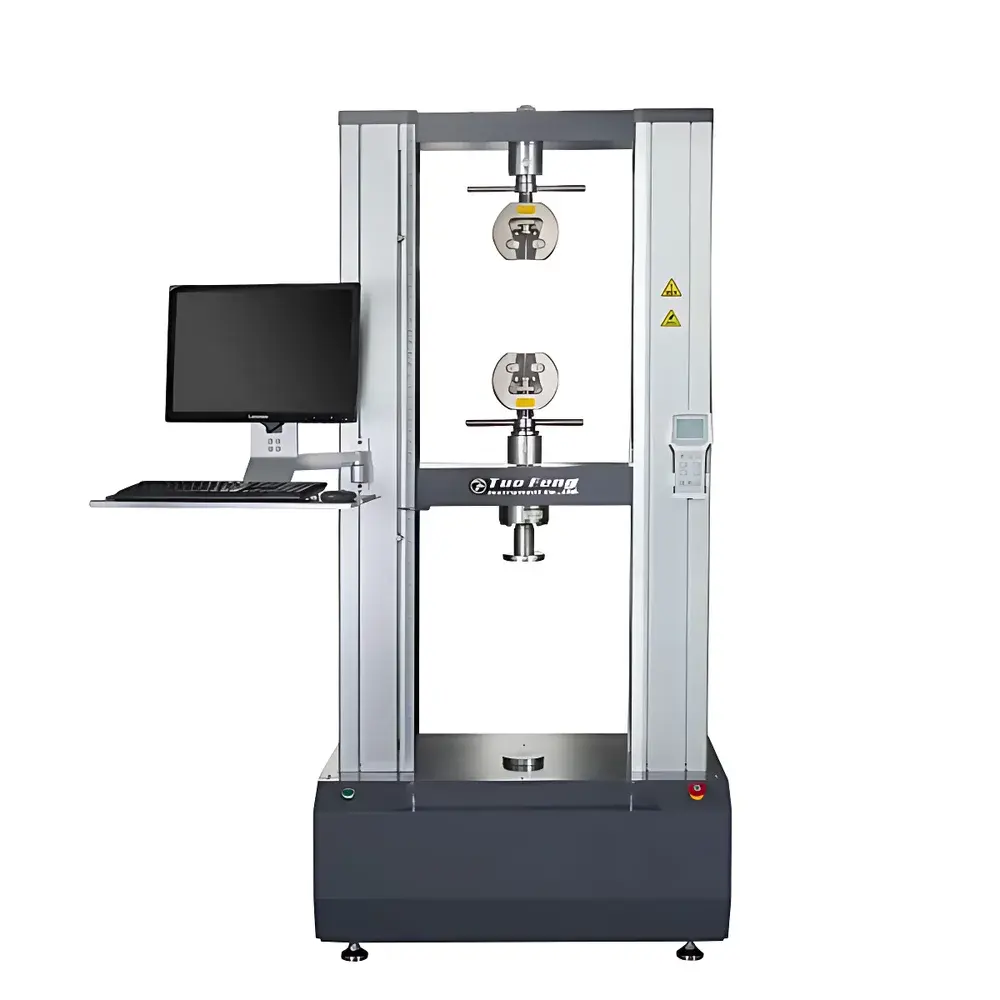
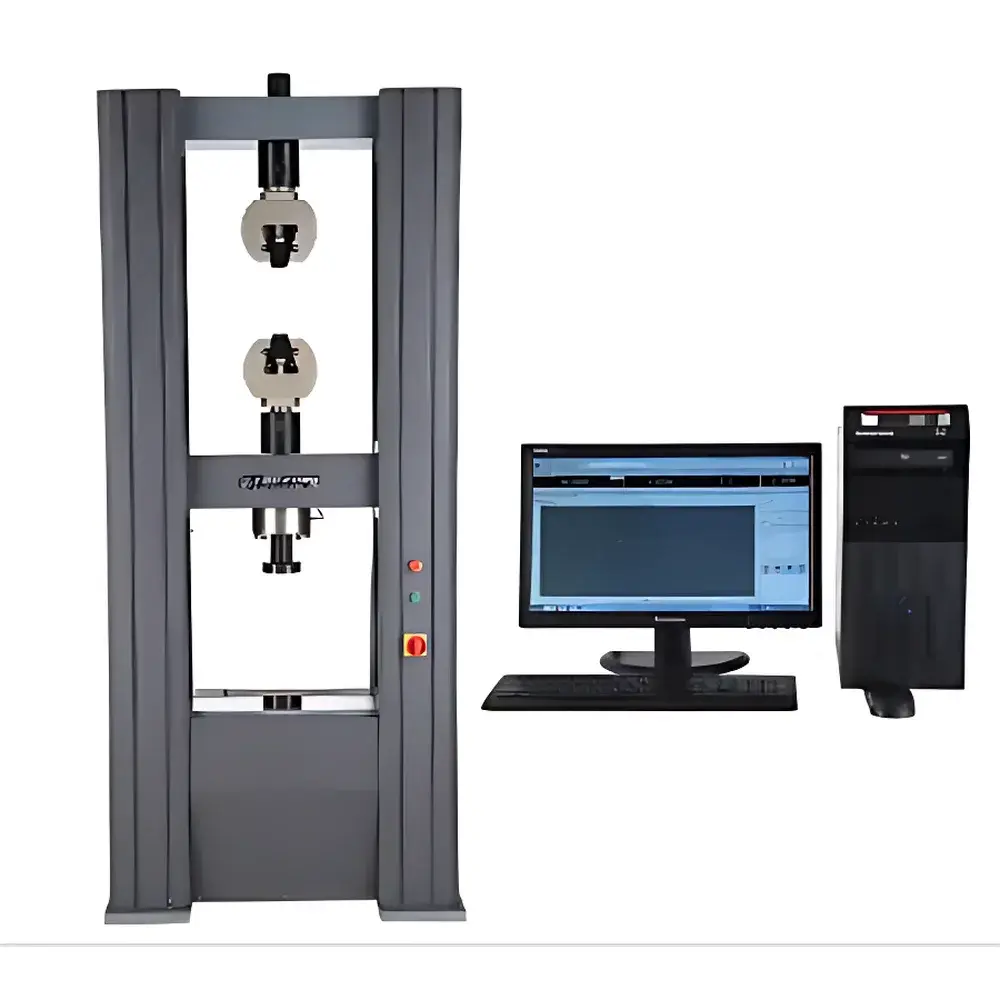
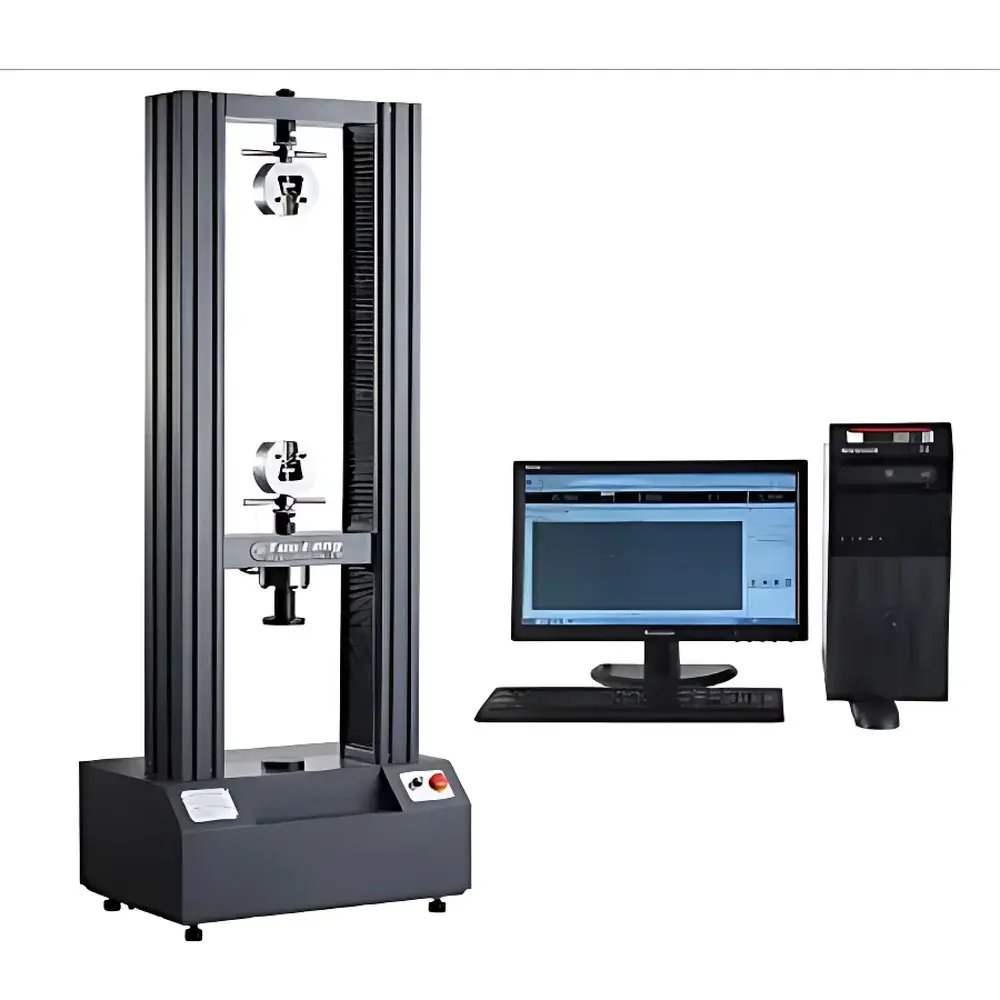
Tuofeng TFW-137 Microcomputer-Controlled Electronic Universal Testing Machine
| Brand | Tuofeng |
|---|---|
| Origin | Shanghai, China |
| Manufacturer Type | Direct Manufacturer |
| Instrument Type | Electromechanical Universal Testing Machine |
| Model | TFW-137 |
| Max Test Load | 137 kN (derived from model nomenclature and standard series alignment with TFW-100S/TFW-200S) |
| Accuracy Class | 0.5 |
| Effective Force Range | 0.2–100% of full scale |
| Force Measurement Accuracy | ±0.005% of reading |
| Load Cell Resolution | 1 part in ±500,000 full-scale codes, single-range, constant resolution |
| Drive System | Imported servo motor with precision worm-gear reducer |
| Lead Screw | High-precision preloaded ball screw |
| Effective Test Width | 600 mm (customizable) |
| Stroke | 800 mm (extendable) |
| Speed Range | 0.001–500 mm/min (infinitely variable) |
| Displacement Measurement | Optical encoder, accuracy ±0.005% of reading |
| Strain Measurement | Optional clip-on extensometer or large-deformation transducer, accuracy ±0.005% of reading |
| Safety Protection | Dual electronic limit switches, emergency stop button, overload protection (110% FS auto-hold) |
| Crosshead Control | Dual-speed motorized up/down with jog function |
| Return Mode | Automatic high-speed return to initial position post-test |
| Fixture Customization | Application-specific grips for tension, compression, bend, shear, peel, tear, and puncture |
| Power Supply | 220 V AC, 1.5 kW |
| Dimensions (W×D×H) | 1000 × 700 × 2000 mm |
| Weight | ~450 kg |
| Compliance | GB/T 16491–2008, JJG 475–2008, ASTM E4, ASTM E8, ISO 6892-1, ISO 7500-1, DIN 51221, JIS Z2241, BS EN 10002-1 |
Overview
The Tuofeng TFW-137 is a microcomputer-controlled electromechanical universal testing machine engineered for high-precision mechanical property evaluation of metallic, polymeric, composite, and ceramic materials. Based on the fundamental principle of controlled axial force application via servo-driven ball-screw actuation, it delivers traceable, repeatable load–displacement data under standardized quasi-static conditions. Its rigid C-frame architecture—reinforced with high-stiffness cast-iron columns and precision-ground crosshead guidance—ensures minimal frame deflection (<0.02 mm at 100 kN), critical for accurate modulus and yield point determination per ISO 527-1 and ASTM E111. Designed for laboratory and industrial QA/QC environments, the TFW-137 meets metrological requirements for Class 0.5 force measurement as defined in ISO 7500-1 and supports full traceability through internal calibration certificate documentation.
Key Features
- High-resolution force measurement system with ±0.005% reading accuracy and 500,000-count A/D resolution—enabling detection of sub-newton load increments during low-force creep or relaxation tests.
- Imported servo motor coupled to a self-locking worm-gear reducer ensures zero backdrive during static hold tests (e.g., ASTM D695 compressive strength or ISO 178 flexural modulus).
- Preloaded recirculating ball screw with <5 µm pitch error guarantees smooth, backlash-free motion across the full 0.001–500 mm/min speed range—essential for strain-rate-sensitive materials such as thermoplastics or shape-memory alloys.
- Dual-mode displacement sensing: optical encoder for gross travel (±0.005% accuracy) and optional ASTM E83-compliant extensometer (Class 1 or 2) for true strain measurement within the gauge length.
- Integrated safety architecture including hardware-based emergency stop, dual electronic limit switches, and programmable over-travel cutoff—fully compliant with ISO 13850 and CE Machinery Directive 2006/42/EC.
- Modular fixture interface supporting ISO 26203-1-compliant tensile grips, ASTM D7264 four-point bend fixtures, and custom-designed shear or peel assemblies for adhesives and laminates.
Sample Compatibility & Compliance
The TFW-137 accommodates specimens ranging from thin foils (0.05 mm thick) to structural steel bars (Ø40 mm), with standard test widths up to 600 mm and extendable stroke for high-elongation elastomers. It supports compliance with international material standards including ASTM E8/E8M (tension), ASTM E9 (compression), ASTM D695 (rigid plastics), ISO 6892-1 (metallic tensile), ISO 527-2 (plastics), and GB/T 228.1–2021 (Chinese metallic materials). All force and displacement channels are independently validated per JJG 475–2008 verification protocol and certified to GB/T 16491–2008 manufacturing specifications. For regulated environments, audit trails, user access control, and electronic signature support can be enabled to meet FDA 21 CFR Part 11 and GLP/GMP requirements.
Software & Data Management
Tuofeng’s proprietary TensilePro™ software (v5.2+) runs natively on Windows 10/11 and provides full IEC 62304-compliant test sequence automation. Users configure multi-step protocols—including preload ramping, dwell periods, cyclic loading, and conditional branching—via intuitive drag-and-drop workflow editor. Real-time plotting supports simultaneous display of up to six parameter pairs (e.g., stress–strain, load–time, displacement–strain). Raw data is stored in vendor-neutral .csv and .tdms formats; metadata (operator ID, environmental conditions, calibration dates) is embedded per ISO/IEC 17025 clause 7.5.3. Batch reporting includes statistical summaries (mean, SD, CV%), outlier detection per ISO 5725-2, and automatic pass/fail flagging against specification limits. Software updates are delivered via secure HTTPS channel with SHA-256 integrity verification.
Applications
The TFW-137 serves as a primary mechanical characterization platform across sectors requiring regulatory-grade material validation. In construction materials testing, it quantifies yield strength (ReL), ultimate tensile strength (Rm), and total elongation (Agt) of reinforcing steel per ISO 15630-1 and ASTM A615. Aerospace suppliers use it for fatigue pre-screening of aluminum 2024-T3 sheets under ASTM E466. Automotive R&D labs employ its high-speed capability (500 mm/min) for dynamic tear testing of seatbelt webbing (ISO 13934-1). Within polymer development, the system supports ISO 1133 melt flow index correlation studies via controlled compression of thermoplastic pellets. Academic users leverage its open API for MATLAB and Python integration, enabling custom constitutive model fitting (e.g., Mooney–Rivlin, Ramberg–Osgood).
FAQ
What standards does the TFW-137 officially comply with for calibration and verification?
It conforms to GB/T 16491–2008 (Chinese national standard for UTM design), JJG 475–2008 (verification regulation), ISO 7500-1:2018 (static calibration), and ASTM E4–2022 (load cell verification).
Can the system perform closed-loop strain control using an external extensometer?
Yes—when equipped with a Class 1 clip-on extensometer (e.g., MTS 632.13F-24), the controller executes real-time PID-regulated strain rate control per ASTM E83 Annex A2.
Is third-party certification available for ISO/IEC 17025 accreditation?
Tuofeng provides factory-issued calibration certificates with uncertainty budgets traceable to NIM (National Institute of Metrology, China); on-site SAT (system accuracy test) and IQ/OQ documentation packages are available upon request.
How is data integrity ensured during long-duration creep tests?
The system logs all sensor readings at ≥100 Hz with timestamped CRC-32 checksums; power-fail recovery resumes from last valid checkpoint without data loss.
What maintenance intervals are recommended for optimal performance?
Ball screw lubrication every 2,000 operational hours; load cell and encoder recalibration annually or after 10,000 cycles—whichever occurs first—as specified in the maintenance manual (Rev. 4.1).



