
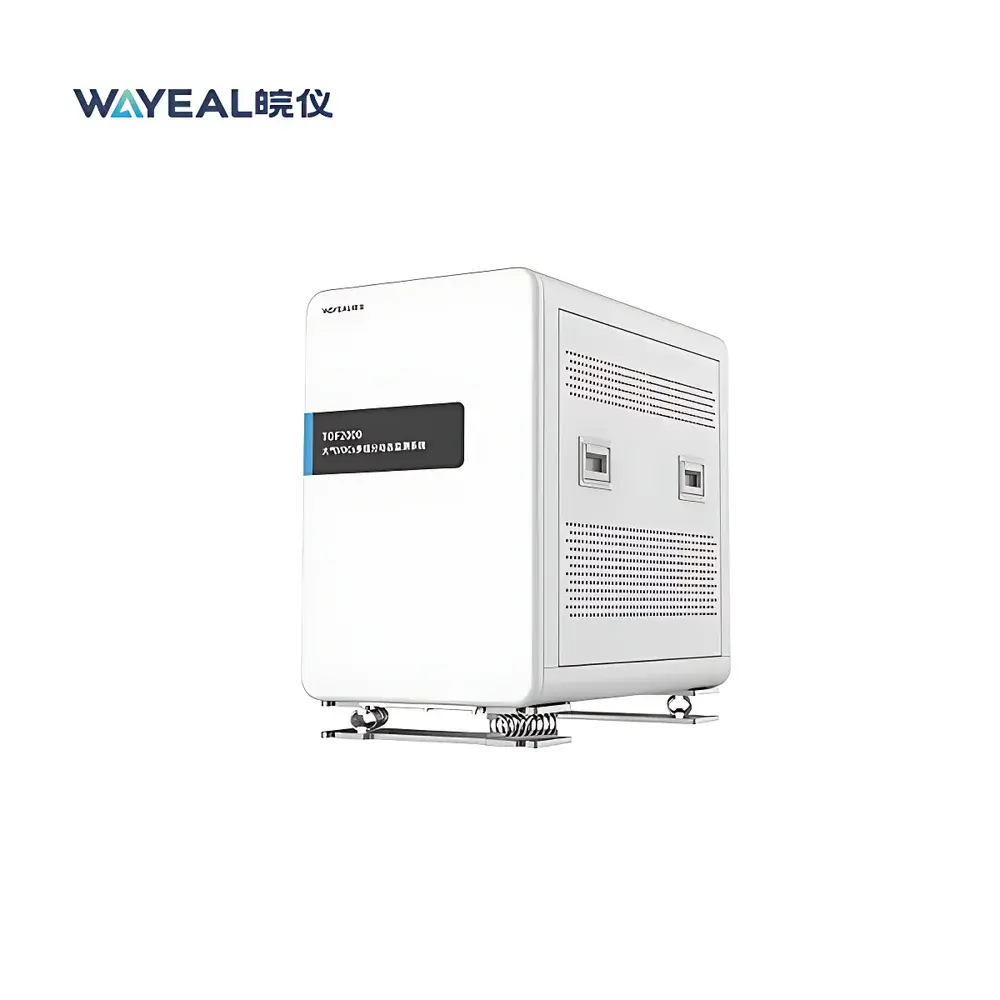
WAYEAL TOF2000 Mobile Multi-Component Atmospheric VOCs Monitoring System
| Brand | WAYEAL |
|---|---|
| Origin | Anhui, China |
| Manufacturer Type | Original Equipment Manufacturer (OEM) |
| Country of Origin | China |
| Model | TOF2000 |
| Instrument Principle | Single-Photon Ionization Time-of-Flight Mass Spectrometry (SPI-TOF-MS) |
| Configuration | Online Fixed/Mobile Deployment |
| Response Time | Sub-second (≤1 s) |
| Analyte Capacity | >300 Atmospheric Volatile Organic Compounds (VOCs) |
| Mass Resolution | >2000 FWHM (Toluene) |
| Linear Dynamic Range | 4 orders of magnitude |
| Vacuum System | Turbo-molecular pump cascade (3-stage) + backing mechanical pump |
| Ionization Source | 10.8 eV VUV lamp (soft ionization) |
| Mass Analyzer | Orthogonal acceleration reflectron TOF with second-order spatial and energy focusing |
| Detection Mode | Direct ambient sampling, no pre-concentration or chromatographic separation required |
Overview
The WAYEAL TOF2000 Mobile Multi-Component Atmospheric VOCs Monitoring System is a high-performance, field-deployable analytical platform engineered for real-time, quantitative detection of volatile organic compounds (VOCs) in ambient air. At its core resides a single-photon ionization time-of-flight mass spectrometer (SPI-TOF-MS), a technique distinguished by its soft ionization capability, minimal fragmentation, and intrinsic compatibility with rapid, direct gas-phase analysis. Unlike GC-MS or PTR-MS systems requiring thermal desorption or chemical ionization, the TOF2000 utilizes a 10.8 eV vacuum ultraviolet (VUV) lamp to selectively ionize VOCs with ionization energies below this threshold—preserving molecular ion signals essential for unambiguous compound identification. The orthogonal-acceleration reflectron TOF architecture delivers mass resolution exceeding 2000 FWHM (measured on toluene), enabling baseline separation of isobaric species such as benzene (78.047 Da) and pyridine (79.039 Da). With a linear dynamic range spanning four decades and sub-second temporal resolution, the system supports both mobile mapping and fixed-site continuous monitoring under ISO 16000-22 and EPA Method TO-15–compatible operational paradigms.
Key Features
- Direct ambient sampling without cryo-trapping, thermal desorption, or chromatographic separation—eliminating carryover and reducing maintenance intervals.
- Ultra-high vacuum architecture: triple-stage turbo-molecular pumping system backed by a dry mechanical pump achieves and maintains ≤1×10⁻⁵ Pa; integrated Pirani and cold cathode gauges provide real-time vacuum health monitoring.
- Vertical injection reflectron TOF mass analyzer with dual-stage ion optics ensures second-order spatial and kinetic energy focusing—maximizing sensitivity and mass accuracy across the full m/z 20–300 range.
- Patented power-loss vacuum lock mechanism: upon shutdown or unexpected power interruption, the vacuum chamber retains integrity for up to 30 minutes, allowing rapid (<5 min) re-establishment of operational vacuum—critical for emergency response and repeated stop-start mobile campaigns.
- Pre-loaded compound libraries compliant with EPA TO-15, PAMS (Photochemical Assessment Monitoring Stations), and sulfur-containing VOC standards—including >300 target analytes with retention-index-aligned spectral references.
Sample Compatibility & Compliance
The TOF2000 is optimized for undiluted, unfiltered ambient air sampling at standard temperature and pressure (STP). It detects VOCs including alkanes, alkenes, aromatics, oxygenates (e.g., formaldehyde, acetaldehyde), halogenated compounds (e.g., chloromethane, dichloromethane), and reduced sulfur species (e.g., methanethiol, dimethyl sulfide) at part-per-trillion (pptv) to part-per-billion (ppbv) levels. Its measurement protocol aligns with ISO/IEC 17025:2017 requirements for testing laboratories and supports data traceability per FDA 21 CFR Part 11 when deployed with audit-trail-enabled software configurations. All calibration procedures follow NIST-traceable gas standards (e.g., Scott-Marrin, Linde) and are documented in accordance with GLP principles for environmental field studies.
Software & Data Management
The integrated WayScan™ Data Acquisition and Geospatial Analysis Suite provides synchronized GPS-tagged acquisition, real-time spectral deconvolution, and automated quantification using internal standard normalization (e.g., deuterated toluene-d₈). Raw .raw files are stored in open-format HDF5 containers compliant with FAIR (Findable, Accessible, Interoperable, Reusable) data principles. Post-processing modules support plume trajectory modeling (HYSPLIT integration), source apportionment via positive matrix factorization (PMF), and dynamic contour mapping of concentration gradients. Export formats include CSV, NetCDF, and ESRI Shapefile—enabling seamless ingestion into GIS platforms (ArcGIS, QGIS) and regulatory reporting workflows (e.g., China MEP’s “Blue Sky Defense” dashboards or EU E-PRTR submissions).
Applications
- Mobile Emission Mapping: Mounted on certified environmental survey vehicles with inertial navigation augmentation, the TOF2000 performs kilometer-scale transects at speeds up to 60 km/h, generating high-resolution VOC concentration heatmaps with georeferenced uncertainty metrics.
- Industrial Fence-Line Monitoring: Deployed at perimeter locations of petrochemical complexes or pharmaceutical manufacturing sites, it continuously tracks fugitive emissions against baseline thresholds defined in GB 37822–2019 and EU BREF reference documents.
- Ozone Precursor Profiling: Quantifies reactivity-weighted VOC distributions (e.g., MIR, OFP) to prioritize control strategies in ozone non-attainment zones, supporting modeling inputs for CMAQ and CAMx simulations.
- Emergency Response Screening: Rapid deployment during chemical incidents enables real-time identification of unknown releases—cross-referenced against the onboard toxicological hazard database (GHS classification, AEGL values).
FAQ
Does the TOF2000 require calibration gases for routine operation?
Yes—daily zero/span verification using certified NIST-traceable standard mixtures (e.g., EPA TO-15 blend) is recommended. Full multi-point calibration is performed weekly or after system maintenance.
Can the system distinguish structural isomers (e.g., xylene isomers)?
Not by mass alone; however, retention time coupling (when used with optional capillary pre-separation module) or tandem MS/MS capability (available in TOF2000-X variant) enables isomer differentiation.
What is the minimum detectable concentration for benzene?
Under typical ambient conditions (25°C, 50% RH), the method detection limit (MDL) is 8 pptv (10-s average), validated per EPA 40 CFR Part 136 statistical protocols.
Is remote diagnostics supported?
Yes—the embedded industrial Ethernet interface supports secure VPN-based remote access for firmware updates, spectral diagnostics, and vacuum system health assessment.
How is data integrity ensured during mobile operation with GPS signal loss?
Internal high-precision IMU (inertial measurement unit) maintains positional continuity for up to 120 seconds; all spectra are timestamped via synchronized GPS-disciplined oven-controlled crystal oscillator (OCXO) with ±50 ns accuracy.







